





 Portuguese
  English
  Spanish
  6 min of reading
  20 comments


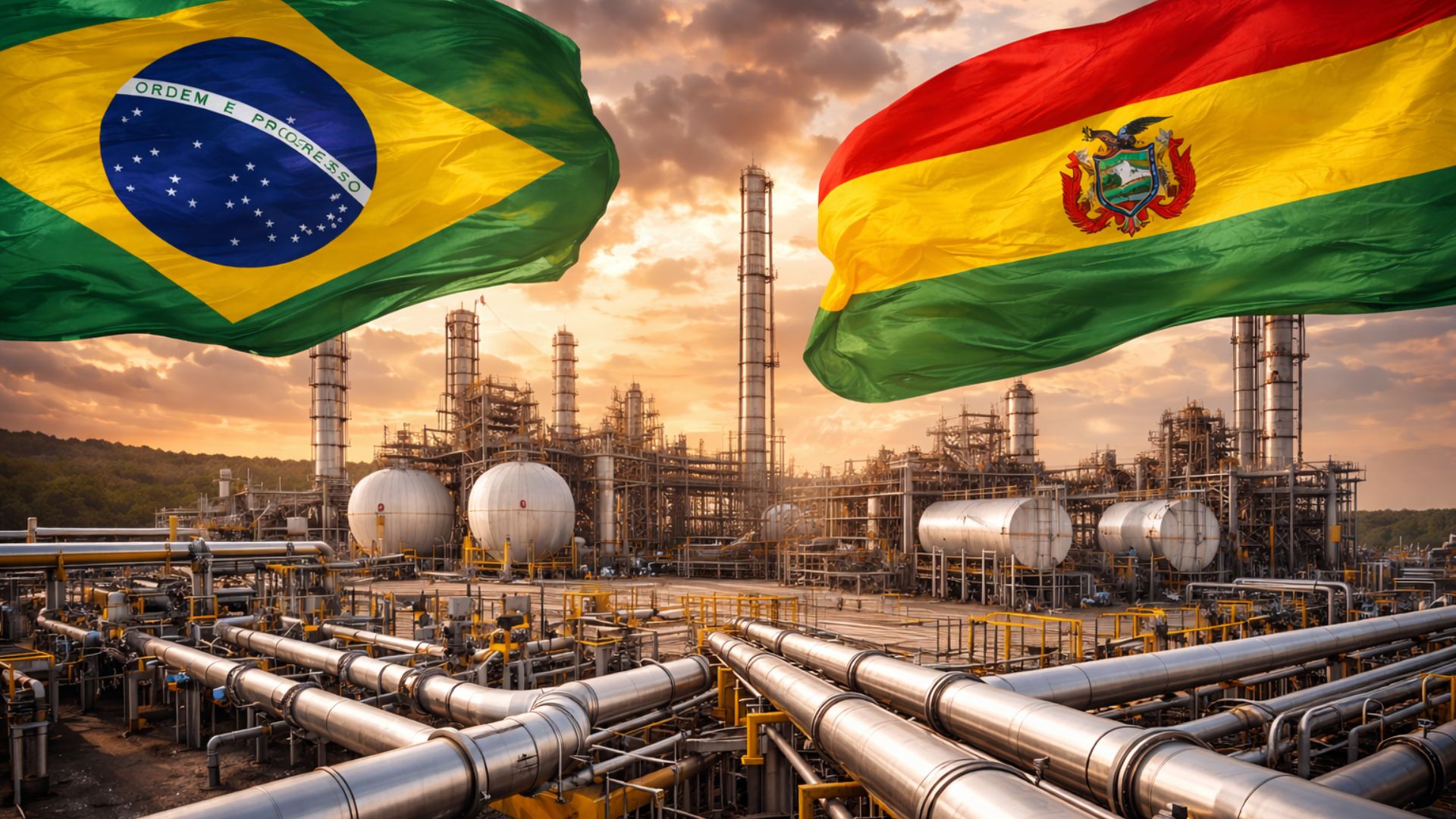


Silent Movement in Natural Gas Places Brazil at the Center of the South American Energy Dispute and Involves Billion-Dollar Investment, High-Complexity Industrial Infrastructure, and Strategic Change That Reduces Historical Dependence on Bolivia and Expands Regional Influence in the Energy Sector.
Energy Reconfiguration Changes Regional Balance
Brazil has initiated a profound reconfiguration in the natural gas sector that is beginning to alter the energy balance of South America.
The movement, detailed in an analysis published by the channel Geopolítica de Concreto on YouTube, involves billion-dollar investments, high-complexity industrial infrastructure, and a strategic change that reduces the country’s historical dependence on Bolivian supply, repositioning Brazil on the regional energy chessboard.
Bolivia as Historical Gas Supplier
For decades, Bolivia occupied a central position in the regional natural gas market.
-
Lula reveals a masterstroke by Petrobras to undo a deal made by Bolsonaro, which involves the return of an important refinery that currently produces less than half of what was expected and makes Brazil dependent on international diesel.
-
A study confirms that the natural gas sector will reduce greenhouse gas emissions in Brazil by 0.5% and accelerate the energy transition by 2026.

-
Petrobras implements a severe adjustment and confirms a 55% increase in the price of aviation kerosene with a proposal for installment payments for the companies.

-
The rise in oil prices could ensure an extra revenue of R$ 100 billion for the Federal Government, indicates a recent economic study.

From large producing fields, the country established itself as a strategic supplier for its neighbors, especially for Brazil, which became the main buyer starting in the 2000s, along with the expansion of thermoelectric plants and the industrial park.
With demand rising, the country began to import over 70% of the gas consumed domestically from Bolivian territory, reinforcing a relationship of dependence that shaped regional energy policy for years.
Brazilian Infrastructure Reduces External Dependence
This arrangement began to transform in recent years.
As outlined by Geopolítica de Concreto, Brazil began to structure a comprehensive network for the production, processing, and distribution of natural gas and industrial gases, designed to reduce logistical vulnerabilities and expand the autonomy of the system.
The project involves pipelines, terminals, industrial plants, liquefaction systems, processing units, and new logistical routes, capable of serving different sectors of the economy in an integrated manner.
Gas as Strategic Industrial Base
The strategy is not limited to supply security.
The central focus is on building an industrial base capable of adding value to gas and integrating it into productive chains such as fertilizers, steel, mining, petrochemicals, electricity generation, food, pharmaceutical, and hospital industries.
In this new design, gas is no longer just an energy source but functions as an industrial platform, expanding its role in the national economy.
White Martins Leads Billion-Dollar Investment
At the center of this movement is White Martins, responsible for an investment plan of R$ 1 billion by 2026.
According to the analysis presented on the Geopolítica de Concreto channel, the funds will be directed toward the expansion and modernization of the infrastructure for the production, processing, and distribution of industrial gases in Brazil, configuring one of the sector’s biggest bets in recent decades.
Industry Gains Efficiency and Competitiveness
The declared objective is to reduce logistical vulnerabilities and eliminate historical bottlenecks that limited the operation of the industry.
At the same time, the expansion increases the ability to meet domestic demand and creates conditions for the country to operate at standards close to those of industrialized economies.
As a result, Brazil decreases external dependence and enhances productive efficiency, strengthening its competitiveness in the long run.
Value Chain Alters Relationship with Bolivia
While Bolivia built its regional influence through the export of raw gas, Brazil is now advancing into more profitable stages of the chain.
This change in posture alters the logic of dependence that characterized the bilateral relationship for years, as the traditional customer becomes more than just a consumer.
By mastering transformation, industrialization, and distribution processes, the country repositions its role in the sector and redefines the regional balance.
Invisible Infrastructure Supports Critical Sectors
One of the points highlighted by Geopolítica de Concreto is the low visibility of this transformation.
Unlike large public works, there are no monumental bridges or symbolic inaugurations, but rather infrastructure that grows silently and continuously.
This includes underground pipelines, cryogenic plants, refrigerated tanks, separation systems, liquefaction units, specialized trucks, and distribution networks that operate 24 hours a day.
Industrial Gases as Strategic Asset
It is this structure that ensures the supply of oxygen to hospitals, keeps steel mills operating continuously, and enables the production of fertilizers on an industrial scale.
Additionally, it ensures the purity standards required by the pharmaceutical industry and other sensitive sectors.
This type of infrastructure has historically sustained the competitiveness of countries like Germany, South Korea, and China.
Brazil Approaches Industrialized Economies
As it moves closer to this model, Brazil integrates into a select group of countries that treat the industrial gases sector as a strategic asset.
This movement helps to explain why, as noted by Geopolítica de Concreto, the transformation has attracted the attention of other markets and international analysts aware of the speed of this change.
Direct Impact on the Bolivian Economy
The implications for Bolivia are direct.
Natural gas has always been one of the main sources of revenue and influence for the country, ensuring negotiating power and economic stability for decades.
However, when the main buyer begins to dominate the more lucrative stages of the chain, the regional balance shifts, reducing the central role of the raw material exporter.
Origin of Brazilian Energy Dependence
To understand the extent of this change, it is necessary to look at the origin of Brazilian dependence.
In the 1990s, Brazil decided to diversify its energy matrix and reduce its exposure to oil, facilitating, through bilateral agreements, the construction of Gasbol.
The project connected Bolivian fields to the Brazilian market, transformed Bolivia’s economy, and at the same time, ensured Brazil greater stability in energy supply.
Change in the Global Energy Scenario
Over the years, the global scenario has changed.
Brazil expanded the exploration of internal reserves, invested in marine import terminals, and began to develop conversion, storage, and distribution technologies.
Bolivia, on the other hand, faced difficulties in maintaining its fields and lost relative competitiveness in light of new energy arrangements.
Investment with Multiplicative Effect
In this context, the investment by White Martins gains strategic weight.
As highlighted by Geopolítica de Concreto, the investment of R$ 1 billion by 2026 represents not just a number in corporate balance sheets, but a set of physical and industrial assets.
It translates to new equipment, industrial units, kilometers of pipelines, and the generation of thousands of direct and indirect jobs, moving a chain that involves component manufacturers, engineering, and specialized logistics.
Industrial Gas Is Hard to Replace


Another relevant aspect is the difficulty of replacing industrial gas in various production processes.
Unlike electricity, which can be generated from multiple sources, gas has specific chemical and thermal properties that are indispensable to the industry.
In steelmaking, it ensures precise cuts and temperature control.
In the pharmaceutical industry, it ensures sterility and molecular purity.
In the food sector, it enables preservation and transport without degradation.
Strategic Sector in Large Economies
For this reason, advanced economies treat the industrial gases sector as strategic and maintain highly profitable companies operating discreetly.
The Brazilian movement indicates, therefore, the construction of a more resilient and competitive industrial base in the long run, supported by infrastructure and technology.
Infrastructure Prepares Path for Hydrogen
The developing infrastructure also relates to the advancement of hydrogen, often pointed out as a strategic fuel for the coming decades.
The production and logistics of this energy vector require cryogenic tanks, liquefaction, and compression systems similar to those currently being deployed.
By investing now, the country prepares the ground for future transitions without fully depending on external structures.
Brazil Advances in the Chain While Bolivia Renegotiates
While Bolivia concentrates efforts on contractual renegotiations and maintaining traditional markets, Brazil advances to the next stage of the chain.
The country is beginning to transform gas into products, technology, and industrial capacity.
To what extent will this silent change, pointed out by Geopolítica de Concreto, be able to durably redefine the geopolitics of natural gas in South America?






Foi fábricada 2006. Gestão Lula na época e praticamente foi entregue de mão beijada para Evo Morales . Agora quer retomar de novo sendo que na época o governo vendeu os ativos da usina para Morales
Que **** de artigo. É falta de informação ou ma fé.
Que pataquada. Ou patranga?