






 Portuguese
  Spanish
  6 min of reading
  0 comments


One Third Of Treated Water In Brazil Is Lost In The Network, And A Unesp Project Aims To Reduce Leaks With Technology
The treated water that does not reach faucets is still one of the major bottlenecks of sanitation in Brazil. The loss rate in distribution reaches 37.8%, which is equivalent to 7.6 thousand Olympic swimming pools per day.
The scenario becomes even more critical in areas with more fragile infrastructure. In Amapá, the loss reaches 71.7%, indicating a large-scale challenge for the operation and maintenance of the networks.
Not all of this loss occurs solely due to physical failures. Part involves illegal installations and also limitations in measuring water meters. Even so, leaks in the pipes appear as the main factor behind the high rates.
-
Embrapa takes cashew, peanuts, and sesame to the world’s largest seed bank in Norway, where Brazil has already stored more than 8,000 samples since 2012 against pests and climate change.

-
Finnish company creates recycled plastic and biomass blocks that fit together without cement, are 10 times lighter than common blocks, and have already been used to build schools in earthquake-affected areas.
-
A US startup wants to build a 10 km space cannon to launch multi-ton payloads into orbit at Mach 23, replacing part of the rockets with a colossal structure that looks like a science fiction weapon.

-
Extreme droughts and floods have doubled on the planet since 1901, according to a study of 1,300 river basins that reveals increasing pressure on agriculture, rivers, soils, ecosystems, and water supply.


What Happened And Why That Got Attention
Reducing losses requires locating damage in buried networks, often hidden beneath a complex urban environment. Cables, streams, and tunnels mix with pipes, which hinders quickly finding broken points.
The size of the network increases the challenge. Only the state of São Paulo has 120 thousand km of underground water and sewage pipes, a volume that makes any total renewal strategy very slow and costly.
There is a technical reference for annual replacement of 2%, starting from the oldest pipes to the newest ones. However, the cost makes the goal difficult, and the search for alternatives focused on detecting and correcting existing leaks gains strength.
Why Brazil Is Not Alone In This Problem
High losses do not only appear in Global South countries. Ireland and Italy deal with rates similar to Brazil’s, while the United Kingdom has 23% and France has 20%.
In the European Union, Germany is cited as the only country that keeps its rate below 5%. This level is treated as a benchmark for efficiency in the operation of networks.
There is also a case of significant recovery. Tokyo ended World War II with 80% losses and much of the piping destroyed, and today it registers 3.9%.
How Unesp And Sabesp Entered The Search For Solutions
The search for technological solutions to locate leaks led to a partnership between Sabesp and mechanical engineer Fabrício César Lobato, a professor at Unesp in Bauru, affiliated with the Faculty of Engineering on campus. He has been working on the topic since 2009, when he started his doctorate at the University of Southampton, England.
During this period, he was mentored by Michael Brennan, an international reference in the area. Brennan has worked in Brazil and currently teaches at Unesp de Ilha Solteira.
The Unesp Sabesp collaboration received funding from Fapesp calls and generated a line of development for equipment and methods aimed at detecting failures in water and sewage networks.
Correlators Help Find Leaks, But The Price Becomes An Obstacle

For decades, detecting underground leaks relied on listening rods and mechanical geophones. These devices amplify sounds from underground, but require trained technicians to recognize the typical noise of water escaping through a hole.
The correlators have advanced because they rely less solely on the operator’s experience. Generally, they work with two sensors coupled to points like hydrants or house water meters on the same street, connected to the main pipe in the region.
When there is a leak, the sound reaches each sensor at different times. With this deviation, the system estimates the approximate point where the water is escaping.
The problem is the high cost. A correlator considered good costs around R$ 300 thousand, and there is no national manufacturer, which reduces its routine use in outsourced operations.
What The Virtual Bench Resolves In Practice
One of the funded projects aimed to create a commercially viable correlator in Brazil. The initiative was successful and also generated an assessment tool called virtual bench.
The equipment simulates the sonic signature of a real leak, allowing testing of correlators from different manufacturers. It also serves to check if the device maintains satisfactory performance after returning from technical assistance.
The procedure allows configuring specific scenarios, such as simulating a leak in a 75 mm cast iron network 10 m from a reference point. This type of control helps to compare results and reduce uncertainties in checking the devices.
Jack-Of-All-Trades Detector Tries To Handle Plastic Pipes And Varied Soils
The gradual replacement of cast iron pipelines with plastic pipes has increased the complexity of detection. In materials like PVC and high-density polyethylene (HDPE), the vibration dampens, reducing the useful distance for identification.
There is a clear contrast in this reduction of range. Previously, it was possible to identify a leak at 1 km or 800 m, while now this level may drop to 100 m or 80 m.
A relevant choice of the project was to keep the hardware accessible and compensate for limitations with software capable of extracting more information from weaker signals.
Another point is the versatility of the equipment, described as a project that measures real-field conditions and reduces the need for the operator to pre-enter material of the pipe and type of soil.
What Can Happen From Now On
Even with technical advances, there is a hindrance to placing the solution on the market. Some products remain at the prototype stage due to a lack of interested and capable companies to manufacture at scale.
This obstacle is known as the valley of death, when the technology already works but has not yet found an industrial path for production and commercialization. The search for partners includes startups and few national companies that operate with equipment for the sector.
The frustration is compounded by the niche profile of the product, which makes it difficult to estimate annual sales volume, a factor that weighs on manufacturers.
Surface Technology Wants To Locate Leaks Without Contact With The Pipe
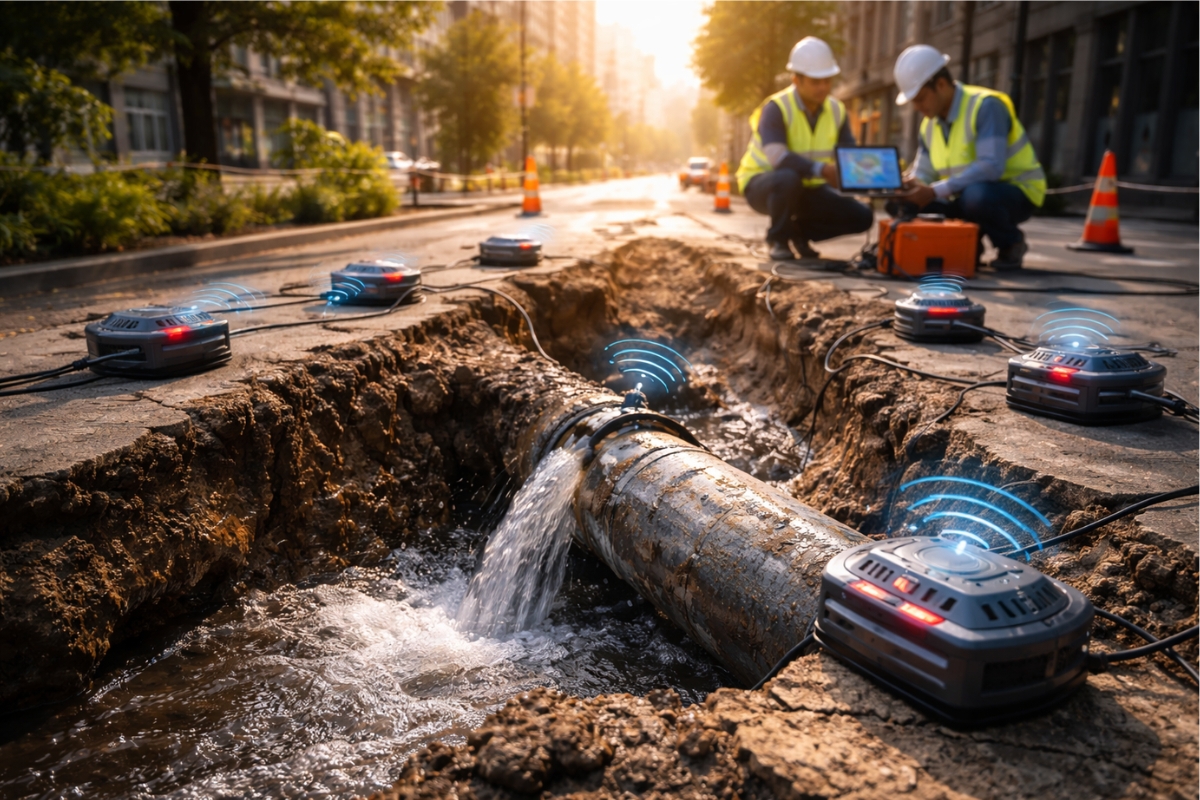
A more recent project, with funding started in 2022, aims for a technical leap: the Surface Leak Locator, called LOCVAS. The proposal is to detect leaks without direct contact with the plumbing, capturing the residue of vibration that reaches the surface through the soil.
The technique can use two sensors on the surface, or expand to six or eight. The logic is based on capturing the sound of the leak with different intensities depending on the distance, allowing calculation of the escape point’s position.
The idea is not to replace existing methods, but to complement the work. The intended use starts with direct measurement on the pipe with traditional correlator; if there is a margin of error, scanning the surface can help reduce false positives.
The group continues to produce studies on details of the technology. A paper published in November in the journal Applied Acoustics dealt with tests using two sensors in a scenario with prior knowledge of the direction of the buried pipe. The expectation is to present a conceptual prototype of the LOCVAS in 2026, with patents in the submission process to INPI.




Be the first to react!