





 Portuguese
  English
  Spanish
  8 min of reading
  13 comments


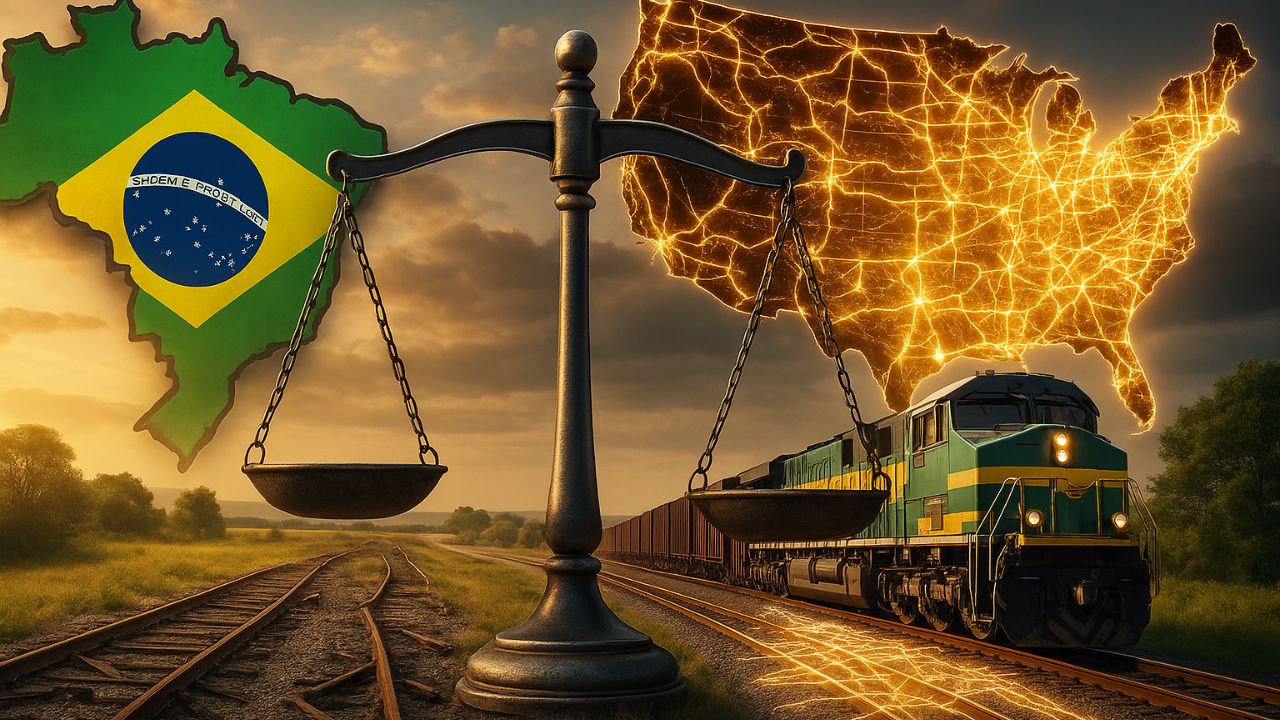


Despite Similar Territories, Brazil and the USA Made Opposite Choices in Railways, Rail Network, Rail Transport, and Logistics, Changing Their Development.
When we place the maps of Brazil and the USA side by side, the similarity is striking. Two continental countries, almost the same size, filled with remote regions, mountains, plains, forests, deserts, and large cities. But just swapping the political map for the railway map reveals the abyss between Brazil and the USA. While the United States boasts about 140,000 kilometers of tracks forming a web that stitches the country from coast to coast, Brazil barely exceeds 30,000 kilometers, largely disconnected, underutilized, or abandoned.
The shock is not in geography, but in choices. Over nearly two centuries, Brazil and the USA made completely different political, economic, technical, and cultural decisions about how to use the tracks to grow. There, railways became a national project. Here, they became a regional tool to export products. And it is in this difference of vision that the story of two giants who walked on opposite tracks begins.
Two Similar Maps, Two Opposite Histories
At first glance, Brazil and the USA seem destined to face similar challenges. Vast territories, long distances to the ports, scattered cities, agricultural production in the interior, and consumption concentrated in major centers. Everything seemed to indicate that the tracks would be the natural way to integrate these spaces.
-
With over 14 million baskets of earth moved, an ancient North American metropolis built a monumental pyramid of 30 meters and established a city with 20,000 inhabitants nearly a thousand years ago.
-
A 1,900-year-old treasure emerges from a Roman house destroyed by fire and sealed since antiquity in Romania, with coins and metals fused among the ashes.
-
The Brazilian colonial city that stopped in time and shares territory with a rocket launch base.
-
79-year-old woman challenges limits, visits 193 countries in the world after 56 years of planning and reveals the behind-the-scenes of a global journey that few have managed to accomplish.


In the United States, that’s exactly what happened. The railway became a symbol of expansion, progress, and unification. The network grew, connecting the east coast, west coast, industrial regions, agricultural areas, desert zones, and mountain ranges. Viewed from above, the American railway network looks like a metallic web stitching the entire country together.
In Brazil, the layout is almost the reverse. Our network, totaling around 30,000 kilometers, has many sections disconnected from one another, with parts abandoned and others operating far below potential. The result is a country that depends on trucks for almost everything and pays dearly for it in freight, worn roads, and loss of competitiveness. Two giant territories, two opposite realities.
Nineteenth Century: When Brazil and the USA Chose Different Paths
To understand why Brazil and the USA followed such distinct trajectories, we must go back to the nineteenth century when the world began to discover the power of the steam locomotive. States, empires, and republics discussed how to connect cities, explore new frontiers, and accelerate their economies. It was time to decide whether the track would be the protagonist or a supporting character.
In the United States, the answer was clear. The railway became the engine of national construction. The country was young, still fragmented, with states poorly connected to each other and a vast interior to be occupied. The government then adopted an aggressive strategy: it approved incentive laws, encouraged private companies to build railways, and distributed land in exchange for every kilometer of track laid through the famous Land Grants. Each new stretch increased land value, created cities, opened markets, and brought the interior closer to the coast.
Meanwhile, Brazil followed a very different logic. The economy was agrarian, based on coffee, sugar, and other commodities, almost always exported through a few strategic ports. Regional elites were strong, decentralized, and focused on their own interests. The first Brazilian railways were short, isolated, and aimed at connecting farms to ports, not cities to cities or regions to regions. The tracks here did not emerge to build a country but to export products. National integration simply was not a priority.
Rails as a National Project in the USA

From there, the stories of Brazil and the USA diverge completely. In the United States, the railway became part of a clear project: to integrate the territory at any cost. The model combined private capital with state support, aligning profit with strategic objectives. From this mixture, monumental works were born, such as the major lines that crossed deserts, overcame snowy peaks, and traversed deep valleys in just a few years.
Every kilometer of track in the USA had a defined function within a larger plan. The lines were not isolated pieces but corridors designed to connect ports, industrial cities, agricultural regions, and new expanding frontiers to the west. The railway was seen as an investment in national security, trade, territorial occupation, and internal strengthening.
Moreover, culture pushed the tracks even further into the center of the country’s narrative. Trains appear in movies, books, and Western stories as symbols of the future, freedom, and opportunity. American society grew up with the idea that the train led to a new world of possibilities.
Fragmented Tracks and Short-Sightedness in Brazil

In Brazil, the logic was different. Without a national plan, each railway emerged as a regional project, often financed by foreign groups and designed to meet a single objective: to take production from one point to a specific port. We formed a patchwork of railways, with no standardization, no coordination, and no vision of the whole.
Sections with different gauges, fragmented concessions, conflicting priorities. While Brazil and the USA faced equally complex geographical challenges, only one of them decided to stitch it all together into a large integrated network. The other accepted to sum up isolated sections that did not communicate with each other.
When the Brazilian state tried to intervene, it lacked continuity, planning, and clear goals. Projects stalled, governments changed, priorities shifted, and contracts got stuck. Unlike a web that integrates, the Brazilian railway became an incomplete puzzle, where many pieces were never placed.
Standardization: The Technical Detail That Changed the Game
There is a technical point that helps explain why Brazil and the USA live such different realities on the tracks: standardization. It may seem like a detail, but it determines whether a train can cross an entire country without stopping or if it will die at every state border.
By the end of the nineteenth century, as the American railway network was rapidly expanding, a real concern emerged: without strict standards, each company would create its own model, leading to a chaos of gauges, parts, and systems. The answer was tough and direct: standardize the gauge at 1,435 millimeters and convert thousands of kilometers of track to this unique standard in a short time.
This allowed a train to leave the east coast and arrive at the west coast without changing cars, axles, or locomotives. Parts, tracks, wheels, and technologies began to speak the same technical language. The railway industry could produce on a large scale, reducing costs, increasing reliability, and accelerating the expansion of transport corridors.
In Brazil, the movement was the opposite. Each railway was born with the gauge that was most convenient for the economic group of the moment. The result: sections with metric gauge, broad gauge, narrow gauge, each with its own rules and limitations. The practical consequence was devastating: trains could not cross the country, cargo needed to be transferred, operations lost time and money, and the railway lost competitiveness to trucks.
The Price Brazil Pays for Betting on the Road
Decades later, this difference in vision appeared in the balance. While the United States consolidated a network of 140,000 kilometers of tracks that still support a good part of logistics and the economy today, Brazil got stuck with about 30,000 kilometers, heavily concentrated in a few corridors and with large gaps between regions.
Projects that had everything to change the game ended up becoming symbols of delay. The Norte Sul railway took decades to become operational, with stretches built in different times and an integration that took much longer than it should have. The Transnordestina accumulated years of construction, stoppages, and revisions. The Ferrogrão, deemed essential for exporting from the Midwest, remains bogged down in disputes and uncertainties. The EF 118, between Espírito Santo and Rio de Janeiro, is already seen as an endless project.
Meanwhile, the truck has become the absolute protagonist of Brazilian logistics, traveling thousands of kilometers on roads that require constant maintenance and inflate transport costs. We pay higher freight rates, more expensive fuels at the end of the chain, less competitive products abroad, and a Brazilian cost that seems never to decrease.
What If Brazil Had Followed the Path of the Tracks
Now imagine if, back then, Brazil and the USA had made similar choices. With a standardized and interconnected network, the country could have railway corridors linking the north and south, coastline and interior, without interruptions. Small cities would have grown around stations, isolated regions would have become economic hubs, and transportation costs would have dropped dramatically.
Food would arrive cheaper on shelves, fuels would be less pressured by long freight, exports would gain competitiveness, and population distribution would be more balanced, with more opportunities in the interior and less pressure on the large capitals. Agribusiness would be even stronger, not only due to production but also due to logistical efficiency. Industry would have more momentum to expand.
In other words, Brazil could have become a more integrated, faster, cheaper, and fairer country, using the tracks as the backbone of development, just as the United States did.
Is It Still Time to Turn This Around?
The comparison between Brazil and the USA shows that it wasn’t geography, nor the size of the territory that separated us. What opened the railway abyss between Brazil and the USA were political, economic, and technical choices made over decades. We got stuck with regional projects, different gauges, a lack of standardization, and no consistent national plan. The network was never completed, and the country still pays dearly for it.
But this story doesn’t have to be over. Projects like Norte Sul, Fiol, Ferrogrão, and other strategic connections show that there is still room to build a Brazil supported by tracks, reducing logistics costs, connecting regions, boosting the interior, and decreasing the almost absolute reliance on road transport. The past explains why we are behind, but the future depends on the decisions we make now.
In the end, tracks do not just move cargo. They move opportunities, shorten social distances, and help define the fate of a nation.
And you, do you think Brazil can still catch up and get closer to the railway reality of the USA, or has the country lost that chance forever?







Moro a beira de um destes abandono em Minas Gerais, até D. Pedro enchergou um futuro brilhante pra nossa Nação…o que nossos brilhantes políticos, não tiveram a capacidade de enchergar…
Sensacional a matéria. Parabéns pela visão e coerência. Sim dá tempo de mudar. Basta um pouco de vontade, inteligência e proatividade política. Já andei muito de trem por este Brasil. Foi uma época saudosa. Mas literalmente andamos para trás. O transporte de cargas por caminhões mostra o atraso e a ineficiência logística do país. Transporte de passageiros por trem amplia horizontes , afinal o trem atrai gente para seu lugar.
Acho que ainda é tempo, sim. Vamos correr atrás do lucro. Mande esta reportagem para o seu Deputado e para o seu Senador. É para eles se sentirem envergonhados e tomarem atitude