





 Portuguese
  English
  Spanish
  4 min of reading
  8 comments


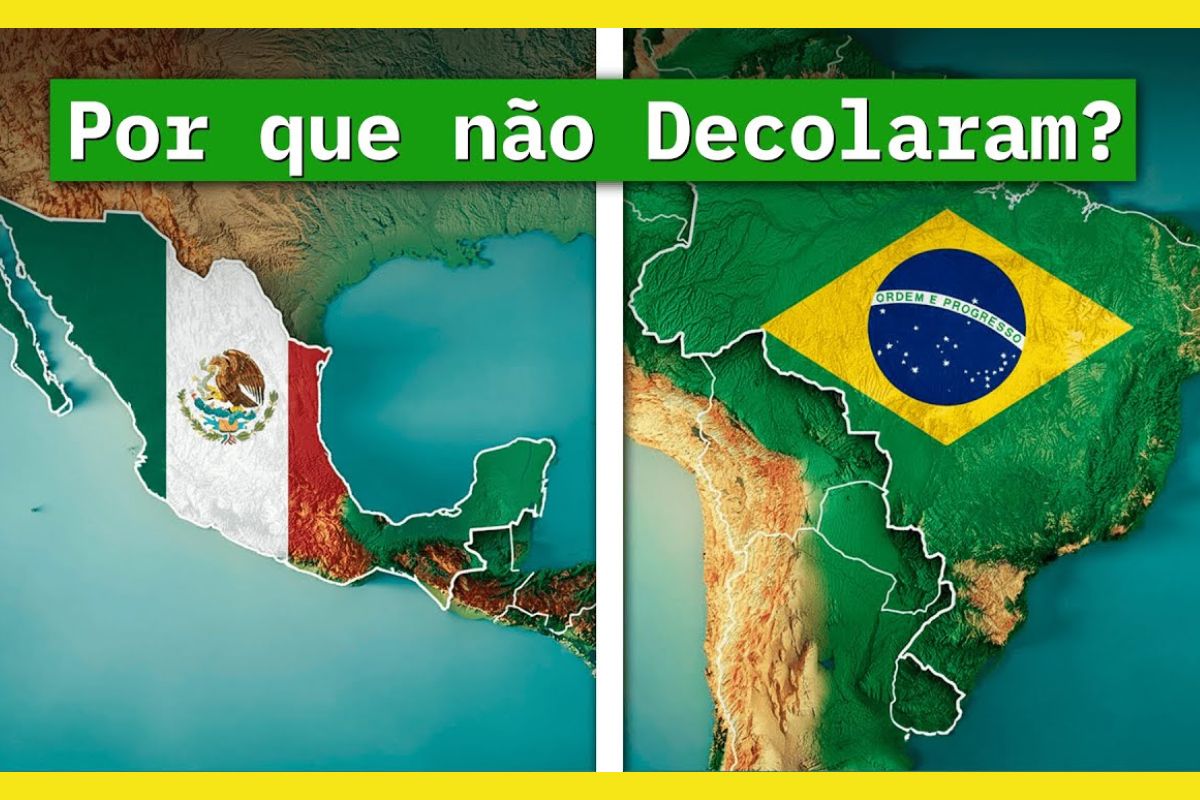


Historical Readings, Institutional Choices, and External Cycles Help Explain Why Brazil and Mexico Remain Large in Territory and Population, but Have Not Consolidated Equivalent Global Influence
The Brazil and Mexico belong to the rare group of very large countries, with abundant natural resources and millions of inhabitants. Still, they have not converted scale into stable global power. The key lies less in the “how much” and more in the “how.” Over two centuries, choices in colonization, institutional design, and economic strategy have created trajectories marked by episodic advances and frequent setbacks, keeping both dependent on the moods of the global cycle.
In practice, Brazil and Mexico alternate phases of accelerated growth with periods of stagnation. When external winds are favorable, economies advance; when they change, gains dissipate. This volatility stems from institutions that do not ensure continuity in public policies, weakening planning, productivity, and technological sophistication over the long term.
Origin of Exploitation Colony and Its Prolonged Effects
The starting point matters. Brazil and Mexico organized as exploitation colonies, aimed at extracting wealth for Iberian metropolises, without creating durable structures of self-government, urbanization, and science.
-
Archaeologists find a colossal 2,000-year-old vessel at the bottom of the sea near Alexandria linked to the elite of Egypt and reveal a pleasure barge from the last dynasty of the pharaohs that the sea has hidden for centuries.

-
United Kingdom clears 40 tons of shells and concrete into the sea in an innovative project that promises to restore a marine ecosystem lost for over 200 years and improve water quality.

-
With emergency diversion to abandoned mining craters, engineers save villages from a devastating flood that was advancing through the desert and threatening to destroy entire communities in a matter of hours.
-
It seems simple, but it enriches: from R$ 500 to R$ 6,000 per piece and up to 10 days of handcrafted production, how is the couple from Praia Grande making a high income with hyper-realistic miniatures and turning a hobby into a money-making machine?


The result was the formation of primary-exporting economies, with low institutional density and an internal market that took time to integrate.
Even after independence, the extractive pattern persisted, with political and economic elites settled in commodity chains and cyclical fiscal revenues.
Brazil and Mexico advanced when external demand pulled, but rarely sustained counter-cyclical policies that safeguarded budget, investment, and innovation when the global scenario shifted.
Late Industrialization, Spotty Advances and Deindustrialization
Broad industrialization arrived late and intermittently. Between the mid-20th century and the mid-1980s, there was significant industrial expansion, accelerated urbanization, and increased productive complexity.
However, there was a lack of continuity and stable state policy to consolidate productivity, technical education, and more sophisticated value chains.
From the late 1980s, the process of deindustrialization gained strength, with a relative loss of industrial participation and increasing primarization of exports.
In Brazil, this meant greater sensitivity to commodity prices; in Mexico, greater dependence on the U.S. cycle, with direct effects on employment, credit, and trade balance.
Dependence on External Cycles and Low Long-Term Coherence
Without institutions that ensure continuity of strategies beyond governments, Brazil and Mexico tend to reconfigure directions with each political cycle.
Industrial, educational, and technological plans are discontinued before maturing, which prevents the accumulation of productive and technological capacities necessary to compete at the top of the global chain.
When commodities rise, Brazil improves terms of trade and collection. When the U.S. economy heats up, Mexico accelerates through trade and investments.
In both cases, the anchor comes from outside. There is a lack of autonomous machinery that maintains investment, R&D, and qualification even in low tides, reducing volatility and preserving productivity trajectories.
The Contrast with Reference Powers
Consolidated powers sustain intertemporal coherence. China, Japan, and the United States operate with national objectives that transcend governments, preserving investments in education, science, infrastructure, and innovation. Execution adjusts, but the route remains.
This guiding thread creates predictability for productive capital and encourages multi-decade projects.
In Brazil, the alternation of directions erodes confidence and hinders scale. In Mexico, excessive exposure to a single partner limits strategic autonomy.
Without a core institutional framework that protects long-term policies, any productive sophistication agenda becomes vulnerable to cyclical shocks and short-term disputes.
Legal Security, Coordination, and Execution Capacity
Reliable institutions reduce capital costs and attract patient investment. What separates potential power from effective power is predictability.
When rules change little, the private sector expands its planning horizon, governments coordinate infrastructure with land use and education, and productivity gains accumulate over time.
In Brazil, local and sectoral gains are lost without stable national coordination. In Mexico, integrated export chains coexist with regional inequalities and institutional vulnerabilities.
In both, the gap lies in continuous execution capacity, which transforms goals into measurable budgetary routines, educational goals, and technological objectives.
The Way Out: Focus on Productivity and Policies That Survive Governments
Overcoming the cyclical pattern requires securing long-term policies: learning goals with annual monitoring, technical training at scale, a regulatory environment that stimulates R&D, and logistical integration that reduces Brazil’s costs and Mexican bottlenecks. Without inventing fads, the agenda is persistence.


In Brazil, combining competitive agriculture with medium-high technology reindustrialization and knowledge-intensive services is a clear path.
In Mexico, diversifying dependencies and climbing technological steps in already integrated chains enhances autonomy. In both, the gain comes from slow and predictable accumulation, not from episodic leaps.
Territory and resources are starting conditions, not guarantees of arrival. Brazil remains large but needs to be coherent; Mexico is integrated but needs to be more autonomous.
Commonly, there is a lack of a core institutional framework that protects multi-decade strategies, shielding education, science, industry, and infrastructure from political tides and external shocks.
In your reading, what would be the first state policy that should transcend governments to change Brazil’s level in the next 20 years: basic education with unshakable goals, logistical infrastructure with protected timelines, or R&D with multiannual commitment?








Em minha opinião deveríamos realmente ter metas claras para acabar com os analfabetismos – Absoluto e Funcional. Esses analfabetismos desenvolvem o egoísmo para, no meio das dificuldades, buscar sobreviver bem e melhor. Esse espírito de luta, continua em todos os níveis sociais.
Bom exemplo são nossos governantes, destaque para o nosso Congresso Nacional. A grande maioria, não governa para o povo, mas sim, falando e fazendo coisas para se reelegerem. A força do egoísmo, por falta de uma melhor alfabetização, vence a do altruísmo sempre, só questão de tempo. Essa constatação obvia, nos trouxe um sistema que usa o voto só para criar expectativas, mas não para mudanças fundamentais que iriam melhorar a vida de todos. Só por isso, não perco mais meu tempo votando. A espera de um milagre é a única coisa que me resta esperar. Por oportuno, sem consideração religiosa.
Os Estados Unidos não deixa não,é marcação cerrada no Brasil,ele sufoca agente,e colocam barreiras nos nossos interesses.
Corrupção e banditismo em geral infiltrados em todos os órgãos para exploração dos seus povos (aos quais deveriam servir).