





 Portuguese
  English
  Spanish
 5 min of reading
  0 comments


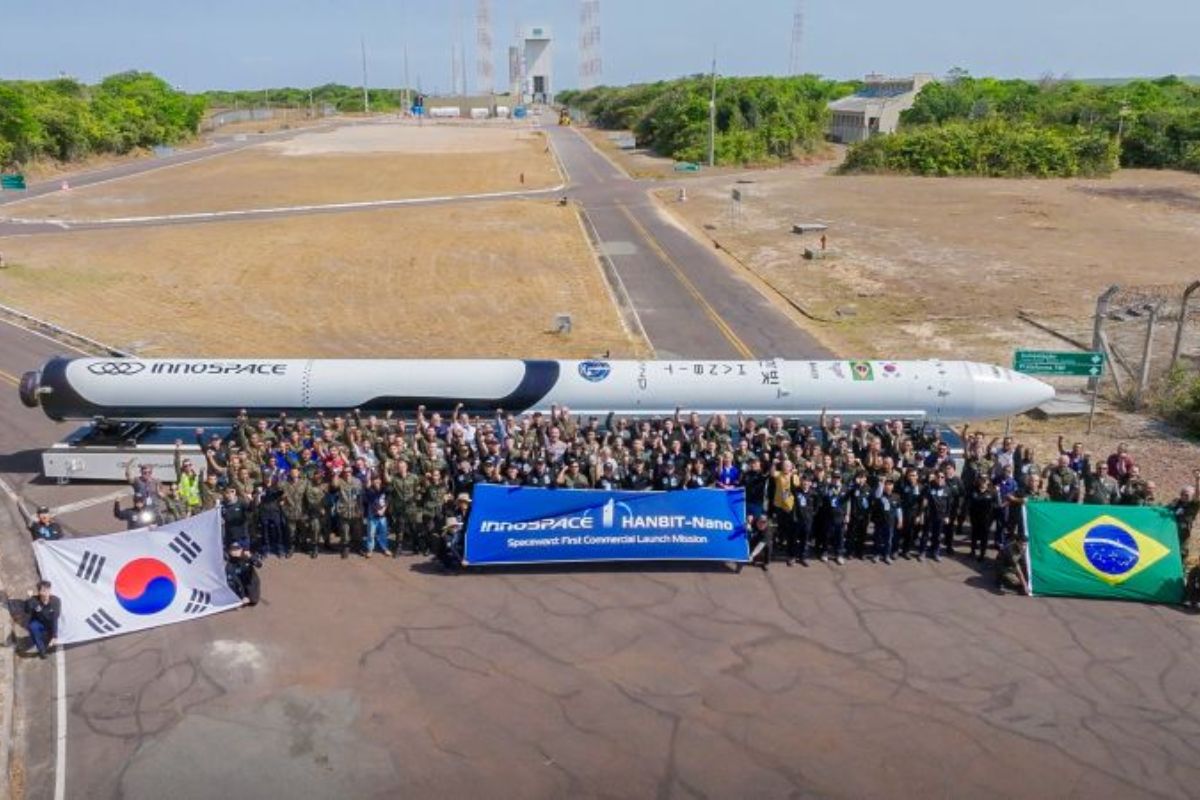
At The Alcântara Launch Center, The First Commercial Orbital Launch With The HANBIT-Nano Rocket In The Spaceward Operation Marks A Decisive Step For The Brazilian Space Program
The Alcântara Launch Center is nearing the final preparations for an unprecedented milestone in Brazilian space history. On November 22nd, at 3 PM (Brasília time), the South Korean HANBIT-Nano rocket, from INNOSPACE, will be launched from the Maranhão base on a commercial orbital mission conducted in partnership with the Brazilian Air Force (FAB) and the Brazilian Space Agency (AEB). This is the first commercial orbital space launch conducted from national territory, consolidating Alcântara’s potential as a competitive platform in the global launch market.
The operation, dubbed Operation Spaceward, has been structured to unite the operational capacity of the Alcântara Launch Center, the institutional expertise of FAB and AEB, and the interest of a private operator in utilizing Brazilian infrastructure to put payloads into orbit. The HANBIT-Nano will carry eight payloads, seven of which are Brazilian and one foreign, totaling approximately 18 kilograms. Among them, three projects are directly supported by AEB, involving universities, research institutes, and national companies, which reinforces the strategic nature of the mission for the development of competencies in the country’s space ecosystem.
Why The Alcântara Launch Center Is Strategic For Brazil
The Alcântara Launch Center occupies a unique position on the global space geography map. Located near the Equator, the Maranhão site offers relevant orbital advantages, such as lower fuel consumption for certain mission profiles and greater efficiency for launches to low and equatorial orbits.
-
Something is happening around the Earth: Inside the huge explosion of fireballs in 2026

-
A hot air bubble coming from Argentina expands over Brazil, causing thermometers to exceed 38 degrees with a thermal sensation of 40 degrees in late March, affecting 6 states at once.

-
The radish leaf that almost everyone throws away has more polyphenols, flavonoids, and fiber than the consumed root, and a 2025 study showed that the leaf contains compounds that protect the intestine, combat inflammation, and may inhibit the growth of cancer cells.

-
A planet that seemed to defy the laws of physics has intrigued scientists for decades, until the James Webb revealed what is really affecting Saturn’s rotation.


This geographical differential turns Alcântara into one of the most valuable assets of Brazil’s strategic infrastructure.
In addition to its position, the Alcântara Launch Center has been gradually prepared to meet the demand of an expanding space market, where small launchers and small satellites are becoming increasingly prominent.
The combination of military infrastructure, civil governance via AEB, and commercial partnerships creates a favorable environment for Brazil to evolve from being a user of space services to competing in the launch segment.
What The Launch Of The HANBIT-Nano Rocket Represents
The HANBIT-Nano, operated by the South Korean company INNOSPACE, is a launcher aimed at small orbital mission targets.
In the Operation Spaceward, the rocket will be used as a vehicle to demonstrate the viability of the Alcântara Launch Center as a base for commercial campaigns and, at the same time, to put into orbit payloads developed by Brazilian institutions.
By uniting a foreign launcher with a national base, the country is practically testing a cooperation model that could support future commercial operations.
The mission anticipates the transportation of eight payloads, seven of which are Brazilian and one foreign.
The national projects included, supported by AEB, encompass academic experiments, onboard technologies, and devices designed for operation in orbit.
Even with a total mass of approximately 18 kilograms, the payload is significant as it represents a showcase of the capacity of universities and research centers to develop space solutions aligned with international standards.
The Operation Spaceward And The Role Of FAB And AEB
The Operation Spaceward is conducted by the Brazilian Air Force in conjunction with the Brazilian Space Agency, utilizing the full infrastructure of the Alcântara Launch Center.
FAB is responsible for operational coordination, airspace security, and launch campaign management, while AEB focuses on institutional articulation, support for Brazilian payloads, and integration of the project into the Brazilian Space Program.
According to the presidency of the Brazilian Space Agency, one of the central points of Operation Spaceward is the opportunity to launch Brazilian payloads from a national base, connecting the work of universities and technological research institutes to the capacity for access to space.
In practice, this means that satellites and experiments developed in the country no longer depend exclusively on foreign launchers operating outside national territory, which adds operational experience to the Brazilian ecosystem.
Brazilian Payloads: From The Lab Bench To Orbit
The set of payloads onboard the HANBIT-Nano reflects the diversity of actors involved in the space chain.
Among the seven Brazilian payloads, universities, public research institutes, and private companies participate, in projects ranging from technological experiments to demonstrators of new components.
This multiple presence reinforces the idea that the use of the Alcântara Launch Center can nourish different segments of the high-tech industry.
Directly supporting three of these projects positions AEB as a key player between the Alcântara Launch Center and the scientific community.
By enabling these experiments to reach orbit, the operation creates a virtuous cycle: results obtained in flight feed back into research, enhance equipment, and strengthen the national ability to develop more complex space systems, with a future focus on commercial and governmental applications.
Alcântara As A Platform For The Launch Market
With the first commercial orbital flight from its territory, Brazil is practically testing the business model it intends to offer to global operators: infrastructure, privileged geographical position, and a Alcântara Launch Center capable of receiving different types of launchers.
If the operation is successful, Alcântara solidifies itself as a concrete option in a market dominated by a few established bases around the world.
At the same time, the commercial use of the Alcântara Launch Center broadens the economic relevance of the base beyond the military dimension.
Launch campaigns can generate a flow of services, specialized jobs, long-term contracts, and opportunities for national suppliers in areas like logistics, payload integration, infrastructure, and ground support systems.
The mission with the HANBIT-Nano, therefore, serves as a proof of concept for a model that can be scaled.
Challenges And Next Steps For The Brazilian Space Program
The advancement represented by Operation Spaceward does not eliminate the structural challenges of the Brazilian space program.
The consolidation of the Alcântara Launch Center as a commercial launch hub depends on continued investments, regulatory predictability, and the expansion of the industrial base capable of providing components, services, and supporting technologies.
International cooperation, such as that established with INNOSPACE, is an important piece but needs to go hand in hand with strengthening domestic capacity.
Another sensitive point is the need to ensure that the development of the Alcântara Launch Center occurs in dialogue with local communities and with attention to social, environmental, and territorial aspects.
The construction of a trustful environment around the base is essential to ensure the longevity of projects and the stability of high-value operations, especially in a capital-intensive sector with long cycles.
The launch of the HANBIT-Nano rocket on November 22nd marks a symbolic turning point for the Brazilian space program and brings the Alcântara Launch Center to prominence on the international stage.
For you, what will be more decisive in transforming this first commercial orbital flight into a routine of successful campaigns in Alcântara: technical capacity, regulatory environment, or attracting new partners and investors for the Brazilian space?






-

-

2 pessoas reagiram a isso.