





 Portuguese
  English
  Spanish
  7 min of reading
  319 comments


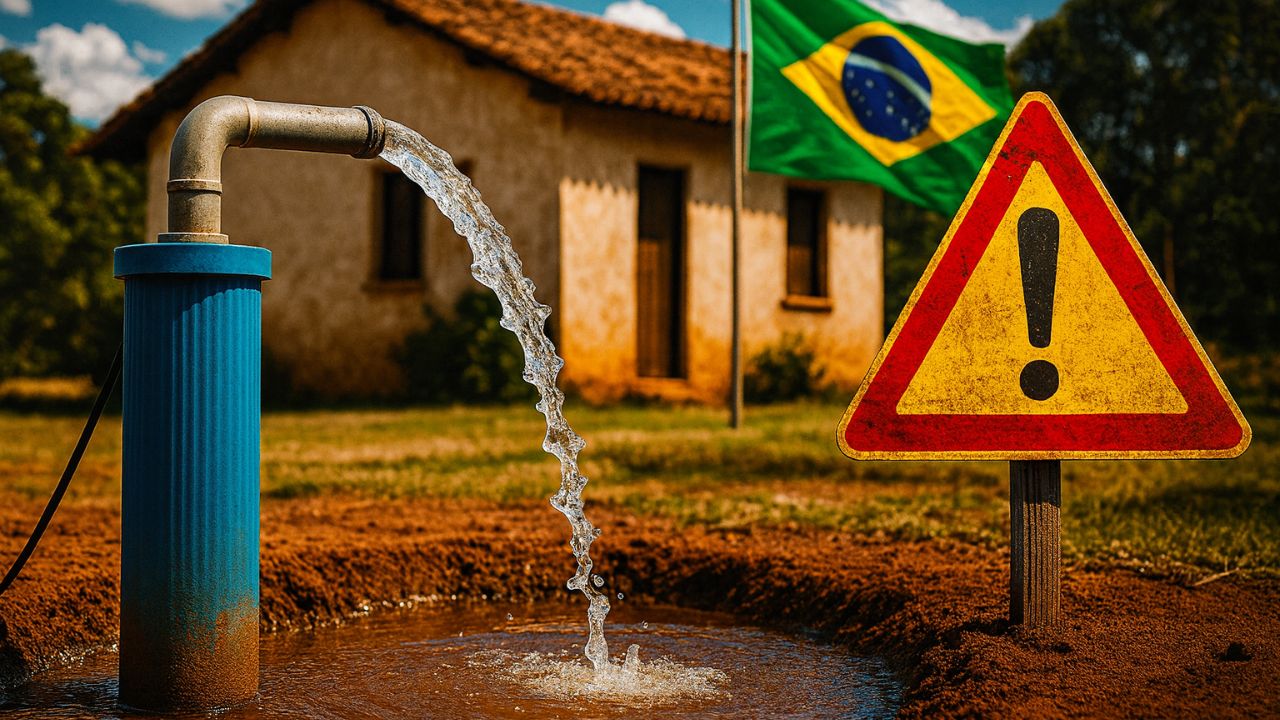


How The Scenario In Which Brazil Prohibits Artesian Wells In Practice Intersects With The Regularization Of Artesian Wells, The Granting Of Water Usage Rights, Water Resources Management, And The Rise Of Illegal Wells Across The Country.
On paper, Brazil claims to protect water. In practice, the path that many Brazilians face makes it seem like Brazil prohibits artesian wells on its own land. To use the water beneath your house, you depend on state authorization, face an expensive, technical, and slow process, and still run the risk of having your well sealed or ignored by the government.
On the other hand, millions of people simply have no alternative. In rural areas, outskirts, and cities with inadequate supply services, an artesian well is the only way to have water inside the house.
As a result: 88% of illegal wells operate outside the law, while the water resources system piles up rules, fights among states, municipalities, and concessionaries, and a labyrinth known as artesian well regularization.
-
The noise law will no longer be in effect at 10 PM starting in June with a new rule valid during the 2026 World Cup.

-
The Chamber opens a debate on driver’s licenses at 16 years old as part of a reform that includes around 270 proposals to change the Brazilian Traffic Code and may redesign rules for licensing, enforcement, and circulation in the country.

-
The new Civil Code could revolutionize marriages in Brazil with “express divorce” and changes that could exclude spouses from inheritance.
-
Banco do Brasil sues famous influencer for million-dollar debt and intensifies debate on delinquency, risks of seizure, and direct impact on Gkay’s credibility.


The Water Under Your Land Is Not Yours
Before the 1988 Constitution, the rule was simple: if the land was yours, the water beneath it was yours too. That changed when the Charter transformed water into a public domain good. In other words, the water under your house is not yours, even if you own the land.
From then on, any significant use of groundwater became subject to water usage rights granted by the public authorities. Law 9.433 of 1997, known as the Water Law, solidified this logic: anyone wanting to extract water from aquifers needs to request authorization from the water resources manager, usually a state agency.
In some cases, when the volume extracted is considered insignificant, the water usage rights may be waived, but registration and monitoring are still required. Each state sets its own limits.
In São Paulo, for example, small volumes can be registered without authorization, while in Rio Grande do Sul, there are specific rules for regularization of old artesian wells.
On paper, this makes sense: to prevent overexploitation of aquifers, ensure water quality, and plan water resources for future generations. But this is where the clash between theory and real life begins.
Water Law And The Granting Of Water Usage Rights

The water usage rights are the heart of state control over wells. In theory, they allow the state to know who extracts, how much is extracted, for what purpose it is used, and if technical and environmental limits are respected.
In practice, this authorization becomes a heavy filter. To advance with artesian well regularization, the citizen must present:
- hydrogeological studies
- water quality reports
- flow and depth data
- technical responsibility from a qualified professional
- forms and registrations in water resources systems
This applies not only to large industries. In many states, even public squares, condominiums, and small users who use well water for irrigation, cleaning, or bathroom need water usage rights or, at the very least, formal dispensation.
Still, the rule remains strict: without authorization, use is illegal. And this is how the scenario in which Brazil prohibits artesian wells consolidates in practice, not by an explicit veto, but by the sum of cost, bureaucracy, and legal uncertainty.
Artesian Well Regularization: Costly, Slow, And Distant From Reality
When speaking of artesian well regularization, the image that comes to mind is that of a technical and organized process. In reality, for most small property owners, this means spending tens of thousands of reais, hiring multiple professionals, and still depending on the goodwill of the water resources management body.
Artesian well regularization involves:
- drilling license
- technical monitoring of the work
- flow and quality tests
- water usage project
- formal request for water usage rights
- installation of a flow meter and mandatory controls
- periodic renewals of the license
It’s no coincidence that 88% of illegal wells in Brazil operate outside the system. It’s not just “a workaround” or bad faith: often, it’s pure necessity combined with the impossibility of meeting all requirements.
The concrete result of this logic is simple: while the authorities talk about water resources management, the resident looks at the budget, at the pile of documents, and understands, in practice, that Brazil prohibits artesian wells for those without money and structure.
Conflict Between States, Municipalities, And Concessionaries
The confusion increases when municipalities and water concessionaries enter the scene. The Constitution and the Water Law state that water resources are managed by states and the Union. The service of supply, however, is municipal, normally delegated to companies like Corsan in Rio Grande do Sul.
When a municipality attempts to loosen restrictions on well usage, a conflict arises. In Santa Maria, RS, a municipal law authorized the use of artesian wells for human consumption in homes and condominiums, provided there was artesian well regularization and quality control.
In practice, the city was trying to allow an alternative source without solely depending on the concessionaire’s network.
The response was swift. The concessionaire argued that the law was unconstitutional because the municipality cannot legislate on water resources or interfere with water usage rights granted by the state. The result was pressure to close wells, even when they were technically adequate.
Illegal Wells, Legal Risk, And Judicial Decisions
When 9 out of 10 wells are considered illegal, the problem has ceased to be an exception and has become the rule. Illegal wells are not only found in isolated rural areas: they are in condominiums, businesses, small industries, and entire neighborhoods that do not trust the network water or can no longer afford the monthly bill.
The judiciary tends to reinforce the priority of the public network whenever there is a conflict. In a case judged in Rio Grande do Sul, a condominium sought authorization to use water from a regularized well for consumption, claiming better quality than that provided by the concessionaire.
Even with all the artesian well regularization in order, the request stumbled on the understanding that, where there is a network, public supply must prevail.
The central argument was the protection of water resources and the environment. In the view of the judges, allowing the indiscriminate use of wells in urban areas could open doors to sanitary risks, contamination of aquifers, and loss of control over the system.
Thus, even those trying to comply with the law end up seeing their well fall into the category of illegal wells for human consumption.
Environmental Risk, Contamination, And Water Resources In Collapse
It would be unfair to treat all regulations as mere defenses of concessionary profits. There are real technical risks involved.
Badly constructed wells can:
- connect layers of soil that should remain isolated
- facilitate the entry of pollution into groundwater
- over-drain an aquifer without allowing adequate recharge
In agricultural regions, wells can be contaminated by pesticides, nitrate, and heavy metals. In urban areas, poorly built septic tanks, gas stations, and industrial waste are permanent sources of threat.
During severe droughts, water resources managers even restrict the use of groundwater, even for authorized wells, allowing only uses deemed essential, such as food industries. It’s a clear message: groundwater is not infinite, and an explosion of illegal wells can compromise entire aquifers.
The problem is that, in trying to protect, the state often creates a control model that few can follow. And so, the technical discourse of responsible management reinforces the scenario in which Brazil prohibits artesian wells in the lives of those who have fewer resources.
Country, City, And The Abyss Between Rule And Necessity
In rural areas, the artesian well is often the only way to have water year-round. Even so, the producer must face the same artesian well regularization required from large enterprises. Studies, projects, water usage rights, technical monitoring: all of this is too expensive for those who already struggle just to maintain production.
In the city, the scenario changes in form but not in essence. Condominiums that attempt to escape expensive or low-quality water encounter decisions that prioritize the concessionaire’s network.
Even when a well is technically correct, the fear of liability in the event of contamination leads companies and judges to choose to reduce or prohibit its use for human consumption.
In the end, water resources are treated as something that needs to be protected from everyone, including those who depend on them the most. Meanwhile, illegal wells continue to multiply because the official alternative is too complex for the concrete reality of the country.
Does Brazil Prohibit Artesian Wells In Practice?
From a legal standpoint, the country does not literally state that Brazil prohibits artesian wells. What it does is encircle the well with so many requirements, steps, and jurisdictional conflicts that, in real life, many people understand the message as a “no.”
On one side, we have laws and agencies trying to protect water resources, prevent contamination, and ensure water for the future.
On the other, a system that makes artesian well regularization nearly unfeasible for the ordinary citizen, pushing millions of people into informality and turning illegal wells into the rule, not the exception.
In the end, the hole is literally deeper: the water is there, beneath your house, but the path to it goes through the state, concessionaire, judge, and a pile of papers.
And you, what do you think of this scenario where Brazil prohibits artesian wells in practice instead of facilitating responsible access to water? If you were to decide, how would you balance the protection of water resources and the citizen’s right to their well?







Ter poço uma alternativa a péssima qualidade da água proveniente das concessionárias. Infelizmente a máfia das concessionárias visa o lucro, se passa rede de água na frente tem que pagar mesmo se não usar. É um sistema muito bem montado para arrecadar e a Lei respalda. Aqui, Brasil, quem menos recebe ou merece em contrapartida aos elevados impostos, que sugam a renda de algumas classes, é quem sustenta toda essa máquina voraz💰💰💰💰💰, nós a população.
Como em tudo que acontece no Brasil, tudo gira em torno de dinheiro, se pagar , tá tudo certo.
Mas esses políticos não tem ****, pois é só burocracia, papéis engavetados,pilhas de projetos e engenheiros e técnicos, estão apenas coçando, em vez de fazer.
Só dificultam os projetos com taxas e mais taxas, cobrando e embolsando o dinheiro,e não dão retorno pra aquilo que o dinheiro na verdade é pra ser empregado. Por isso as pessoas se obrigam a fazer na clandestinidade, como todos os projetos que precisam de licenças, é só roubo e burocracia.
Bem, lá vamos nós novamente comentar as aberrações deste governo.
Poços artesianos: – A água assim como o ar, é um direito divino de todos os seres vivos na face do Planeta.
– Posto isso, um poço, pode servir a várias famílias, com isso, gerar uma prosperidade e saúde na vida do campo. O custo da perfuração será absorvido pelos usuários com prazer, pois verá sua terra produzir, seus filhos crescerem sem pensar em abandonar a terra natal em busca de sobrevivência.
– Prosperidade na região e não a dilaceraçao de famílias.
– Mas… Este governo só pensa em arrecadação, o povo pobre, é um peso psra o país.
O mais importante é o bolso dos políticos estarem casa vez mais cheios.