





 Português
  Inglês
  Espanhol
  9 min de leitura
  12 comentários


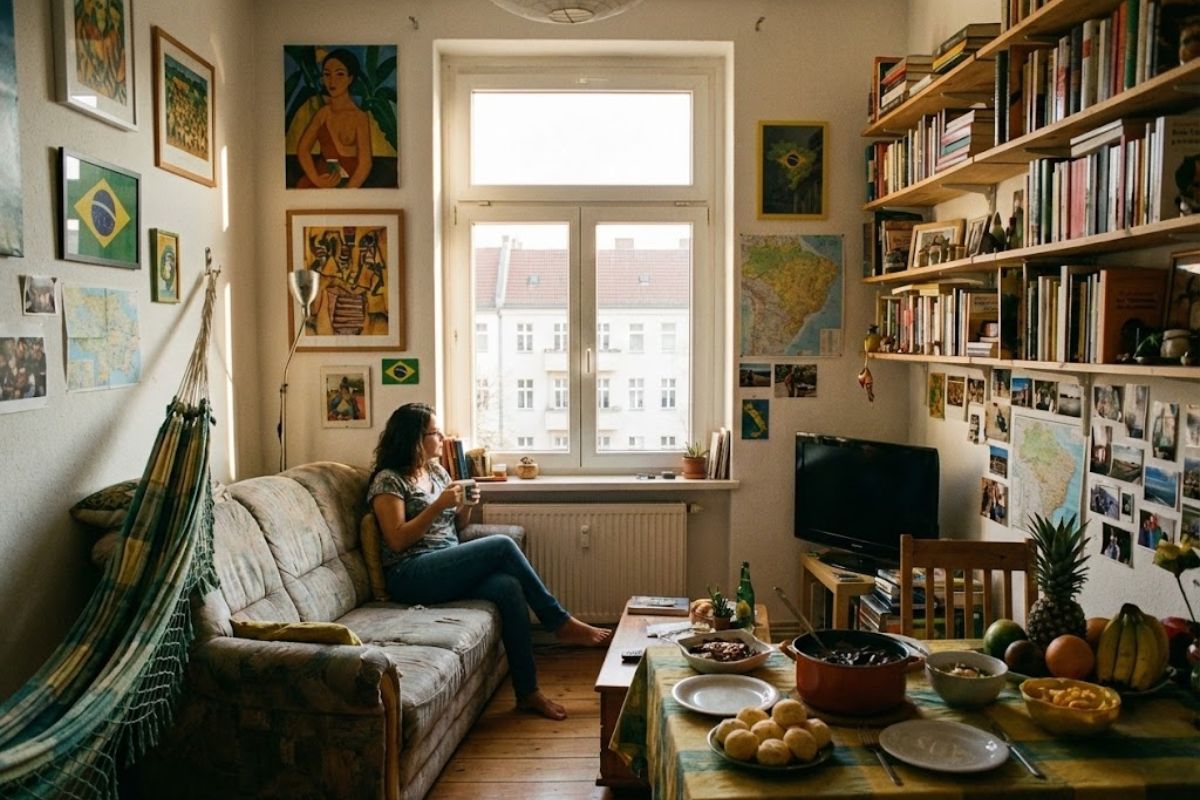


Among Shelves Full Of Books In Portuguese, Cordel Frames, Indigenous Objects And The Smell Of Cheese Bread, Brazilian Women In Germany Reinvent Home To Face Loneliness, Prejudice And Identity Crises, Keeping Roots Alive As They Build Routine, Friendships And Belonging In Another Distant European Country Day After Day.
In 2023, when Germany already housed the seventh largest Brazilian community in the world, with about 160,000 people, many Brazilian women in Germany discovered that the first step to endure the distance was to transform their apartments into emotional shelters, full of colors, scents, and memories that kept their heads in place.
This reconstruction of home relies on a long history: from 1824, the year marked by the beginning of the migration flow of Germans to Brazil, to personal memories like the diploma hanging from 1989 and the record of the day when Brazil celebrated its 500th anniversary, everything becomes material to resist the identity crisis and continue living between two worlds.
Women, Home And The Border Between Staying And Returning

Women have historically formed the largest part of the Brazilian community in Germany and, in general, arrive with a high level of education.
-
In a silent race, Shopee signs a mega contract in Guarulhos and accelerates the e-commerce war with faster deliveries, pressured shipping, and a new threat to rivals in Brazil.

-
Oil surged to $115 a barrel due to the war in the Middle East, and diesel in Brazil has already risen to R$ 7.45 per liter, while the United States…

-
Brazilian city bets on the business environment to generate jobs and attract investments in the energy sector — secretary reveals strategy at Macaé Energy 2026.

-
50 viaducts, 4 tunnels, 28 bridges, and 40 kilometers of bike paths: BR-262 in Espírito Santo will receive 8.6 billion reais for the largest engineering project in the state’s history, inspired by the Immigrant Highway in São Paulo.


Many Brazilian women in Germany came to study, work, or accompany their partner, as is the case of Juliana from Pernambuco, and many others who now live torn between the desire to stay and the constant doubt about returning.
For anthropologist Simone, who researches this adaptation, home is a central tool to alleviate the identity crisis, that uncomfortable feeling of always being “the Brazilian” in Germany while simultaneously hearing in Brazil that she has become “the German.”
Between one label and another, home becomes a silent laboratory for reconstructing belonging.
Books, Cordel, Miniatures And Northeastern Roots In Sight

In Juliana’s home, literature was the first thread that connected her German apartment to Brazil.
She filled the shelves with books and scattered small frames of cordel literature across the wall, in addition to miniatures from master Vitalino that depict scenes from the Northeast.
Each piece serves as a living reminder of the proud Pernambuco and Northeastern identity she refuses to abandon.
On the main shelf, photographs of her parents share space with a painting of parrots made by her mother, in vibrant colors that immediately evoke Brazil.
Slowly, these elements have strengthened her sense of belonging, reinforcing her Pernambuco roots and helping Juliana feel that her previous life hasn’t been left behind, just gained a new address.
Nature Corner And Hybrid Identity Within The Apartment

In addition to books and sculptures, Juliana created a space dedicated to nature inside her home. Plants, soft light, and a reserved corner to observe the greenery became a refuge on days of loneliness and cultural shock.
She says that nature always reconnects her to Brazil and to her own history, serving as an emotional safe haven.
Looking at everything she has gathered, Juliana defines herself as a hybrid being.
She manages to maintain her Brazilian roots while simultaneously accumulating elements from other cultures she encounters in Germany.
The result is a home where Northeast, Europe, and personal memories coexist, without any part needing to be erased for the other to exist.
Memory Notebooks, Old Photos And Rode’s “Brazilian Corner”
Rode, who grew up between Rio de Janeiro and Minas Gerais, arrived in Germany with her parents 25 years ago and has never returned to live in Brazil, only for vacations.
The longing that already existed grew over time, and one of the ways she found to cope with it was to handwrite memory notebooks.
In one of them, she recorded the day Brazil turned 500 years old and made a prayer for the country to become fairer.
On the wall, she hung the photo of her first diploma, obtained in 1989. All the photographs are often revisited, like someone flipping through an identity album to remember where they came from.
With many books in Portuguese, and whenever possible in both Portuguese and German, Rode has gathered everything in a specific corner, which she now calls her “Brazilian corner.”
Personalized Frame, Roots In The Heart And Declared Belonging
This corner gained even more strength with a painting created by a Brazilian artist, Bruna, based on Rode’s personality and stories.
On the canvas, a heart full of roots stands out as a symbol of an identity that does not fade with time.
For her, even if she spends 30 or 40 years in Germany, her Brazilian roots remain visible because they are nurtured every day.
Rode sees every image of Brazil on the wall as an intimate gesture and a public message at the same time.
It’s the way she found to silently tell any visitor that behind the life built in Germany, there exists a previous Brazilian story that still matters.
It’s a way of affirming that, even far away, she remains part of something greater.
House As A Political, Emotional Microcosm And Mirror Of Choices
Simone, as an anthropologist, sees the house as a microcosm of what each person thinks, feels, and practices in the world.
Upon entering a home, she says it’s not even necessary to speak much, because the objects, the phrases on the walls, and the colors already tell the story.
Everyday life, for her, is at the center of it all.
That’s why Simone’s own apartment in Germany was designed as a manifesto.
Aesthetics are tied to ethics at all times. Phrases scattered throughout the rooms are not neutral: many are works by artist friends, others are her own creations, and others still appear on dish towels with strong messages, like the denunciation that machismo sustains a system of privileges and needs to be fought against.
Black And White Bathroom, Texts On The Walls And Discreet Activism
One of the most symbolic spaces in Simone’s house is the bathroom, entirely in black and white. She decided that only objects in these two colors should enter there and preferably with texts.
Each frame, sticker, or paper brings a message for anyone using the space, transforming the bathroom into a small militant reading room.
These phrases serve as daily reminders for the residents and clear messages for visitors. In just a few minutes, anyone understands that two women who believe in fighting against machismo and other political causes live there.
The house, thus, becomes both an emotional refuge and a space for positioning, even thousands of kilometers away from Brazil.
Indigenous Objects, Protection On The Ceiling And Captured Dreams
When deciding what to bring from Brazil to Germany, Simone faced a dilemma. She knew that in the first few years, she wouldn’t master the language and that adaptation would be slow.
Therefore, she carefully chose affectionate objects linked to her professional journey and the relationships built in Brazil. Among them is a piece from an indigenous group she worked with for many years, the Wayanas and Aparais, from the north of Pará and Amapá.
It’s a wheel that hangs from the ceiling, associated with protection, accompanied by a fire fan and indigenous combs that are no longer produced.
Each object carries memories of fieldwork, friendships, and struggles shared in Brazil, serving as a symbolic anchor to not lose one’s own history.
In another corner, she keeps a dream catcher, a typical object of Indigenous peoples of North America, which first came with her parents from Canada and was later incorporated into her new European home.
The Smell Of Cheese Bread, A Set Table And Affection That Becomes A Takeaway
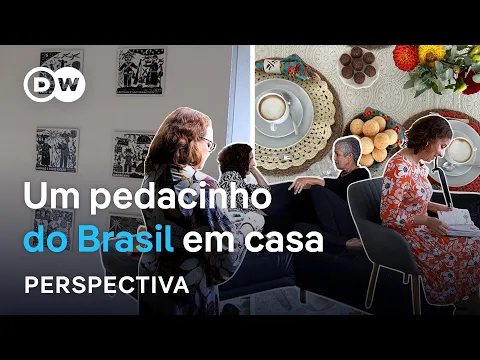
In Rode’s house, the memory of Brazil also comes through the kitchen. To receive the reporting team, she prepared fresh cheese bread for afternoon coffee and set a beautiful table, designed to last only for the duration of the conversation.
At the end of the visit, she still packed a takeaway, a gesture that many immediately recognize as typical Brazilian affection.
For Simone, who researches the lives of Brazilian women in Germany, from food to aesthetics, everything can be a tool to adapt to the destination country without abandoning who one is.
The set table, the smell of the oven, the shared coffee, and the habit of offering something to take home afterward are extensions of a culture of care that these women carry as part of their identity.
Between The Cologne Station And The Baroque Exaggeration Of Minas Gerais
Ana and Paula left São Paulo three years ago. Despite the short time, they have already created an emotional ritual: whenever the train arrives at Hauptbahnhof, the central station of Cologne, they nearly chorus “ah, I’m home.”
The German city has gradually gained emotional weight as a fixed address without replacing Brazil, merely sharing space with it.
The environment shown at the beginning of the video is at one of their homes.
At first glance, it doesn’t directly resemble Brazil, except for some colors and perhaps a certain exaggeration that recalls the baroque style of Minas Gerais, the state where she was born.
Nonetheless, this space reflects who she is and undeniably includes the fact of being Brazilian. It is a scenario that mirrors this multiple identity, built between memories and adaptations.
Brazilian Identity As An Anchor For Mental Health
Ana summarizes what many Brazilian women in Germany report: the relationship with Brazilian identity cannot be erased because it is what guarantees mental health, steadiness, and the ability to cope with the challenges of living abroad.
To abandon this part would be to lose oneself.
At the same time, she acknowledges that one cannot live solely in the past.
It is necessary to engage in new relationships, learn German, understand the local context, and build a minimally coherent life in the destination country.
The key, they say, is to accept that one thing need not erase the other. It is possible to remain Brazilian while simultaneously opening up space for a new life in Germany.
Shared History Between Brazil And Germany Within The Homes
The connection between the two countries is not recent. Extremes have come closer together more intensely since 1824, with the beginning of the migration flow of Germans to Brazil.
Today, over 10 million Brazilians have German ancestry, while the community of Brazilian women in Germany grows and reinvents itself in every domestic detail.
In this movement, the homes of these women become discreet showcases of this shared history. The walls display cordel frames, paintings made by mothers, artworks produced by friends, political phrases, indigenous objects, old photos, and diplomas dating back decades.
The shelves accumulate books in Portuguese and German, daily reminding them that living between two worlds can be painful, but also profoundly creative.
Living Between Worlds, Filling The House With Meaning And Moving Forward
Ultimately, all these choices respond to the same silent question: how to transform an apartment into a portable homeland.
By filling the house with books, art, memories, food, and messages, these Brazilian women in Germany create an emotional map that helps them navigate foreign territory without losing sight of who they were before crossing the ocean.
Between the train station that already sounds like home, the smell of cheese bread coming from the oven, the black and white bathroom filled with notes, and the frame with roots emerging from the heart, they build, day by day, their own way of living between worlds, holding onto longing with one foot in the past and the other in the present.
And you, if you had to live in another country, what objects, scents, or phrases would you bring to your home to continue feeling at home every day?









…e por que foram???
Eu, vivi 20 anos fora do Brasil, entre esses anos, vivi também na Alemanha, porque me casei com cidadão Alemão. Nunca sairia do meu país para viver em outra cultura, se não tivesse um forte argumento. Fui, ciente das diferenças e aberta à tudo que fosse encontrar. Isso faz parte. Vivi também na Holanda, Italia, Portugal e estando na Europa, conheci outros países, tendo ido também à China, Mauricio, Hong Kong… culturas ainda mais diversas… quero dizer que precisamos ser responsáveis por nossas escolhas e entender que em todas, alguma coisa se perde…porisso: escolhas…
Nada, não tenho apego a está questão de nacionalidade.
Nunca senti desejo de morar fora do Brasil, Amei a decoração do apartamento, ajuda muito amenizar a saudade. Muita força e foco na vida de vocês.