





 Portuguese
  English
  Spanish
 4 min of reading
  1 comment


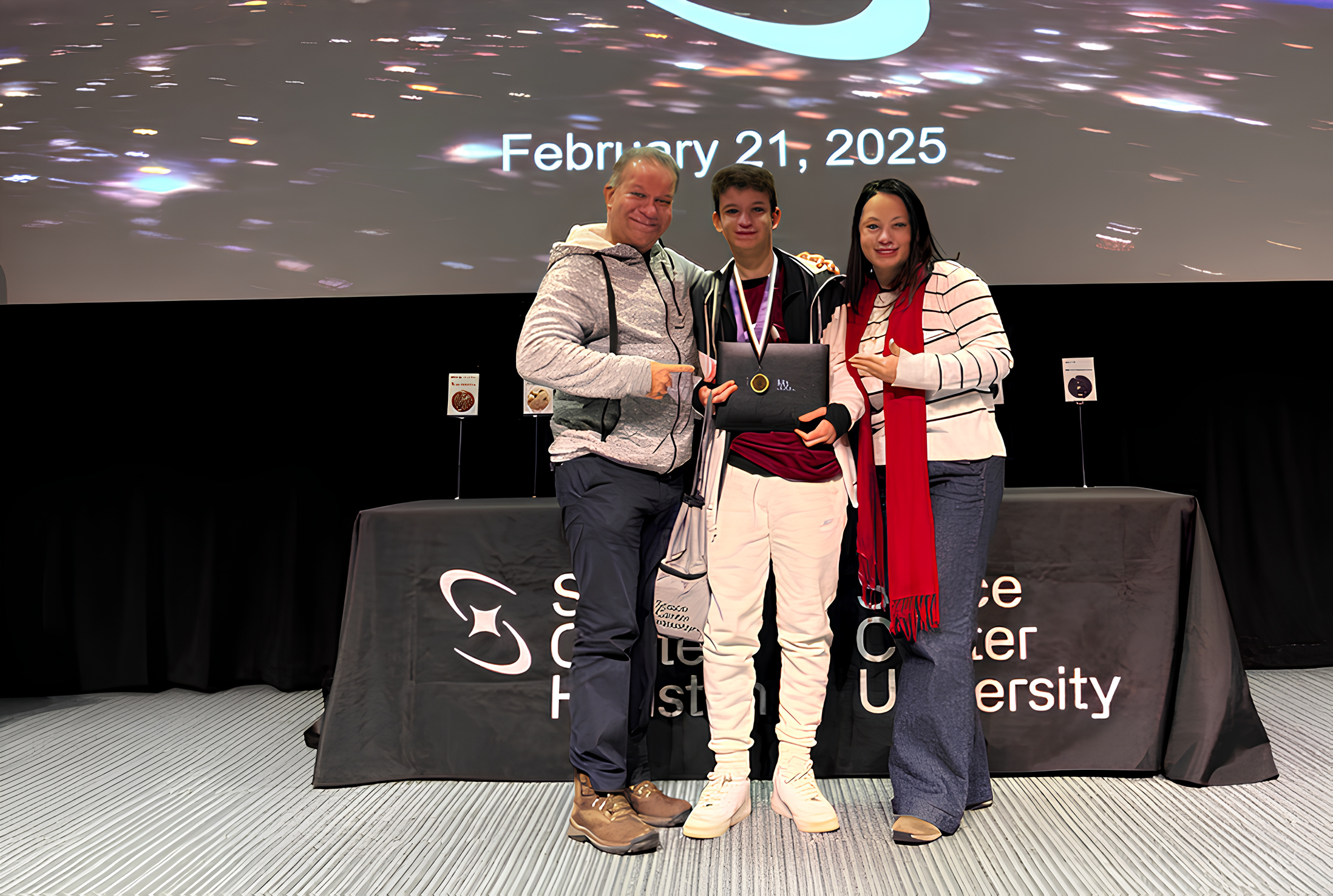


In February 2025, Leon Amaral, 14, shone in a program linked to NASA in Houston. He won three challenges, highlighted the importance of English, and inspired his community, even without space on large portals.
In March 2025, regional portals from Rio Grande do Norte reported the story of a teenager who took Brazil’s name to one of the most iconic stages of world science: Houston, Texas (USA). This is Leon Amaral, just 14 years old, who excelled in the Young Leaders Program, an initiative linked to NASA aimed at young talents in science and technology.
According to reports, Leon secured 1st place in three of the six challenges proposed by the program, standing out in robotics, programming, and applied cryogenics. Although this achievement has yet to gain traction in major national media outlets like G1, R7, or Estadão — and has not been officially announced by NASA — its impact on regional portals has already made the young man a symbol of inspiration.
And it’s worth noting: the lack of coverage in major media does not diminish the merit of the achievement, which remains an example of the potential of young Brazilians when they have access to quality education.
-
It took just two days of walking in the jungles of New Guinea to find the plane that historians had been searching for for 80 years: the legendary Marge still had its original red paint and the face of the woman who named the most feared fighter of World War II.

-
On a rocky stretch of just 40 meters in South Africa, scientists found dozens of footprints that are 132 million years old hidden beneath the tide, revealing the youngest record ever identified in the southern part of the African continent.

-
Artemis 2 makes history by bringing astronauts in a ‘fireball’ at over 40,000 km/h and 2,700 °C in an impressive reentry that challenges human limits.

-
At over 2,000 meters above sea level, archaeologists have found a medieval city spanning 120 hectares with four citadels hidden in the mountains of Uzbekistan. This discovery dismantles the idea that the Silk Road was merely a passage and reveals a colossal urban center where no one imagined.

A Brazilian Among the Highlights of the Young Leaders Program
The Young Leaders Program is an international program that challenges teenagers to solve complex problems inspired by real situations from space exploration. Held in Houston, home of the NASA Johnson Space Center, it brings together young people from various nationalities for team competitions.
Leon excelled in three specific areas:
- Applied Robotics, creating prototypes with recycled materials to simulate operations in space stations.
- Advanced Programming, developing codes for autonomous navigation in hostile terrains.
- Cryogenics and Material Resistance, with experiments testing solutions in extreme temperature conditions.
These victories secured the young man from Potiguar first place in half of the proposed challenges, an achievement that reinforces the relevance of his participation.
The Support of the School and the Value of English
Leon’s journey was celebrated by the school where he studied for most of his childhood and adolescence. The director of Maple Bear Natal, Eduardo Bezerra, highlighted the importance of the young man as a symbol of overcoming and Brazilian potential:
“Leon’s participation in NASA’s Young Leaders Program is an example of the potential of young Brazilians and the importance of quality education for the formation of global leaders”, Bezerra stated.
Leon also stressed a decisive factor for his performance in Houston: his command of English. He joined Maple Bear in 2011, at just one year old, and studied until the 8th grade of elementary school, in 2024.
“The English I learned at Maple Bear was fundamental, as everyone at the event communicated in that language”, the teenager explained, emphasizing that fluency in the language was essential to interact with peers from other countries and present his ideas clearly.
The Early Talent of the Northeast for the World
Originally from Natal, Leon Amaral has always shown interest in areas related to science and technology. Even as a teenager, he is already familiar with advanced programming concepts and practical experiments, characteristics that helped him stand out in Houston.
His achievement reinforces a central point: Brazilian youth can compete equally in international programs, provided they have access to adequate teaching tools. Leon’s case shows that it is not just about innate talent, but also about investment in quality education from an early age.
The Regional Repercussion and National Invisibility
While blogs and portals from Rio Grande do Norte highlighted Leon’s victory, the news has yet to gain traction in the largest media outlets in Brazil.
The lack of national coverage or official announcements from NASA, however, should not be seen as a demerit. On the contrary: it reinforces how many inspiring stories remain restricted to local news, when they could serve as examples for millions of young people.
It is precisely this contrast that makes Leon’s story even more symbolic: great talents often emerge far from the spotlight.
More than just overcoming technical challenges, Leon Amaral represents a Brazil that dreams of taking its place in global science and technology. His performance in Houston shows that genius can come from anywhere — including a 14-year-old from Natal who decided to take on international challenges.
Even without making headlines in major portals, Leon is already an example: a teenager who, with dedication and quality education, took Brazil’s name to one of the most respected centers of world science.







Muito bom