






 Portuguese
  Spanish


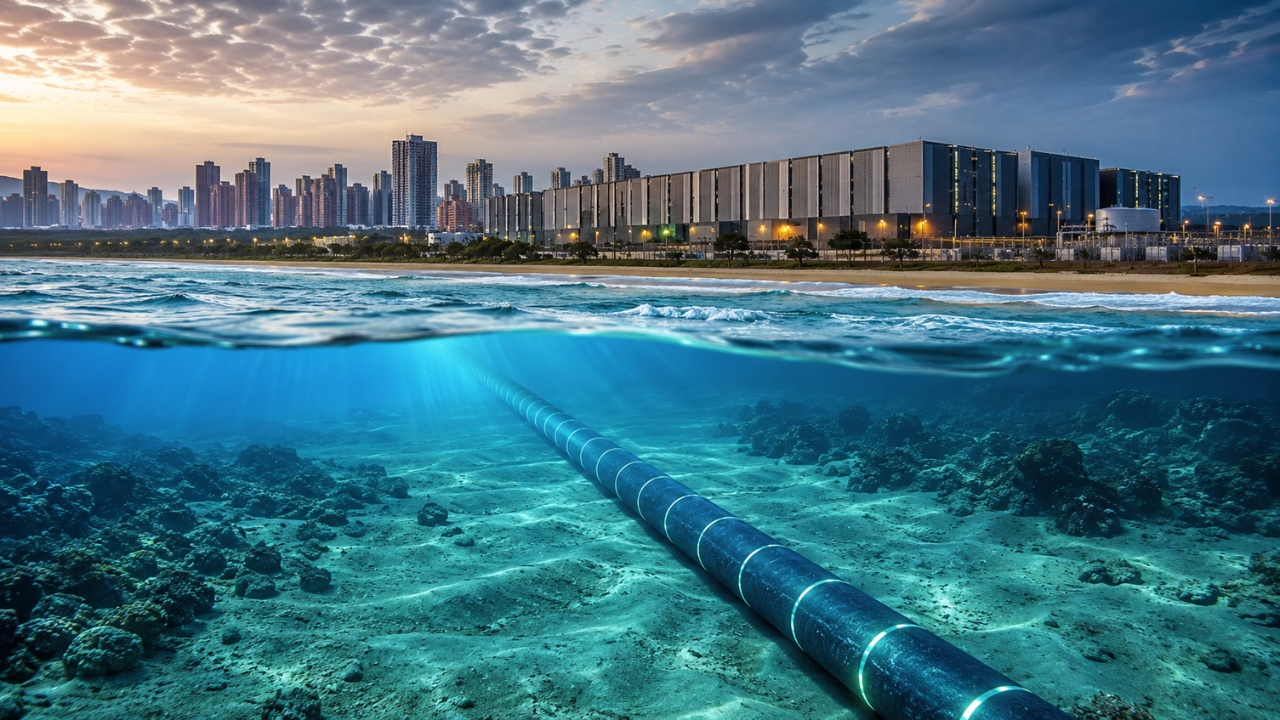

With Synapse, V.tal prepares a new data route between Brazil and the USA, bringing Fortaleza to the center of the digital infrastructure that supports the internet, cloud, streaming, and artificial intelligence in the country.
Fortaleza returned to the spotlight of the Brazilian digital infrastructure in 2026. After the inauguration of the Mega Lobster in October 2025, the capital of Ceará now appears linked to a new international project by V.tal: the submarine cable Synapse, announced on January 20, 2026 to connect Brazil to the United States.
According to information released by Data Center Dynamics, the system will be about 9,700 kilometers long, starting from Tuckerton, New Jersey, in the United States, to Brazil, with an expected arrival on the coast of São Paulo and a land connection to São Paulo.
But the point that makes this project even more strategic news is the planned branching for Fortaleza. The capital of Ceará is expected to connect to the system through an extension linked to the Mega Lobster, a giant data center installed at Praia do Futuro, which was already established as one of the largest digital structures in the Northeast.
-
Chinese J-35 Fighter’s Silver Finish Raises Concerns About Corrosion and Radar Invisibility in Salty Air

-
Rare Green Opal Discovered in Piauí’s Interior Surprises Geologists and Opens New Mining Opportunities
-
Your smartwatch might be ‘lying’ about how many calories you burned, study reveals after testing popular brands in the lab

-
Airbus to Manufacture H145 Helicopter in Brazil Post Lula-Macron Negotiations; Project Requires Initial Order of at Least 40 Units and Involves a Brazil-France Partnership Estimated at R$ 1 Billion


Synapse Cable was announced in 2026 and targets the explosion of artificial intelligence
The Synapse project arrives at a time of accelerated data traffic growth. The demand for artificial intelligence, cloud services, streaming, social networks, digital banks, online games, and corporate platforms requires increasingly faster, more stable connections with great international capacity.
The construction of the cable is scheduled to begin in the second half of 2026, with operation estimated between 2029 and 2030, depending on regulatory, environmental, and technical stages. In other words, the project is not yet operational but already places Brazil on the map of major digital projects for the next decade.
With 16 pairs of optical fiber, next-generation architecture, and high-speed circuits, Synapse was designed to expand capacity between Brazil and the United States, one of the most important routes for digital traffic in Latin America.
Fortaleza enters the map with a strategic branching
The main route of the submarine cable is expected to link the United States to São Paulo, but the project includes a Branching Unit, a branching unit that can extend part of this infrastructure to Fortaleza. This extension is expected to be about 460 kilometers and connect directly to the Mega Lobster.
This means that the capital of Ceará will not just be a city near the route. It could function as a strategic interconnection point, reinforcing its position as the Atlantic digital hub and one of the main gateways for international data entry and exit in Brazil.
Fortaleza already hosts one of the largest submarine cable infrastructures in Latin America. The arrival of another connection of this magnitude further strengthens the city in a competition involving technology, data centers, low latency, data security, and the attraction of global companies.


Mega Lobster, the giant data center that places the Northeast at the center of the internet
The Mega Lobster is a key piece in this story. Inaugurated on October 23, 2025, in Fortaleza, the Tecto data center was presented with 20 MW of installed power, an investment of about R$ 550 million, and an area of approximately 13,000 m².
Located at Praia do Futuro, a region known for the presence of submarine cables, the enterprise was created to serve companies that need high processing capacity, storage, security, international connection, and low latency.
And the movement did not stop at the inauguration. In May 2026, Tecto already appeared with plans to expand the IT capacity of Mega Lobster from 3 MW to 6 MW, with an estimated investment of US$ 30 million. This data reinforces that Fortaleza is not just receiving infrastructure: it is accelerating its entry into the data center market.
Why an undersea cable can make the internet more stable
The internet that reaches the cell phone, computer, and TV seems invisible, but it depends on gigantic physical structures. Among them are the submarine fiber optic cables, responsible for transporting most of the data that circulates between countries and continents.
With a new cable like Synapse, Brazil gains more international capacity, more possible routes for data traffic, and more redundancy in case of failures or congestion. This can help reduce bottlenecks and make critical connections more stable.
In practice, the average user may feel indirect effects on services that depend on communication with servers outside the country, such as streaming, online games, videoconferences, digital banks, AI platforms, social networks, and cloud work tools.
Will Brazilian internet become faster?
The promise draws attention, but it needs to be understood carefully. The new cable does not mean that all Brazilians will have an automatic increase in speed on their residential internet plan. The improvement depends on the operators, content providers, routes used, and investments within the country.
Even so, the infrastructure is decisive. When there are more cables, more capacity, and more available paths, the network tends to be better prepared for demand peaks, technical failures, and the growth of digital consumption.
Therefore, Synapse can contribute to a more resilient internet, with lower latency on certain routes and greater support for heavy applications, especially those related to the cloud, artificial intelligence, and international services.
Fortaleza stops being just a tourist destination and becomes a digital powerhouse
Praia do Futuro is known for its stalls, tourism, and coastline, but it has also become a strategic point for the global internet. It is there that submarine cables arrive, data circulates, and companies plan structures capable of connecting continents.
With the branching of Synapse and the presence of Mega Lobster, Fortaleza reinforces a silent transformation: from tourist capital to digital capital of the South Atlantic. The city is increasingly taking on an important role in the infrastructure that supports the connected economy.
This position can attract technology companies, cloud providers, content platforms, AI operations, and new investments in data centers. In a world driven by data, being close to the cables means being close to the future.


