





Researchers Have Located the Planet’s Largest Known Octopus Nursery 3,200 Meters Deep Off the California Coast, Documenting 5,718 Animals in 2.5 Hectares and Estimating Over 20,000 Around Davidson Seamount Where Hot Springs Warm the Nests and Drastically Reduce Egg Incubation Time.
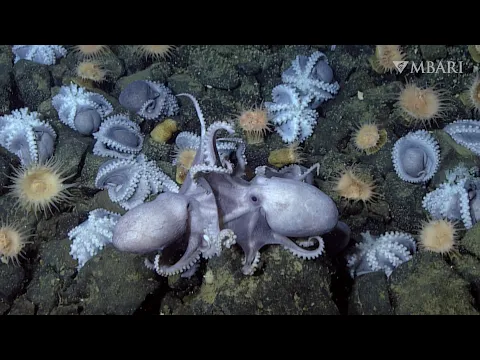
The Octopus Garden, located 3,200 meters (about 10,500 feet) below the ocean surface off Central California, features the largest known concentration of octopuses on the planet. Researchers documented 5,718 animals across just 2.5 hectares at the center of the nursery and estimate that the total population within the entire small seamount of 333 hectares could exceed 20,000 individuals.
According to a statement released by the Monterey Bay Aquarium Research Institute (MBARI) on August 23, 2023, monitoring confirmed that pearl octopuses migrate to the site for mating and nesting. The study, published in the journal Science Advances, further concluded that the heat emitted by the hot springs accelerates egg development.
Octopus Garden is 3,200 Meters Deep
The nursery is situated on a small hill near the base of the Davidson Seamount, off Central California.
-
9-Meter Dinosaur with Nearly 500 Teeth Lived 105 Million Years Ago with Continuous Dental Replacement in Just 14 Days

-
At 15, Canadian Girl Invents Battery-Free Flashlight Using Body Heat to Power an LED for Over 20 Minutes, Wins Google Science Fair with a $26 Prototype

-
Brazil’s Health Agency Mandates New Controlled Prescription Formats Since May, Plans National Electronic System Launch by September 2026
-
Scientists Assess the Impact of Thousands of Visitors on Everest: Heat from Human Activities Melts 2,492 Tons of Ice and Snow in One Season




The site lies at a depth of 3,200 meters, approximately 10,500 feet, in a region where the absence of light, low temperatures, and extreme pressure make scientific observation particularly challenging.
Davidson Seamount is an Extinct Volcano

The geological formation associated with the nursery is an ancient underwater volcano.
The Davidson Seamount is located approximately 130 kilometers southwest of Monterey, California, and is classified as an extinct volcano. The Octopus Garden is situated near its base.
Thousands of octopuses were discovered in the region in 2018
The large concentration first drew attention in October 2018.
Researchers from the Monterey Bay National Marine Sanctuary, NOAA, Ocean Exploration Trust, and collaborators, working aboard the E/V Nautilus, observed thousands of octopuses gathered on a rocky rise near the seamount.
Females appeared upside down protecting the eggs

The position of the animals helped researchers understand what was happening in that section of the ocean.
Many of the octopuses were upside down, with their arms positioned around their bodies, a posture associated with females protecting and incubating their eggs.
The species was identified as Muusoctopus robustus, known to researchers as the pearl octopus.
Pearl octopus is approximately the size of a grapefruit
The Muusoctopus robustus exhibits a pale purple coloration.
According to MBARI, the animal is approximately the size of a grapefruit and occurs in the northeastern Pacific Ocean, from Oregon down to Baja California.
The institute has observed the species at depths between 2,300 and 3,600 meters.
MBARI monitored the nursery for three years

Doc Ricketts from MBARI carried instruments to measure environmental conditions inside the octopus nests, including temperature and oxygen levels. Image: © 2020 MBARI
After the initial discovery, researchers began a prolonged investigation to determine why so many animals were concentrated at that point.
For three years, MBARI and partner institutions employed cameras, sensors, remotely operated vehicles, and other equipment to observe the behavior of octopuses and the environmental conditions of the nursery.
Team Conducted 14 Dives with the ROV Doc Ricketts
The remotely operated vehicle Doc Ricketts, from MBARI, played a central role in the research.
During 14 dives, scientists found adult males and females, developing eggs, and hatchlings. No individuals of intermediate size or evidence of feeding were observed at the site.
These observations indicated that the octopuses gather there specifically to mate and nest.
Normal Water at the Bottom Is Only 1.6°C
The thermal conditions helped explain why this small area attracts so many animals.
At approximately 3,200 meters, the normal water temperature is around 1.6°C.
However, in the crevices and fissures used by the octopuses, water warmed by the hydrothermal vents reaches nearly 11°C.
Hydrothermal Vents Are Concentrated in Nest Fissures

The initial researchers observed a “sparkling” appearance in the water, caused by the mixture of hot and cold water.
Subsequent investigations confirmed the existence of hydrothermal vents and showed that the nests are clustered precisely in the fissures bathed by the warmer water emerging from the seabed.
Eggs Could Take Five to Eight Years in Cold Water
Octopuses are ectothermic animals, and the cold of the deep waters reduces their metabolism and slows embryonic development.
At temperatures close to zero found in the abyssal environment, researchers expected that the eggs of pearl octopuses would need five to eight years, or even longer, to hatch.
Heat Reduced Incubation to Under Two Years
Individual monitoring of the females revealed a much different outcome.
Using 4K imaging and features like scars to recognize the animals, scientists tracked their clutches and found that the eggs hatched in less than two years.
The study attributes this acceleration to the heat from the hydrothermal vents, which increases the mothers’ and embryos’ metabolism.
Shorter Incubation May Increase Hatchling Survival
Researchers believe that spending less time inside the eggs offers a reproductive advantage.
The longer the incubation, the greater the period during which the embryos are subject to predation, injury, infections, and other sources of mortality.
Therefore, the natural warming of the nests can increase the chances of survival for the offspring.
Each female lays approximately 60 eggs
Females migrate to the Octopus Garden in search of the warm locations where they can nest.
Each one lays a clutch of approximately 60 elongated eggs and covers the embryos with her body while they develop.
During this period, the mothers utilize existing reserves in their own tissues to sustain themselves.
Survey counted 5,718 octopuses in 2.5 hectares
The size of the concentration was measured using a combination of photographs and detailed mapping of the seabed.
The LASS system, installed on the Doc Ricketts ROV, allowed high-resolution images to be produced and a photomosaic of the region to be assembled.
In this survey, researchers documented 5,718 octopuses in just 2.5 hectares at the center of the Octopus Garden.
Area of 333 hectares can host more than 20,000 animals
The direct count represents only a portion of the area.
The slight elevation where the nursery is located occupies approximately 333 hectares, or 823 acres.
Based on the surveys conducted, the team calculated that the total population could easily exceed 20,000 individuals.
Camera produced more than 12,200 images in six months
The monitoring continued even during intervals between expeditions.
A time-lapse camera captured a photograph every 20 minutes, accumulating over 12,200 images between March and August 2022.
The material allowed for the observation of octopus behavior, predators, and animals that feed on organic matter in the area over more than six months.
Octopuses die after reproduction
The life cycle also turns the nursery into a food source for other species.
As is typically the case among cephalopods, both male and female pearl octopuses die after reproduction. Most mothers remain alive until the eggs hatch, although some exhaust their reserves before development is complete.
Octopus remains provide 72% more food to the local community
The carcasses are consumed by various organisms from the deep.
Ratfish, cusk eels, sea slugs, anemones, and other scavengers take advantage of the remains left after reproduction.
Researchers estimated that this biomass provides 72% more food to the local marine community than would be available outside the Octopus Garden.
Region is protected within a marine sanctuary
Davidson Seamount and the Octopus Garden are part of the Monterey Bay National Marine Sanctuary.
Expeditions conducted by MBARI in 2002 and 2006 had already revealed a community of corals, sponges, and fish on the slopes of the seamount. In 2008, the protected area was expanded to include Davidson.
Largest known nursery still holds unanswered questions
The Octopus Garden is described by MBARI as the largest known concentration of octopuses on the planet, but several aspects of the phenomenon remain incompletely explained.

Scientists are still eager to discover where the hatchlings go after they emerge, how the adults locate the hydrothermal vents, how the species has adapted to reproduce in these heated areas, and how many other similar environments might exist in the ocean depths.
In your opinion, what stands out most about this discovery: over 20,000 octopuses concentrated around an extinct volcano, the count of 5,718 animals in just 2.5 hectares, or hydrothermal vents reducing an expected incubation period from up to eight years to less than two? Share your thoughts in the comments.


Wot a beautiful and brilliant find protect it