





 English
  Francês
  Alemão
  Italiano
  Japonês
  Norueguês
  Portuguese
  Spanish
  6 min of reading
  0 comments


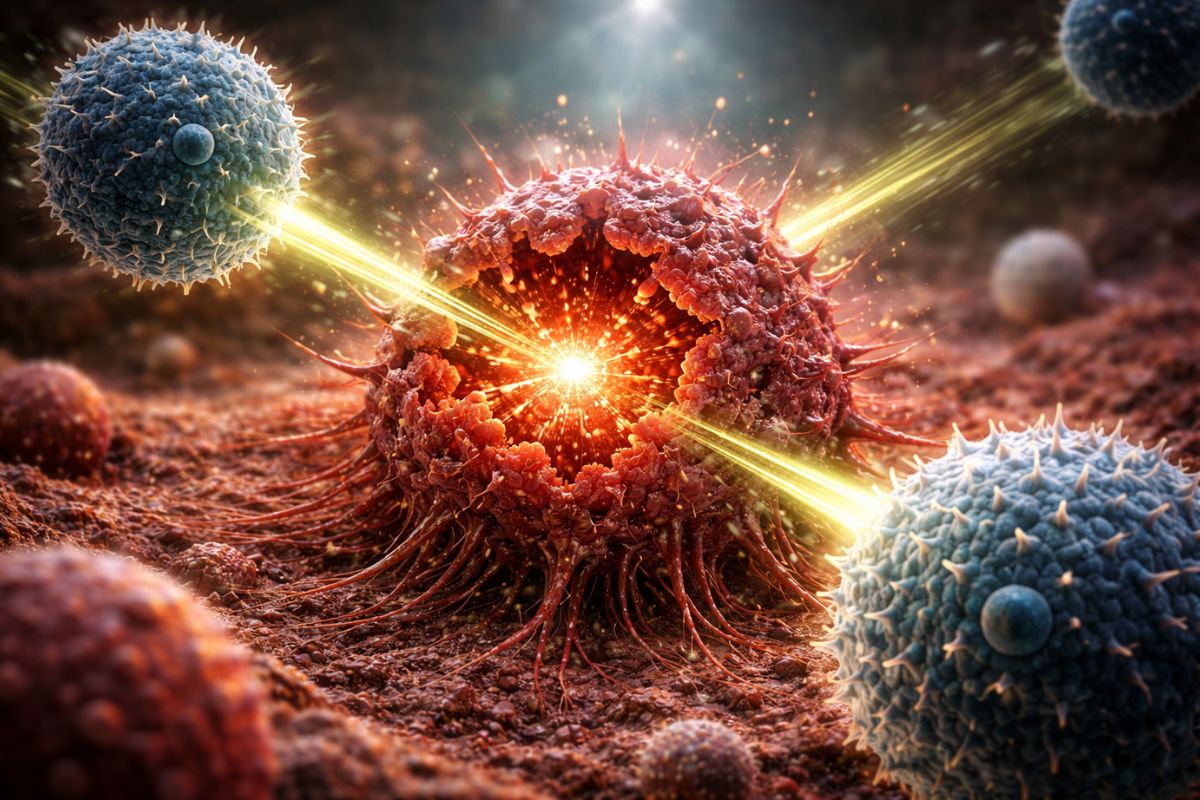
The Brazilian discovery presented by a biomedical professional working abroad proposes a turn in the fight against cancer: instead of hindering the activity of tumor cells, the strategy seeks to push them to a stress threshold that ends in collapse.
The discovery draws attention because it breaks with the logic that dominates much of the current treatments. Instead of trying to directly block the growth of cancer cells, the technique stimulates these cells until they enter an extreme state of overload, lose the ability to continue dividing, and ultimately die.
At the same time, the discovery comes with caution. Although the initial results are promising and the first clinical tests are set to begin in Europe focusing on colorectal cancer, there is still a long way to go before this approach can be considered safe and accessible for patients.
How the discovery arose from an unexpected result
In science, not always an advance arises from a confirmed hypothesis. Sometimes, it appears precisely when the experiment produces the opposite of what was expected. This is what happened during studies on cell division conducted by Matheus Henrique Dias.
-
Storms on Jupiter generate lightning up to 100 times stronger than that on Earth, and data from the Juno spacecraft reveal extreme discharges in the planet’s superstorms.

-
In the depths of the African forest, these rare and terrifying native species dominate rivers, swamps, and treetops with venom, brute strength, lethal teeth, and behaviors that seem impossible in the heart of the wild.

-
The end of total solar eclipses has a deadline: the Moon is moving away from the Earth at about 3.8 cm per year, and in approximately 600 million years, it will no longer completely cover the Sun, ending one of the rarest coincidences in the Solar System.

-
Embraer’s flying car successfully takes off in SP, advances towards certification, has already completed 35 flights, reaches 43 meters in height, and promises to operate with much less noise than helicopters.


During the tests, the team applied a substance that was supposed to stimulate cell multiplication. What appeared, however, was an opposite effect. The cells stopped growing instead of accelerating further. At first, the possibility of error was considered. But, after repeating the experiments, the behavior was confirmed.
This point transformed chance into a line of research. The team realized that cancer cells, which already operate at a high pace, can enter a state of extreme stress when given even more stimulation. This overload pushes the cell to a limit it cannot withstand.
The logic of the technique is to invert traditional fighting
The biggest difference of this approach lies in the reasoning behind the treatment. In many cases, traditional therapies try to slow down or block the functioning of tumor cells. In this new proposal, the path is different.
The technique combines two actions. First, the cancer cell is stimulated to further increase its activity. Then, another agent prevents it from recovering from the stress generated by this excess. The result described by the research is a cellular collapse, as if the cell suffered a biological failure.
The discovery, therefore, does not just seek to attack the tumor from the outside in. It tries to make the cell itself fail due to excessive functioning. This makes the proposal different and helps explain why it has generated so much interest.
Why this could be important against treatment resistance
One of the biggest problems in cancer treatment is resistance. Over time, certain tumors manage to adapt and continue growing even in the face of therapies that previously worked. This reduces the treatment’s effectiveness and complicates disease control.
According to the initial results described in the database, the new strategy showed a lower chance of resistance. Additionally, the cells that survive the process tend to become less aggressive. This detail is relevant because it is not just about killing tumor cells, but also about reducing the adaptation potential of those that remain.
This point could represent an important advance if confirmed in the next stages. In oncology, any approach that can limit resistance is already on the radar as a valuable possibility.
The discovery also tries to reduce damage to healthy cells
Another recurring problem in treatments like chemotherapy and radiotherapy is the difficulty of completely differentiating sick cells from healthy cells. This helps explain why many patients suffer from intense side effects during treatment.
The new approach attempts to act more specifically on the behavior of tumor cells. The proposal is to explore precisely the vulnerability created by the accelerated pace at which these cells already operate. In theory, this opens up space for a more targeted action with less impact on healthy tissues in the body.
It is still early to assert what the real extent of this advantage will be in clinical practice. Nevertheless, the possibility of reducing collateral damage already places the discovery in a very promising position.
The first tests should focus on colorectal cancer
The advance now enters a decisive phase. The first tests with patients are expected to begin soon in Europe, initially aimed at cases of colorectal cancer that no longer respond to conventional therapies.
This stage is important because it marks the transition between experimental results and the attempt to apply them to patients. It is here that researchers begin to observe more precisely how the technique behaves outside the initial laboratory environment.
The discovery gains strength precisely because it is already advancing to this new stage, but this does not eliminate the need for caution. The transition between scientific promise and approved treatment is often long, rigorous, and full of obstacles.
The path to becoming treatment will still be long
Even when research shows strong signs of potential, it still needs to go through several stages before reaching the public. Safety, efficacy, appropriate dosage, and possible adverse effects need to be measured very carefully.
In the case of this discovery, this process is still in its early stages. This means that enthusiasm needs to walk alongside caution. The technique still needs to prove that it works consistently, safely, and reproducibly in different clinical contexts.
This is precisely where the difference lies between a great promise and an available treatment. The fact that the research is already being observed by other laboratories around the world reinforces its potential, but does not automatically shorten the regulatory pathway.
What makes this discovery so different
The most striking point is that the research proposes an inversion of logic. Instead of containing the tumor cell from the beginning, it starts from the idea of pushing it beyond its biological limit. This changes the way of thinking about attacking cancer.
This change is relevant because it shows that science continues to seek paths outside the traditional model. In complex and resistant diseases, innovative solutions often arise precisely when someone decides to look at the problem from another angle.
The Brazilian discovery stands out because it does exactly that. It does not promise miracles, does not erase the complexity of cancer, nor does it eliminate the challenges of treatment, but presents a new strategy to face a disease that continues to be one of the most difficult in medicine.
Real hope, but without shortcuts
The research opens up a concrete possibility of advancement, especially by suggesting less resistance and potentially less damage to healthy cells. This alone would be enough to justify the attention it has been receiving.
But the moment is still one of responsible hope. Cancer remains a complex disease, and each new treatment must go through a long sequence of validations before reaching patients.
The discovery can indeed pave the way for a new therapeutic line in the future. However, this future still depends on tests, confirmation of results, and proof of safety. It is a relevant promise, but still under construction.
In your opinion, do discoveries like this show that the future of cancer treatment may lie precisely in strategies that challenge traditional logic?







Seja o primeiro a reagir!