





 Portuguese
  English
  Spanish
  5 min of reading
  0 comments


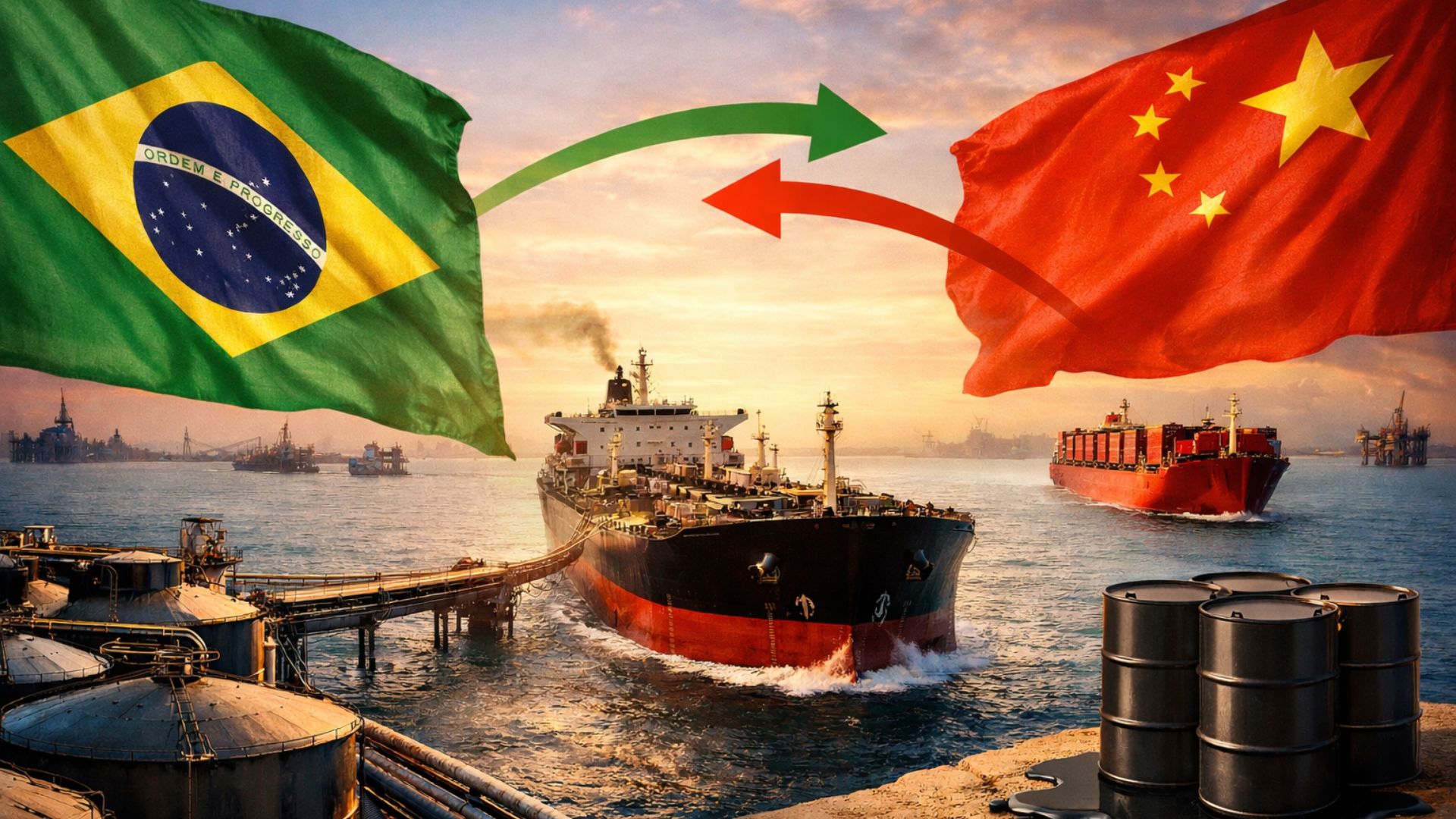
Brazil’s oil exports gain strength with China’s demand, boosting the economy, increasing foreign revenues, and positioning the country as a highlight in the global energy market.
Brazil’s oil exports reached one of the highest levels in recent history, primarily driven by strong demand from China. In March, the Asian country imported about 1.6 million barrels per day of Brazilian oil, a record volume that represented approximately 67% of all national exports during the period, according to information from InfoMoney.
This advance brought the total exported by Brazil to about 2.5 million barrels per day, a growth of 12.4% compared to the previous month and the second highest level ever recorded. The result highlights a strategic moment for the economy, with a significant increase in foreign revenues and strengthening of the country in the global energy market.
At the same time, the international scenario — marked by tensions in the Middle East and changes in trade routes — contributed to reposition Brazilian oil as a reliable alternative for major global consumers.
-
São Paulo has connected its two airports by rail for the first time in history, and now you can travel by train from Congonhas to Guarulhos for just R$ 5.40. However, the journey requires four transfers, takes about two hours, and only operates during a narrow time window that almost no one can use.

-
The savings of Brazilians are depleting: savings accounts recorded the third consecutive month of withdrawals, with over R$ 41 billion taken out in the first quarter of 2026, the largest outflow in an entire year.

-
Curitiba will have a direct flight to Europe starting in July, and for the first time in history, Paraná will have a continuous air connection with Europe, saving three hours of travel for passengers who previously needed to connect in São Paulo.

-
The federal government will cancel Bolsa Família and other benefits for millions of Brazilians who do not update their CadÚnico in 2026, and the new system already cross-references data with the Federal Revenue Service in real time to identify those who are irregular.

China leads purchases and redefines Brazil’s oil exports in the global scenario
The strength of China as the main buyer was decisive for the leap in Brazil’s oil exports. The volume of 1.6 million barrels per day surpassed the previous record of approximately 1.46 million barrels per day, recorded in May 2020.
This growth not only expands Brazil’s presence in the Asian market but also reinforces a strategic trade relationship between the two countries. For the Brazilian economy, the impact is direct, with greater influx of foreign currency and stimulation of the energy sector.
The growing dependence on Chinese demand also reveals an important trend: the shift of the global energy axis towards Asia, which seeks more stable suppliers in light of geopolitical uncertainties.
Tensions in the Middle East open space for Brazilian oil
The increase in Brazil’s oil exports is directly linked to disruptions in the Middle East, especially in the Strait of Hormuz, through which about 20% of the global oil flow passed before the tensions involving Iran.
With logistical difficulties and elevated risks, importing countries began to seek alternatives. In this context, Brazil stood out as a reliable supplier, while China intensified its purchases to ensure energy security.
This scenario generated positive impacts for the Brazilian economy, including:
- Significant increase in external demand
- Reduction of dependence on traditional markets
- Greater appreciation of national oil
- Expansion of exports to new destinations
The global reorganization of energy flows opened a window of opportunity that Brazil was able to seize.

Asia increases presence in purchases and consolidates new dynamics of oil exports
In addition to China, other Asian countries also increased their imports. India, for example, accounted for about 7% of Brazilian exports in March, reinforcing the movement of diversifying suppliers in the region.
This advance demonstrates how Brazil’s oil exports began to meet a broader demand from Asia, which seeks to reduce its dependence on the Middle East. With growing production, Brazil has become a strategic option.
Other destinations also stood out:
- Spain, with about 6.7% of exports
- United States, with approximately 6.1%
Even with this diversification, China’s leadership remains dominant and continues to be the main driver of this growth.

Oil exports reach historic levels and boost the Brazilian economy
The total volume of 2.5 million barrels per day exported in March places Brazil’s oil exports at a level close to the historic record, trailing only March 2023.
This performance reinforces the role of the energy sector as one of the pillars of the national economy. The increase in exports generates a series of positive effects, such as:
- Greater influx of dollars into the country
- Strengthening of the trade balance
- Increase in public revenue
- Stimulus to investments in the oil and gas sector
With China driving demand, Brazil reinforces its position as a relevant supplier in the international scenario.

Decline in diesel imports reveals parallel challenges for Brazil
While Brazil’s oil exports are growing, the country is facing an opposite trend in diesel imports. In March, about 1.05 billion liters were imported, a decrease of 25% compared to February.
This reduction is linked to two main factors:
- Increased global competition for fuels
- Rising international prices
Additionally, shipments that were previously destined for Brazil have been redirected to regions such as Asia, where China and other countries are paying higher premiums. For the economy, this raises a red flag, as the country still relies on imports to meet about 25% of its internal diesel demand.
Changes in suppliers reflect the new geopolitics of energy
The reorganization of the market has also altered the profile of diesel suppliers for Brazil. The United States reduced its share from 8.3% to less than 1% in March, while Russia increased its share from 58% to 75%.
This movement shows how the global dynamics, influenced by China’s demand, directly impacts the Brazilian energy chain. Even with the growth of oil exports, the country still needs to deal with structural challenges in refining and supply.
Another relevant point was the maintenance of exports from countries like Saudi Arabia and the United Arab Emirates, with about 130 million liters each sent to Brazil.
Geopolitical uncertainties may influence the pace of exports
Despite the positive moment, Brazil’s oil exports still depend on external factors. The possible complete reopening of the Strait of Hormuz, following a truce involving the United States and Iran, could ease pressure on Asian markets.
This could reduce the need for alternative imports by China and other countries. Still, experts assess that:
- Asian demand is expected to remain high
- Diversification of suppliers will continue to be a priority
- Brazilian oil will remain competitive
For the economy of Brazil, the scenario is one of opportunity, but also caution in light of global uncertainties.
Brazil strengthens global position and expands prominence in the energy market
The advancement of Brazil’s oil exports marks an important transformation in the country’s role in the international scenario. From a relevant exporter, Brazil is now seen as a strategic supplier, especially for major economies like China.
This new positioning brings significant gains for the economy, including greater revenue predictability and strengthening of trade relations. The combination of increasing production, heated international demand, and geopolitical changes creates a favorable environment for the country. Although there are challenges, the current moment points to a cycle of sustained growth.
By seizing this scenario, Brazil reinforces its global relevance and expands its prominence in a sector that will continue to be essential for economic development in the coming decades.
In light of this rapidly changing global market, one question gains strength: Will Brazil be able to maintain this pace of oil exports even with the possible normalization of routes in the Middle East — or is this advance just a momentary peak?







Seja o primeiro a reagir!