





 Portuguese
  English
  Spanish
  5 min of reading
  0 comments


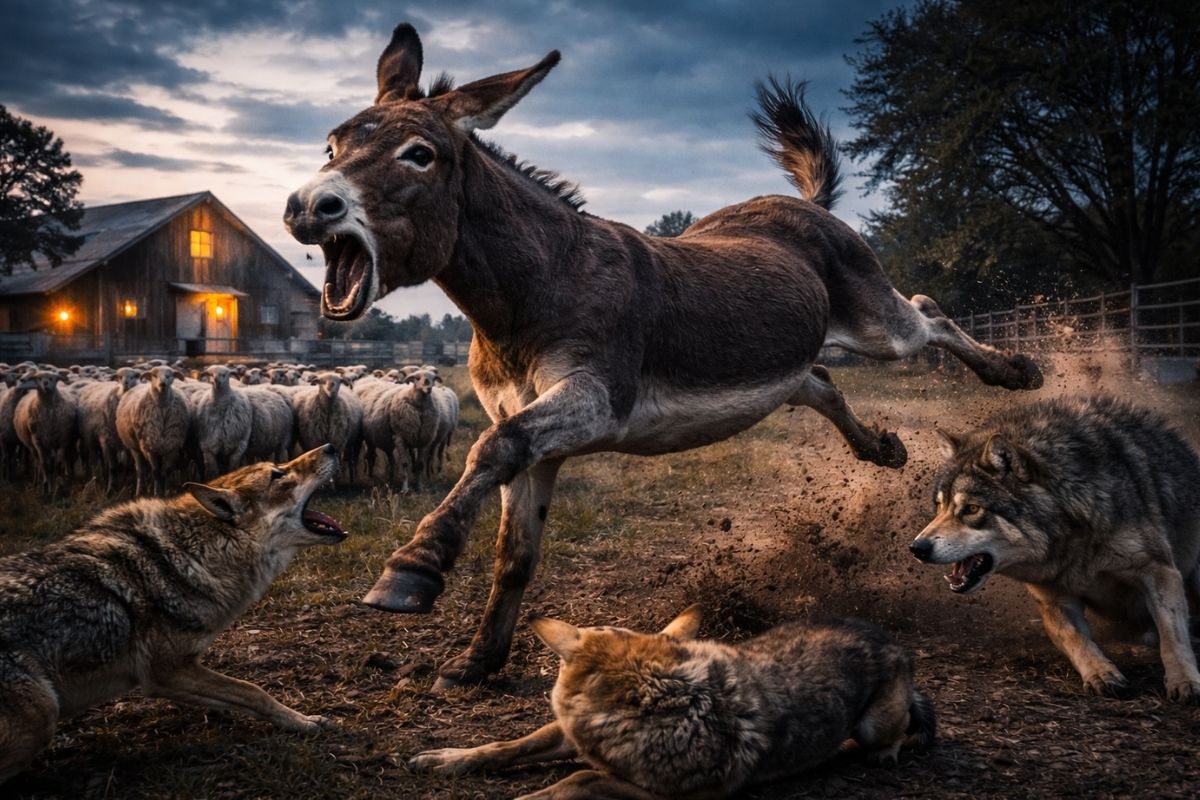
Donkeys in the Field Have Become Herd Guardians with Shouts, Pursuit, and Kicks, Reducing Losses, Requiring Visible Pasture, and Taking the Producer Out of the Cycle of Useless Fences and Sleepless Nights
In the field, donkeys are becoming the most direct response to an old problem: predator attacks on farms. After high fences, weapons, devices, and expensive dogs, many producers realized that a “common” animal can provide constant surveillance, presence in the pasture, and quick reaction.
The logic is simple and practical. Donkeys enter the herd, identify the threat, make noise to alert the producer, and charge when they invade the territory. The result is less night-time chaos and a protection that depends more on instinct than on technology.
Why Donkeys Became Herd Guardians

The central point is behavior.
-
In Mexico, a 3,000-year-old Maya site with the dimensions of an entire city may have been built as a colossal map of the cosmos, created to represent the order of the universe and reveal how this people organized space, time, and rituals.

-
Japan wants to build a solar ring of 10,900 kilometers on the Moon to continuously send energy to Earth.

-
Weighing almost 1 ton, with temperatures of up to 3,000°C, the ability to launch 10,000 fragments within a radius of 1 km, capable of penetrating concrete and melting steel, Turkey’s terrifying bomb emerges as one of the most destructive non-nuclear weapons ever presented.

-
After a submarine disappeared beneath the “Doomsday Glacier,” scientists announce a new monstrous machine capable of operating at 3,000 meters depth to return to the heart of the ice and investigate a threat that could raise sea levels worldwide.


Donkeys have a natural hatred for dogs and relatives, which includes coyotes, foxes, and wolves.
When they see a predator as a threat to the herd, the reaction follows in sequence: loud braying, pursuit, and, in some cases, powerful kicks with their front hooves.
They don’t need to “hurt everyone” like a poorly trained dog.
The focus is territorial.
The predator enters, the donkey reads it as an invasion, and the response comes immediately, loudly, and physically.
What They Do in Practice When the Threat Appears

The data you provided describes a pattern of action that repeats: a bray calls attention, the animal rushes to pressure the threat and may finish with a kick or bite, as donkeys also have strong teeth.
This explains why they function as a “living alarm.”
The producer doesn’t need to be by the pasture all the time.
The donkey gives the first alert, halts the advance, and buys time for the rest of the response.
How Many Animals Can a Donkey Protect
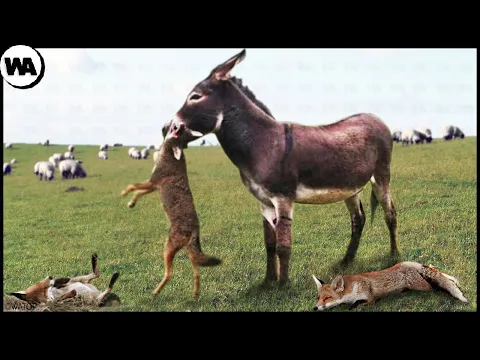

The practical rule presented is clear: one donkey can guard up to 200 sheep or goats, as long as they are in the same area and with good visibility.
This is where the operational limit comes in.
If the pasture is too large, with dense bushes, trees, or rough terrain, the risk increases because predators can hide.
In this scenario, donkeys lose their main advantage, which is seeing the approach before the attack.
When Donkeys Don’t Work and Why
The text points out a clear condition: donkeys need a visible area.
Where visibility is obstructed, predators hide, alerts are delayed, and defense becomes a gamble.
In these areas, the solution often returns to alternatives mentioned in your material: high-voltage electric fences, guard dogs, or a combination of methods.
The message is that donkeys are not a universal solution. They are a strong solution in open and well-defined pastures.
Training, Selection, and the Mistake That Can Lead to Loss
There is training and even selective breeding.
In other words, some donkeys are chosen and prepared specifically for “guard qualities,” and this affects the price.
But there is an important warning: common males can be aggressive without justification and may confuse a newborn with an intruder.
Therefore, the material states that females are better at protection, and the ideal animal should be medium or large to deal with a predator.
Cost and Maintenance Compared to Dogs
The figures from your material lay out the costs clearly.
Donkeys
Purchase between US$ 500 and US$ 800, varying by breed, seller, sex, and guard qualities.
Maintenance between US$ 150 and US$ 200 per year, including food, hoof care, and smaller items.
Feeding can be the same grass as the herd.
Dogs
A purebred shepherd dog can start at US$ 1,000.
Veterinary care, routine, vaccines, exams, and care can range between US$ 700 and US$ 1,500 per year, in addition to food and accessories.
In practice, what drives adoption is the sum: donkeys cost less to acquire and less to maintain, and this shifts the decision for those who operate with tight margins.
Long Lifespan and What That Changes in the Field
The text reinforces an advantage that becomes a definitive argument: donkeys live several times longer than dogs, with some cases reaching up to 60 years.
This changes farm planning because the “guardian” becomes a long-term asset.
There is also a safety observation: it is unlikely they will escape if the fences are in good condition, which reduces the fear of losing the animal or creating problems outside the property.
Intelligence, Memory, and the Myth of the “Dumb” Donkey
You sent an interesting twist: stubbornness appears as self-preservation.
The material also states that donkeys have excellent memory and good learning abilities, citing a 2013 study by The Donkey Sanctuary indicating that they learn and solve problems quickly, in addition to a statement by Nora Matthews from Texas A&M claiming they are smarter than horses.
This matters because a guardian needs to recognize patterns, react, and repeat the right behavior. Donkeys do this consistently, but also with autonomy.
The Texas Case and Why the Model Spread
Your content cites a numerical landmark: US$ 9 million in losses for Texas farmers in 1988 due to predators.
From there, donkeys came into play, even in combination with traps, sirens, propane cannons, and lights.
The most striking data follows: a year later, a ranch in Texas was guarded by 1,800 donkeys.
The interpretation is straightforward: when the stakes are high, the producer picks what works in the pasture, not what looks “pretty” on paper.
In the field, do you think donkeys will become a standard for guarding herds, or will they remain a niche solution, only for those with open pastures looking to cut protection costs?








-

-

-

-

-

24 pessoas reagiram a isso.