





 Portuguese
  English
  Spanish
  4 min of reading
  0 comments


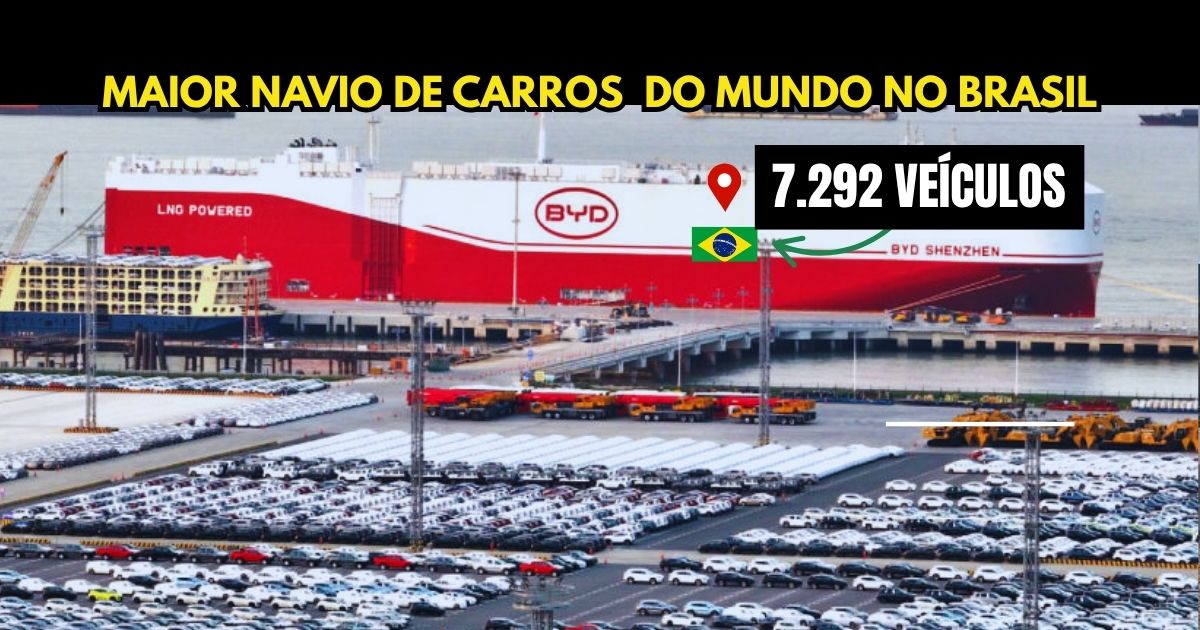
The Arrival Of The Largest Vehicle Transport Ship In The World Brings Thousands Of BYD Hybrid Cars To Brazil, Driving An Unprecedented Operation And Indicating Significant Changes In The National Automotive Market And Its Future Competitiveness.
A historic milestone in the Brazilian automotive sector was recorded on Wednesday, May 28, 2025, with the arrival of the BYD Shenzhen, the largest vehicle transport cargo ship in the world.
The vessel docked at the port of Santa Catarina bringing an impressive cargo of 7,292 hybrid vehicles from Chinese manufacturer BYD, all ready to increase competition in the national market and challenge giants like Toyota, Volkswagen, GWM, and Nissan.
This record landing occurred through the RoRo (Roll-on/Roll-off) system, which allows vehicles to enter and exit the ship via ramps, eliminating the need for cranes and reducing operation time.
-
Home environment can influence the brain, mood, and well-being: studies indicate an increase of up to 15% in productivity, a reduction of 12% in stress with plants, and a direct impact of the circadian rhythm on the 24 hours of the day.

-
A Brazilian millionaire couple restores a farm over 150 years old in the interior of São Paulo and transforms the historic property with Portuguese tiles, antique furniture, and new spaces into a refuge that blends tradition, comfort, and sophistication.

-
Submerged city in a lake in Minas reveals intact streets, preserved vehicles, and houses after more than 60 years, impressing divers.

-
Yellowstone has started to rise again in an area of the caldera, and the movement rekindles fears surrounding the U.S. supervolcano, as scientists monitor the deformation and try to understand what is happening underground.


With a highly complex logistics mobilization, around 130 car-carrier trucks and over 500 professionals participated in the process, which managed to move 100 cars per hour.
The operation, according to information from BYD itself, became the largest of its kind ever recorded in Brazil.

The BYD Shenzhen Ship And Its Unprecedented Capacity
With a length of 219.9 meters and a width of 37.7 meters, the BYD Shenzhen has the capacity to transport up to 9,200 cars and sail at a maximum speed of 18.5 knots, roughly 34.3 km/h.
This is the second time the ship has docked in Brazilian territory, reinforcing the manufacturer’s strategy to expand its presence in Latin America until the local factory in Camaçari, Bahia, is fully operational.
Unloaded Models And Origin Of The Cargo
Among the unloaded models are the Song Pro, the new Song Plus, and the Song Plus Premium, vehicles that combine advanced hybrid technologies and modern design, aligned with the demands of Brazilian consumers seeking sustainable and efficient alternatives.
The vessel departed from the port of Ningbo, in the Chinese province of Zhejiang, which is the fourth largest in China, bringing 5,524 electric and hybrid vehicles from the Dolphin, Song, and Yuan families.
This significant volume of cars highlights BYD’s commitment to strengthen its offering of models that meet increasingly stringent environmental regulations and the expectations of an audience that values innovation and sustainability.

Strategy And Impact Of BYD In The Brazilian Market
The unloading in Santa Catarina is strategic for BYD, which still maintains its industrial operations in the country in expansion, with the Camaçari hub promising to increase local production of electric and hybrid vehicles.
The factory, expected to start operations in 2025, aims to reduce logistical costs and expand the supply for the Brazilian market and neighboring countries.
The impact of the massive arrival of BYD vehicles goes beyond the commercial aspect.
The strategy of the Chinese manufacturer signals a transformation in the national automotive landscape, pressuring traditional manufacturers to accelerate their investments in green technologies and digital innovation.
Industry experts say this movement could accelerate the transition to a fleet with lower emissions of polluting gases and stimulate the development of the necessary infrastructure, such as charging stations for electric vehicles.

Efficient Logistics And Benefits For The Consumer
Moreover, the import model via giant ships, like the BYD Shenzhen, brings significant logistical gains, making the supply chain more efficient and reducing the time between production and the arrival of cars to the end consumer.
This also implies greater price competitiveness, benefiting the Brazilian consumer.
According to analysts, BYD’s aggressive entry into Brazil coincides with a growing awareness of sustainable mobility in the country, reflected in governmental incentives for electric and hybrid vehicles, such as tax exemptions and public policies to stimulate technological innovation.
For now, BYD’s presence does not yet threaten the absolute dominance of traditional leaders, but the scenario is changing rapidly.
The capacity to bring large volumes in a single operation and the diversification of the product line are factors that can indeed redefine the competition among the major automakers operating in Brazil.
Do you think the arrival of BYD will permanently change the Brazilian automotive market? How do you see the future of hybrid and electric vehicles in Brazil? Comment and participate!









-

Uma pessoa reagiu a isso.