





 Portuguese
  English
  Spanish
  3 min of reading
  0 comments


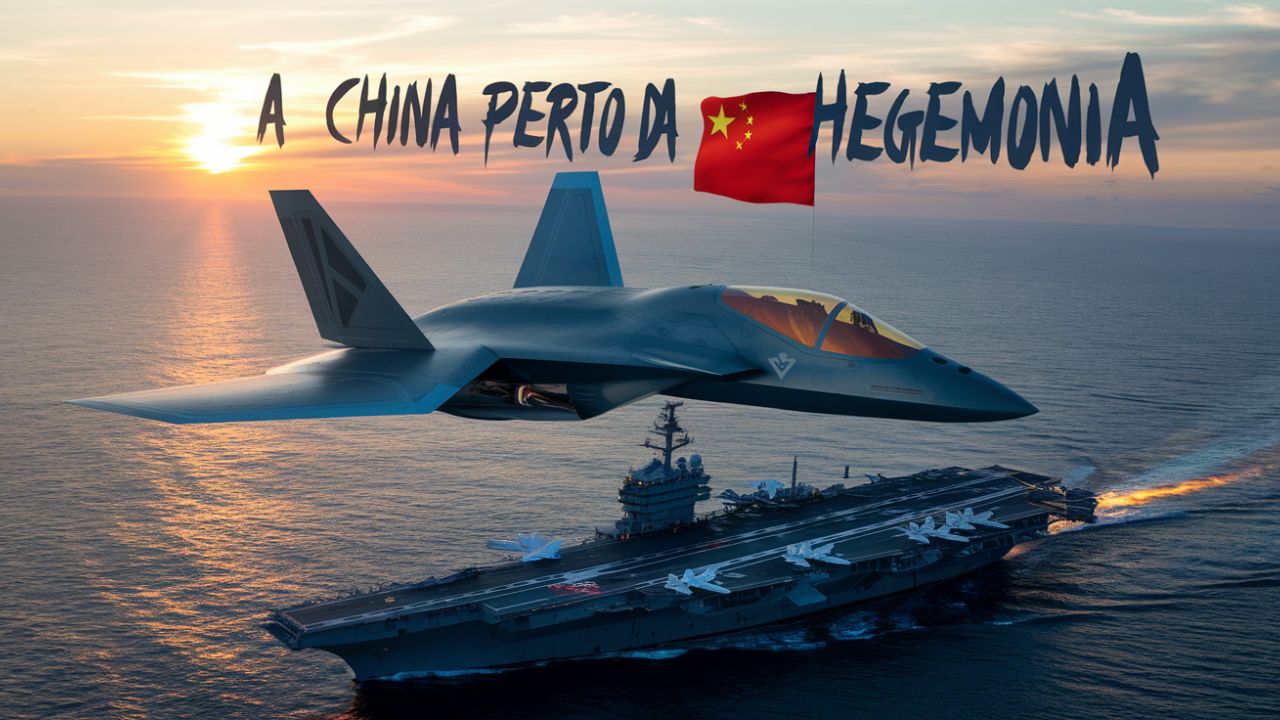
With Prototypes Designed for Aircraft Carriers and Long-Range Missions, China’s 6th Generation Stealth Fighters Promise to Redefine Global Air Superiority by Integrating Tailless Design, Supercruise, and Artificial Intelligence.
The technological advances in military aviation often mark turning points in history. China, in a frantic race to dominate the skies, recently revealed two prototypes of 6th generation stealth fighters, showcasing futuristic tailless designs and distinct objectives. These models not only demonstrate ambition but also place the country in a strategically advantageous position against Western powers.
Twin Prototypes with Distinct Missions
The J-50, designed with a focus on agility, stands out as a potential pillar of operations on aircraft carriers. Its foldable vertical tail and aerodynamic design are not only modern but also practical for landing in confined spaces. This fighter promises to dominate the skies in the first island chain, offering a balance between stealth and maneuverability in aerial combat.

On the other hand, the J-36, larger and more robust, features three engines and a diamond wing configuration. Its priority is clear: long-range missions and high payload. With supercruise capability, it can reach supersonic speeds without the use of afterburners, making it ideal for operations in the second island chain. The third engine indicates potential for stealth bombing in enemy territories.
-
In a flooded well, archaeologists found a 1,700-year-old Roman egg that still contains clear and yolk intact inside the very thin shell.

-
Something is happening around the Earth: Inside the huge explosion of fireballs in 2026

-
A hot air bubble coming from Argentina expands over Brazil, causing thermometers to exceed 38 degrees with a thermal sensation of 40 degrees in late March, affecting 6 states at once.

-
The radish leaf that almost everyone throws away has more polyphenols, flavonoids, and fiber than the consumed root, and a 2025 study showed that the leaf contains compounds that protect the intestine, combat inflammation, and may inhibit the growth of cancer cells.


Cutting-Edge Technological Features of 6th Generation Stealth Fighters
The tailless design of the new fighters is not just visually impressive, but also reduces detection by enemy radars. The foldable tail of the J-50, for example, provides flexibility in close-quarters combat and challenging landings, while the diamond wings of the J-36 offer greater operational range and stability.
Both models incorporate cutting-edge technologies such as supercruise and autonomous systems. This means these fighters can operate as “flying intelligence hubs,” coordinating drones and other attack platforms, ensuring superiority on the battlefield.
The Strategic Weight of China’s New Stealth Fighters
With increasing tensions in the Indo-Pacific, the introduction of these fighters serves as a warning to neighboring nations, especially Taiwan. The range and stealth of the J-36 could pose a direct challenge to American forces in the region, while the J-50 enhances China’s rapid response capability in maritime conflicts.
As the United States develops the Next Generation Air Dominance (NGAD) program, the Chinese advancement with 6th generation stealth fighters threatens to narrow the technological gap between the two powers. Analysts believe that China may achieve aerial superiority sooner than expected, possibly within this decade.
The Race for Global Air Superiority
6th generation stealth fighters are not just war machines; they are key pieces in military diplomacy. They strengthen China’s strategic presence and offer a new approach to deter adversaries in dispute scenarios.
With these advances, China solidifies its position as one of the global leaders in military aviation. The ability to integrate stealth technology with multifunctional capabilities places the new models in the spotlight on the international stage.
The development of 6th generation stealth fighters by China is not just a technological milestone, but also a strategic move that redefines the balance of power in the global landscape. As the world watches, the skies become the next battleground in the quest for military supremacy. After all, those who lead in air dominance control the future of conflicts.










-

-

3 pessoas reagiram a isso.