





 Portuguese
  English
  Spanish
  7 min of reading
  0 comments


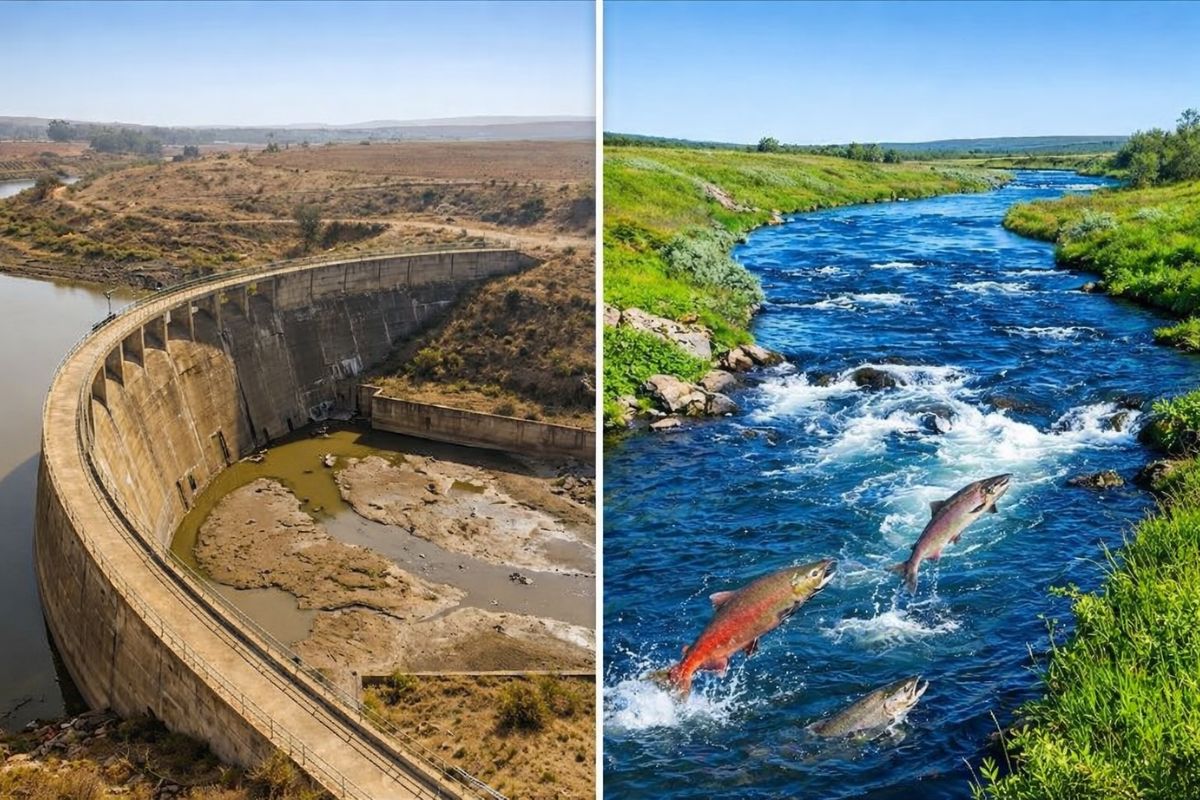
Carmel River Changes Course, Dam Disappears and the Valley Breathes: Radical Diversion Isolates 2.5 Million Cubic Yards of Sediment, Reopens Threatened Fish Routes and Transforms a Seismic Risk into Visible Restoration in California After Years of Impasse.
The removal of the San Clemente Dam completed in California in 2015 was not just demolition: it was surgery on the Carmel River. By opening a diversion channel, California cut the trapped sediment out of the flow, reduced the risk to downstream communities, and restored ecological connectivity to segments blocked for almost a century.
The Carmel River spent decades living a silent contradiction: a dam built to store water ended up becoming a “plug” for sediment and a point of fear for those living below. When a river loses space, it doesn’t stop working: it accumulates, pressures, changes the game.
What seemed like mere aging infrastructure turned into a risk, cost, and ecology equation. The reservoir was gradually filled with material brought down from the slopes, until little useful water remained and a lot of potential instability was left. And when it became clear that removing sediment as if it were “cleaning” was unfeasible, the solution had to address what no one wanted to touch: the river’s path.
-
With over 14 million baskets of earth moved, an ancient North American metropolis built a monumental pyramid of 30 meters and established a city with 20,000 inhabitants nearly a thousand years ago.
-
A 1,900-year-old treasure emerges from a Roman house destroyed by fire and sealed since antiquity in Romania, with coins and metals fused among the ashes.
-
The Brazilian colonial city that stopped in time and shares territory with a rocket launch base.

-
79-year-old woman challenges limits, visits 193 countries in the world after 56 years of planning and reveals the behind-the-scenes of a global journey that few have managed to accomplish.


Why a Dam Becomes a Problem Even Without Breaking

Old dams are often evaluated by two criteria that rarely appear together in the same headline: ability to fulfill the original purpose and structural safety against extreme events. In the Carmel River, both pillars began to fail in sequence. First, the reservoir lost usable volume as sediment accumulated over decades. Then, the safety discussion gained urgency when the structure began to be treated as seismically unsafe.
The risk, there, was not theoretical. A collapse could push water and sediment all at once towards a valley with residences and infrastructure. The danger of a mudslide does not depend on “panic”: it depends on gravity, volume, and response time. When a community lives below a point with massive accumulation, each heavy winter and every tremor changes the perception of what is “normal.”
Furthermore, there is a counterintuitive side effect: as the reservoir fills with sediment, the dam can cease to be a “lake” and become a hydraulic bottleneck. Instead of regulating, it starts to hinder. The river continues trying to follow its course, only to be compressed against a wall that no longer delivers the benefit that justified its construction.
The Sediment That Changed the Project’s Math
The size of the sediment was what stalled conventional solutions. In the Carmel River, it was estimated that around 2.5 million cubic yards had accumulated, a volume large enough to make removal by trucks a logistical nightmare. To handle this, hundreds of thousands of trips would be necessary, with impacts on roads, noise, dust, cost, and time, in addition to the central problem: where to take the material.
The alternative to “release” this sediment downstream was also unacceptable. A river is not a disposal conveyor; it is an ecosystem with its own life and dynamics. Dumping sludge all at once alters turbidity, suffocates gravel beds, reduces oxygenation, and can compromise species that need cleaner water and suitable substrate for reproduction. Sediment, in the wrong place and at the wrong time, becomes an environmental disaster even without “poison.”
And exploding the dam would mean trading one risk for another: the problem would stop being “a contained deposit” and turn into “an uncontrolled discharge.” When all options seem bad, engineering stops looking for the perfect option and starts looking for the viable option, the one that cuts risks in chain, rather than creating new ones.
The River Diversion That Became the Most Unlikely Solution

The turnaround came from a simple observation made on the ground: a narrow rocky ridge separated two drainages, and sediment had concentrated more in one arm of the system than in the other. Instead of fighting to remove all the trapped material, the question that reorganized the problem arose: what if the Carmel River could bypass the deposit, without touching it?

This changes the logic. The focus shifts from “how to remove 2.5 million” to “how to build a new path with control.” The project opened a channel through rock, about 3,000 feet long, diverting the river to connect to San Clemente Creek upstream, so that the sediment remained isolated, out of the main flow. It was less a work against the river and more a work to return the river to a possible course.
The detail that makes this powerful is the proportion. Instead of disturbing everything that had accumulated, the intervention moved about 380,000 cubic yards of earth and rock to open the bypass, a fraction of the total volume trapped behind the dam. The “impossible” shrinks when you stop trying to empty the world and start cutting the problem in the right place.
The Inner Workings: New Channel, Demolition, and Recycled Concrete
Diverting a river is not just digging a trench. It is designing slope, flow energy, bank stability, and behavior in floods. In the Carmel River, the new channel had to be sized to handle winter flows without becoming a point of destructive erosion. A newly diverted river tests the work in the first major storm, and so every meter of alignment matters.
With the diversion operational, came the most symbolic stage: the demolition of the San Clemente Dam, carried out in phases to reduce impacts on the river corridor. The decision to crush and reuse concrete on-site was also strategic. Instead of becoming debris, the material was repurposed to form stepped structures and pools, mimicking small natural falls and helping create passages where fish can rest and overcome gradients.
In the end, the landscape changes its language: “concrete wall” gives way to “river landscape.” The river regains continuity, the valley ceases to carry a concentrated threat, and the surrounding area begins to be treated as recoverable space, not as an “appendix” of the old work.
What Changes When the River Runs Again: Fish, Habitats, and Floods
The reconnection of a river usually has a very concrete marker: who returns first. When the Carmel River regained continuity, routes that were previously blocked began to be used again by migratory species, especially fish that depend on specific stretches for reproduction. The effect is not instantaneous in terms of population, but can be quick in terms of behavior: as soon as there is a path, biology tests the path.
Monitoring numbers over the following years helped show a trend of return in stretches above the old blockage, with counts that grew from the initial level to dozens and then over a hundred at counting points. When a river reopens a passage, it returns possibilities, not guarantees, but possibilities already change the future of species that were trapped.
And there is an even more interesting aspect: in rivers with episodic flood climates, major storms can quickly reshape the bed, redistributing gravel, forming pools, reorganizing banks, and creating microhabitats in weeks. Restoration, in this case, is not “painting”; it is geomorphology in action. The river goes back to doing what it has always done, just without the blockage that interrupted the process.
Safety, Cost, and Legacy: What Other Regions Learn from the Carmel River
The case of the Carmel River became a reference for a practical reason: it simultaneously solved a risk problem for communities and an ecological connectivity issue, without turning sediment into a new crisis. Isolating the deposit out of the main flow was a risk engineering choice because it prevents the material from being reactivated suddenly with each extreme event.
It was also a lesson in structural cost-benefit. The project was expensive, but the relevant comparison is not “expensive versus cheap”; it is “expensive versus unfeasible.” When total removal would require gigantic logistics and create cascading impacts, the concentrated diversion becomes the realistic way to unlock a historical impasse. In river projects, the most efficient solution is not always the most obvious; it is the one that cuts the most risks at once.
Finally, there is a human legacy: works of this type do not come ready-made; they go through decades of debate, authorization, design, and execution. What appears as “before and after” is the visible tip of a long persistence. And when it works, it changes the conversation about other old dams that, in many places, continue to silently accumulate sediment and risk.
The Carmel River did not “return to the past”; it gained a new path to start functioning again. By removing a historic dam and diverting the river to isolate sediment accumulated over decades, California reconnects habitats blocked for almost a century and reduces the risk to an entire valley that lived under threat.
When a river is forced to stop, the cost appears in one way or another: in safety, in biodiversity, in money and in time. The difference is whether the response comes early, with planning, or late, under pressure.
Now I want to hear from you straightforwardly: if there were an old dam in your municipality, would you support a controlled river diversion to reduce risk, even if it changed the local landscape? And have you seen any case where “progress promise” turned into a headache decades later?








-

-

3 pessoas reagiram a isso.