





 Portuguese
  English
  Spanish
  7 min of reading
  0 comments


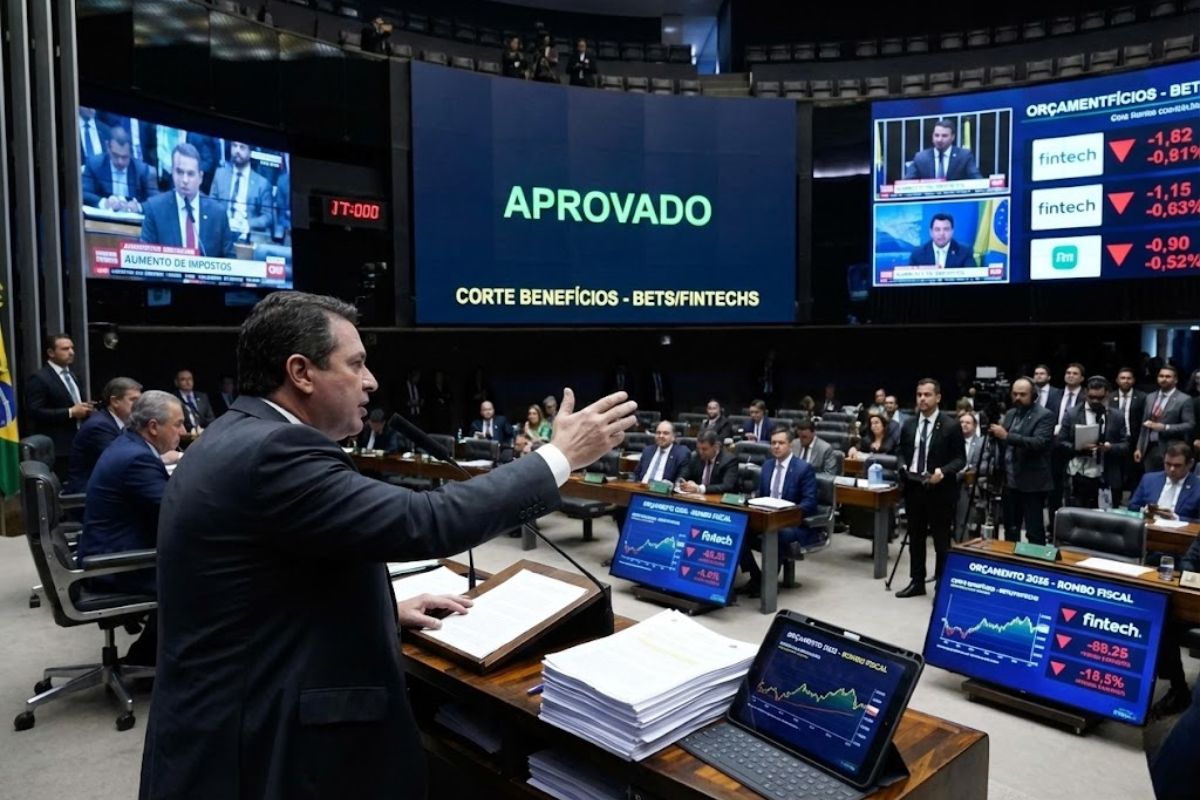
Bill Approved by the Chamber Reduces Federal Tax Incentives by 10%, Increases Taxes on Bets and Fintechs, Raises Income Tax on Equity Interest, Imposes a 2% of GDP Cap on Benefits and Allocates Part of the New Revenue to Social Security and Health Actions in 2026 and Reinforces Fiscal Adjustment.
In 2025, the Chamber of Deputies approved Complementary Bill (PLP) 128/25, which cuts federal tax benefits by 10% across various sectors, increases the tax on bets and fintechs, raises taxation on equity interest, and prepares changes that will mostly take effect starting January 1, 2026.
The proposal, reported by Aguinaldo Ribeiro (PP-PB) at the government’s request, is presented as a central piece to close the budget deficit for 2026, with new transparency rules, a 2% of GDP cap on incentives, and a heavier burden shared among companies, financial platforms, and the online betting market.
10% Cut in Tax Benefits and Focus on Federal Taxes
The approved text mandates a 10% reduction in federal tax benefits and incentives, primarily affecting: PIS/Pasep and PIS/Pasep-Import, Cofins and Cofins-Import, IPI, IRPJ, CSLL, Import Tax, and the social security contribution paid by employers.
-
The Senate approves a bill that criminalizes misogyny, hatred, or aversion towards women, and includes the crime in the Racism Law with a penalty of up to 5 years.

-
Chamber Approves Bill That Allows Pepper Spray for Women Over 16 and Imposes Strict Rules for Purchase, Possession, and Use as Self-Defense

-
Chamber Approves Law to Combat Leucaena, Fast-Growing Plant That Dominates Land and Threatens Native Species in Various Regions of the Country

-
Asset Division: Know What Cannot Be Divided in Case of Divorce


The decrease applies to the so-called tax expenditures listed in the appendix of the 2026 Budget Law or granted by specific regimes.
In practice, the Executive gains leeway to decide where the 10% cut will be applied, as long as the established exceptions are respected.
In presumed profit regimes, for example, the text allows a 10% increase in the final result of the tax base calculation, but only on the portion of gross annual revenue that exceeds 5 million reais.
Programs Affected and Presumed Credits Under Analysis
Potential targets of the fiscal cuts include benefits linked to programs and sectors currently receiving presumed credits.
Included in this radar are the Special Regime of the Chemical Industry, IPI credits for exporters on the purchase of packaging and raw materials, and presumed PIS/Cofins credits, including on imports.
The list cited by the rapporteur includes, among others, credits linked to:
- pharmaceutical products
- goods of animal or vegetable origin
- animal-origin goods destined for export
- flours and vegetable oils
- coffee exports
- citrus exports
- revenue from regular intermunicipal and interstate passenger road transport
Additionally, zero rates of PIS/Cofins for importers of pesticides, fertilizers, and petrochemical naphtha may also face partial reductions.
The main argument is that broad and poorly assessed benefits distort the tax system, favoring private interests without proportional social returns.
Who Is Exempt from the Benefit Cuts
The bill preserves a series of policies considered strategic or protected by the Constitution.
The following are exempt from the 10% reduction:
- constitutional immunities, such as those for religious entities, political parties, and books
- benefits of the Free Trade Zone of Manaus and free trade areas
- products from the national basic basket defined in the tax reform
- benefits for non-profit philanthropic entities
- companies subject to the Simples Nacional regime
- incentives capped by a global ceiling, such as those from the Aldir Blanc Law
- Minha Casa, Minha Vida and Prouni programs
- tax compensations for the granting of free electoral advertising slots
- payroll tax exemption by CPRB
- incentives for industrial policies related to information technology, communications, and semiconductors
Benefits granted for a fixed term to taxpayers who have already fulfilled burdensome counterparties will also not be cut, provided these programs have been approved by the Executive by December 31, 2025.
Products with incentives based on rates expressed in reais per unit (ad rem taxation) are currently exempt from the cuts due to operational control difficulties.
Transparency, 2% of GDP Cap, and Tax Crimes
One of the structural changes is the inclusion of transparency and results evaluation rules in the Fiscal Responsibility Law, requiring that the impact of tax benefits be monitored more rigorously.
If the total of tax incentives exceeds the equivalent of 2% of GDP, the text prohibits new grants, expansions, or extensions of benefits, unless there are compensation measures for the entire duration.
The bill also amends the tax crime law to increase penalties when the offense is related to assets covered by constitutional immunities.
The political message is clear: defrauding taxes in constitutionally protected areas is now seen as an even more serious offense, subject to harsher penalties.
Tax on Bets Increases to 15% and Affects Advertising
To boost revenue, the bill directly adjusts the tax on bets, specifically on fixed-odds betting.
The rate, currently at 12%, rises to 13% in 2026, 14% in 2027, and reaches 15% starting in 2028. Half of this increase will be allocated to social security, and the other half to health actions.
The text also tightens oversight over the betting ecosystem.
Entities will now jointly be liable for owed taxes:
- companies and individuals who advertise unauthorized betting sites
- financial and payment institutions that continue to operate with irregular platforms after formal communication
In practice, those profiting from promoting or moving irregular bets may be liable along with the betting house itself, increasing the legal risk for sponsors and intermediaries.
Higher Equity Interest for Companies
Another significant change affects equity interest, a mechanism used by companies to compensate shareholders with a tax advantage compared to dividends.
The withholding Income Tax rises from 15% to 17.5% on these payments.
Consequently, the government aims to reduce the attractiveness of equity interest as a tax planning tool, bringing the burden on this form of compensation closer to the taxes applied to other operations.
Some business leaders argue that the increase reduces competitiveness and raises the cost of long-term investments, while the government’s base insists on the need to rebalance the system and eliminate distortions.
Fintechs and Financial Institutions Will Pay Higher CSLL
The bill also gradually increases the Social Contribution on Net Profits for financial institutions, with a special focus on fintechs and capitalization societies.
For these businesses, the CSLL rises from 15% to 17.5% until December 31, 2027, and reaches 20% starting in 2028.
Additionally, the 9% CSLL rate increases to 12% by the end of 2027 and to 15% starting in 2028 for organized over-the-counter market administrators, stock exchanges, commodity exchanges, clearing and settlement entities, and other societies classified as financial institutions.
The government argues that highly profitable sectors need to contribute more to fiscal adjustment, while critics warn of potential investment flight risks.
Outstanding Payments and Validity of the New Rules
The rapporteur also revisits a theme already addressed in Complementary Law 215/25 by allowing the validation of unpaid outstanding payments canceled from 2023, with a deadline for settlement until the end of 2026.
The idea is to provide leeway for the completion of works and services with resources already committed but not yet paid.
Regarding the validity, most changes take effect on January 1, 2026. Measures that involve a reduction in tax waiver, an increase in the tax on bets, and an increase in the CSLL, as they alter taxes, depend on the so-called noventena, meaning they will only take effect 90 days after the publication of the new complementary law.
Government Advocates Tax Justice; Opposition Sees Increased Burden and Risk for the Poor
In defense of the text, Mauro Benevides Filho (PDT-CE) stated that around 77% of tax incentives currently have no defined limits and that the project meets a constitutional requirement for control.
For him, the goal is to prohibit new benefits without indiscriminately cutting existing ones, requiring counterparties and results evaluation.
The government leader in the Chamber, José Guimarães (PT-CE), argued that the proposal does not aim to give money for the government to spend, but to ensure the balance of public accounts and prevent cuts in discretionary expenses in 2026.
Meanwhile, the leader of the PT, Lindbergh Farias (RJ), emphasized that the approval of the text is considered a condition for voting on the 2026 Budget.
Among allies, Neto Carletto (Avante-BA) described the changes as a step forward in tax justice, highlighting the importance of the tax on bets and the charges on fintechs to fund policies aimed at the most vulnerable families.
In opposition, Joaquim Passarinho (PL-PA) criticized the fact that the tax on equity interest will have a higher rate than that applied to bets, drawing attention to the impact of the burden on companies investing in the real economy.
Leaders from the PL, Novo, and other opposition members stated that raising taxes drives away investors and tightens the budget of poorer families, as part of the costs tends to be passed on to prices and tariffs.
Members of the Novo party also attacked the speed of the proceedings in the Plenary, arguing that a text with a billion-dollar impact and multiple structural changes in the tax incentive system should be analyzed more thoroughly and transparently.
In the end, the government base won the political dispute surrounding PLP 128/25, but left open a discussion that promises to continue in the Senate and in the productive sector: what is the acceptable limit for cutting benefits, increasing the tax on bets, taxing fintechs while preserving competitiveness and social protection?
Do you think it is fair to raise the tax on bets and cut tax benefits for companies to close the 2026 Budget?










-

Uma pessoa reagiu a isso.