





 Portuguese
  English
  Spanish
  3 min of reading
  0 comments


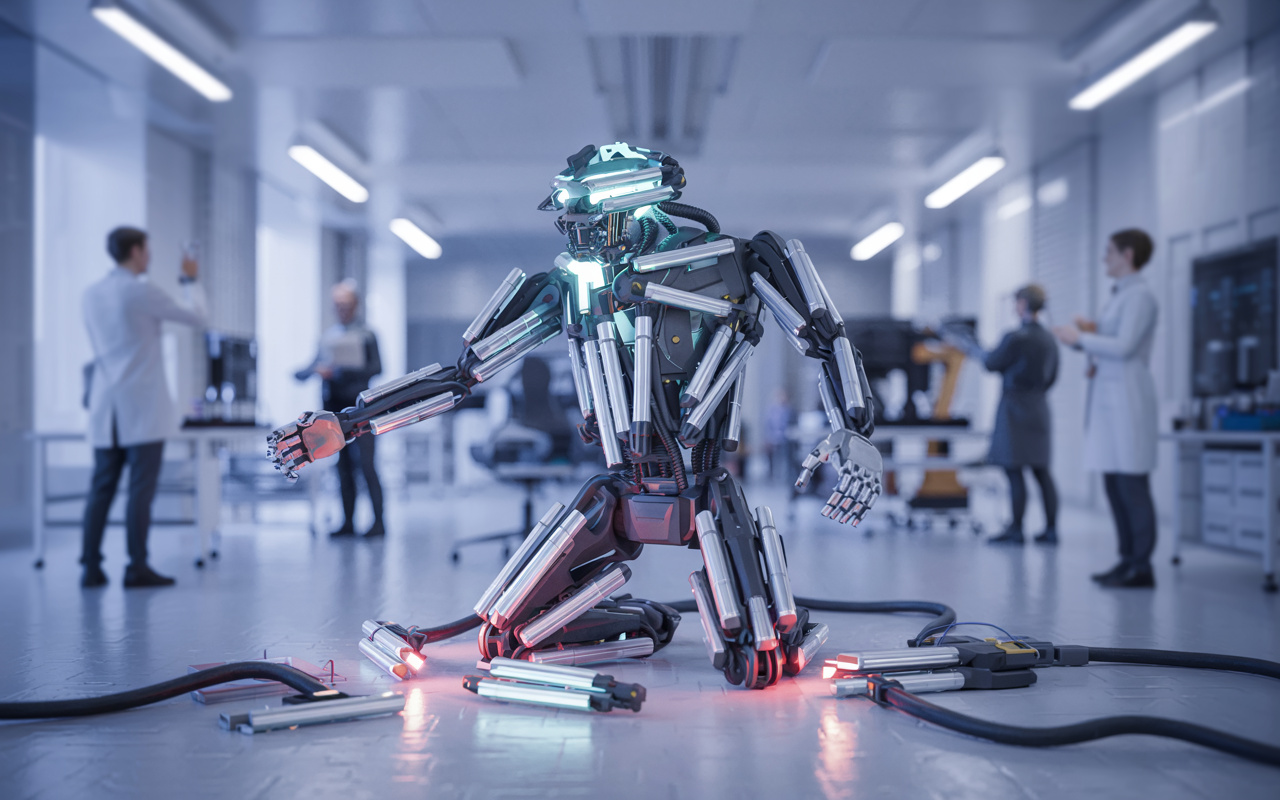
Scientists from the USA Create Modular Robot Capable of Reconstructing Itself by Absorbing Parts from Other Robots. Prototype Promises to Revolutionize Robotics with Adaptive and Sustainable Machines.
Imagine a robot that, when it suffers a malfunction or needs to change shape, simply absorbs parts from other robots around it and continues functioning as if nothing had happened. It sounds like science fiction, but it is already happening in the laboratories of Columbia University in the United States.
There, a group of engineers developed an experimental prototype that grows, changes shape, and adapts to its environment by joining magnetic modular pieces — as if it were a kind of “cannibal robot.”
The Robot That “Devours” to Evolve
The basis of the invention is a simple structure, similar to a stick, called Truss Link. Each stick has magnets at the ends and can connect with others in an intelligent and strategic way. When these modules come together, they create robots with different shapes and functions.
-
With a cost per shot close to zero, the DragonFire laser could change naval warfare in 2027 and provide British ships with nearly unlimited defense against drones.

-
A British startup creates tires that generate electricity in electric vehicles when passing over potholes, speed bumps, and cracks.

-
Scientists have created robots made with living cells that have their own nervous system, swim on their own, explore the environment, and self-organize without any genetic engineering, and now they want to do the same with human cells.

-
Students create a solar-powered ambulance that operates without a plug, without fuel, and still keeps medical equipment running in remote areas.




The most interesting part? These connections are not fixed. The machine can dismantle old parts, attach new pieces, and transform itself based on the task it needs to perform. As if it is assembling its own body in real time.
According to the creators, the concept was inspired by nature: while the “mind” of robotics (software and AI) evolves rapidly, the “bodies” of robots remain rigid and difficult to adapt. The idea is to make robotic bodies as flexible and regenerative as those of living beings.
Grows, Changes, and Even Replaces Worn Parts
In laboratory tests, researchers demonstrated that the modular robot is capable of:
- Crawling like a snake, stretching and shortening its body precisely;
- Changing direction, creating joints with new modules;
- Replacing a discharged part with a new one, maintaining continuous operation;
- Increasing its speed and performance by incorporating pieces that enhance its structure.
In one simulation, by adding a new segment to the triangular shape of the machine, it increased its speed by over 60%. All of this without stopping movement — just connecting a new stick in the middle of the process.
What This “Cannibal Robot” Could Do in the Future?
Although it may seem like a tech toy for now, the potential is immense. The creators themselves suggest applications such as:
- Rescue Missions, where robots could form bridges or unite to clear debris;
- Assembly of Antennas or Temporary Structures, adapting to the terrain;
- Space Exploration, creating machines that build themselves using local resources;
- Circular Economy in Robotics, with reused parts among different equipment.
With the addition of embedded artificial intelligence, these robots will be able to organize themselves and act like a colony of intelligent organisms, assembling cooperative structures without relying on humans for every decision.

It Is Just the Beginning
The technology is still in the laboratory phase. The tests were conducted with identical parts, under controlled conditions, and the challenge now is to make the robots recognize and connect with different modules or components from other real machines.
Even so, the progress is promising: it represents a paradigm shift. Instead of creating robots for a single task and discarding them when they break, we may be moving towards machines that repair, evolve, and adapt on their own — almost like living organisms made of metal and code.
It may seem strange to call such an advanced technology “cannibal,” but the nickname makes sense: these robots literally survive and evolve by absorbing parts from other similar ones. It is a discreet revolution, but it paves the way for a future where robotics will be more organic, adaptable, and sustainable.







-

-

3 pessoas reagiram a isso.