





 Portuguese
  English
  Spanish
  4 min of reading
  0 comments


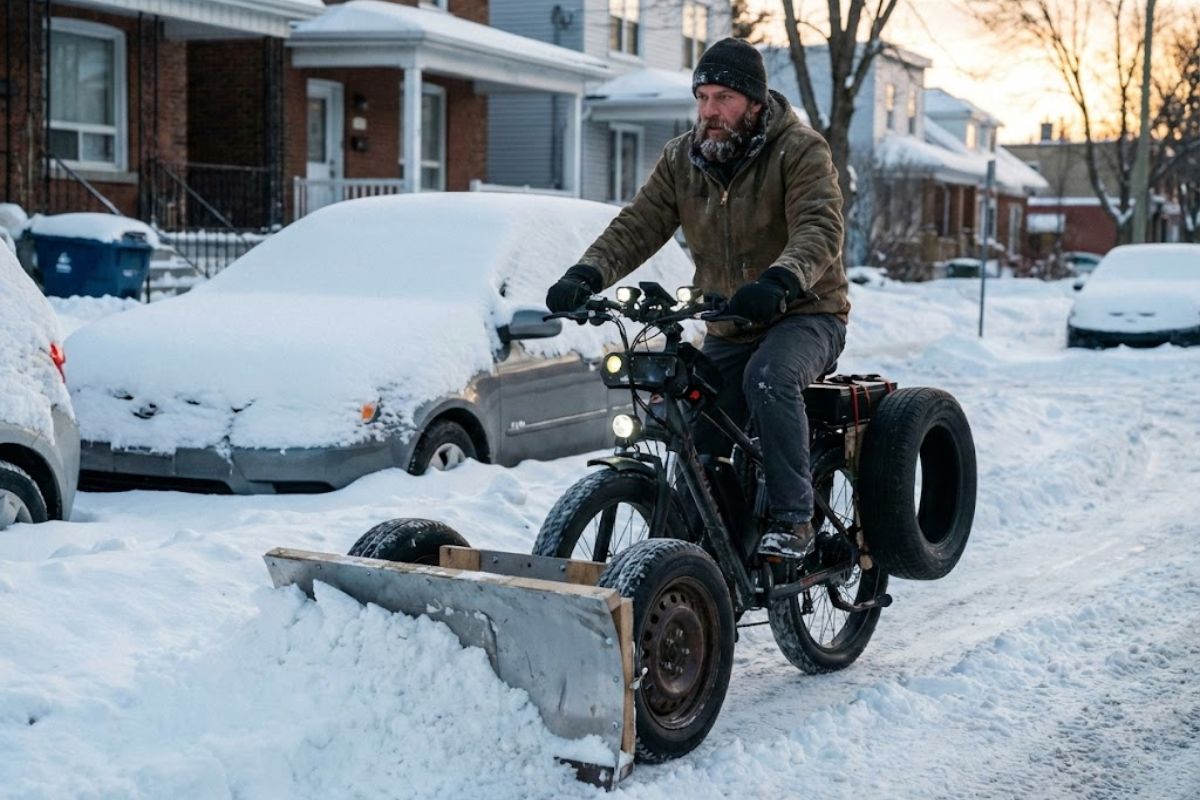
In Victoria, British Columbia, a technician who also works with electric bikes adapted his own bike with a front snow plow, tested two versions, cleared paths on snow-covered streets, and became a sight of collective wonder, while reigniting the debate about clean bike paths, extreme winter, and individual initiative throughout the city.
The bicycle has ceased to be merely a means of transportation and has become an emergency tool in Victoria, British Columbia, when a resident attached an improvised snow plow to the front and began to clear paths where cars, cyclists, and pedestrians were stuck in accumulated snow.
Known for doing appliance repairs and also for manufacturing electric bikes at Sustain-A-Wave, he explained that the idea was born out of the difficult routine on winter days, when waiting for official snow removal meant delays, blocked movement, and little predictability for working and getting around the city.
From Home Experiment to an Unexpected Urban Scene
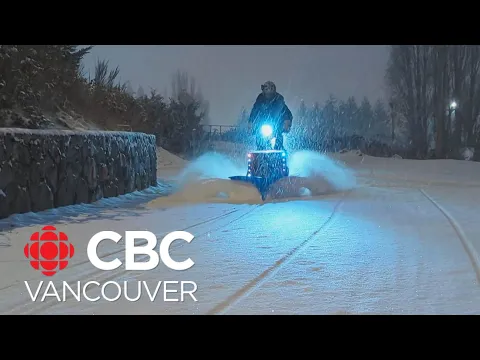

The account began with a previous attempt: last year, he fixed a simple plow to the front of the bike to see if he could push snow. He described that it worked better than expected, which opened the door for a second version, with a more divided design and apparently more efficient at keeping the flow of snow to the sides during pedaling.
-
China creates hypersonic engine that can make planes and missiles fly more than 6 times the speed of sound with less weight, more range, and without system change.

-
Mysterious object on Mars divides NASA and Harvard after Curiosity image reignites suspicions about what was really found on the planet.

-
Giant structures 14 meters beneath Egypt are revealed by satellites and expose a millennia-old secret buried in Buto.

-
Children have been making clay pieces for 15,000 years in Southwest Asia, and fingerprints preserved on 142 ornaments helped archaeologists prove this.


In the most recent test, the experiment left the realm of curiosity and hit the streets. The cyclist reported that he left without planning a long route, but continued because the system was responding well. In no time, drivers began to observe in astonishment, pedestrians laughed, and the bicycle with the snow plow became a rare episode of improvised mobility functioning before everyone’s eyes.
How the Snow Plow Bike Appears to Have Worked in Practice
From what was described, the principle is straightforward: the bike moves forward and the front blade displaces the snow, creating a “wave” to both sides. In an urban environment, this can be enough to open an immediate passageway in sections where the main issue is the superficial accumulation that blocks wheels, shoe soles, and circulation rhythm. With electric assistance, the cyclist’s effort tends to be more manageable on heavy surfaces.
Technically, this type of adaptation depends on a balance between traction, speed, and control of the handlebars. If there is hard ice underneath, very compacted snow, or a steep incline, efficiency drops and risk increases. Safety factors also come into play: longer braking distances, reduced visibility, and a need for heightened attention to pedestrians and other cyclists. Functioning in one stretch does not mean equal performance throughout the city.
What This Case Reveals About Winter, Bike Paths, and Public Response
The scene draws attention because it highlights a daily conflict: when snow accumulates, the operational priority usually goes to vehicle lanes, while bike routes and short trips are often sidelined. In practice, this increases time, uncertainty, and reduces options for those who rely on bikes for work, providing services, or simply crossing neighborhoods with autonomy.
At the same time, the case should not be seen as a replacement for public management by individual effort. Personal innovation addresses urgency, not the entire system. Winter cleaning involves scale, ongoing planning, and priority criteria that consider motorists, buses, pedestrians, and cyclists. The episode in Victoria reinforces this very discussion: when the average person needs to “become their own plow,” there is a clear signal of an urban bottleneck to be addressed.
How Much This Solution Solves, How Much It Costs, and What Remains Open
Regarding concrete results, the visual impact was evident: he cleared paths, traveled through streets, and even decided to plow his own route when heading to downtown. However, no formal numbers were presented regarding the cost of the adaptation, average cleaning time per stretch, total covered area, or capacity in different types of snow. Without this data, the proper reading is of a promising spot solution, not a universally validated model.
Practical questions remain for any replication: how to standardize the attachment of the blade to the bike, what is a safe usage limit on shared pathways, and what local rules allow or restrict this type of adaptation. Still, the case leaves an objective message: when infrastructure fails during critical times, the bicycle can be converted into a tool for immediate public utility, provided there is technical criteria and responsibility in execution.
The story of the Victoria resident shows that the bicycle, in extreme context, can surpass its transport function and act as a direct response to a real urban problem. Improvisation does not erase the obligation of public planning, but highlights a demand that is already in the streets: winter mobility needs to include those who bike and walk, not just those who drive.
In your city, on days of heavy rain or mud, have you ever seen someone adapt a bike or another light vehicle to solve a collective problem that the government took long to address? What kind of local solution would you consider useful, safe, and realistic for your neighborhood?






-

Uma pessoa reagiu a isso.