





 Portuguese
  English
  Spanish
  5 min of reading
  0 comments


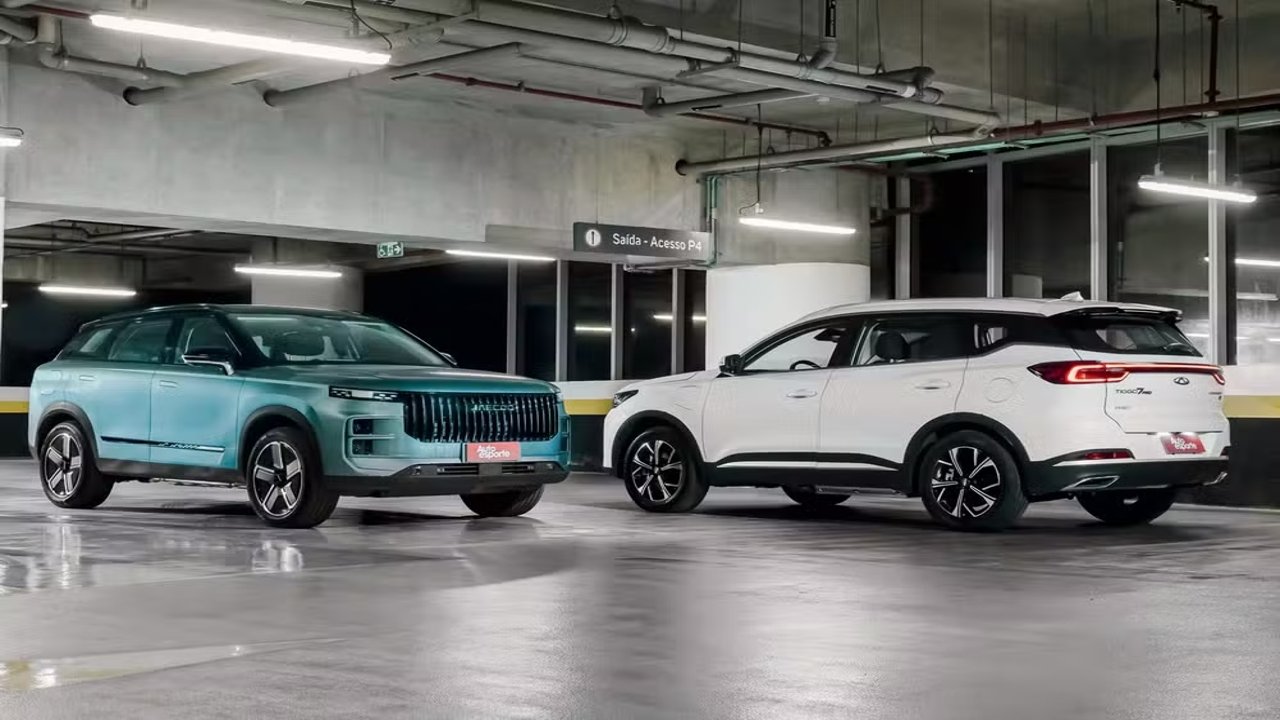
Manufactured in China and Equipped with Plug-In Hybrid Engines, the Tiggo 7 PHEV and Jaecoo 7 PHEV SUVs Share Origin and Platform, but Deliver Quite Distinct Experiences Behind the Wheel
The hybrid SUV market is consistently growing in Brazil — driven by consumers seeking economy and technology. In this scenario, two new models stand out: the Caoa Chery Tiggo 7 PHEV, sold for R$ 219,990, and the Jaecoo 7 Prestige PHEV, launched for R$ 249,990.
Both are produced in Wuhu, China, and share the same technical base: the T1X platform, used by various brands of the Chery group.
But there is one important difference: the Jaecoo 7 is operated by Omoda Jaecoo, a company that marks Chery’s direct return to Brazil, now competing with Caoa Chery, its former production and distribution partner in the country.
In other words, what was once a collaboration has now turned into direct competition — and this “family duel” promises to redefine the standard for Chinese hybrid SUVs in Brazil.
-
Less than a Tera TSI, up to 710 km of range and charging in 9 minutes: the new BYD Song Ultra expands the Chinese brand’s bet on increasingly faster, more technological, and competitively priced electric SUVs.

-
With a 1.0 engine producing 75 hp and costing less than R$ 70,000, Fiat’s car returns to the podium as the cheapest in the country; a temporary promotion for the 2026 Like version reduces the price of the Fiat Mobi.
-
With a mild hybrid system of 48 V, 176 hp and a price of R$ 175,990 in the Sahara version, the new Jeep Renegade changes mostly on the inside, improves slightly in fuel consumption, and remains almost the same car.
-
With a 293.5 cm³ engine and a range of up to 400 km with a 14.1-liter tank, the Honda CB 300F Twister 2026 has up to 24.7 hp, an initial price of R$ 25,150, and already exceeds R$ 29,000 in the Fipe Table.
Design: Modernity Versus Tradition
The Jaecoo 7 PHEV bets on a technological and sophisticated look. Its narrow and pixelated headlights, large front grille, and elegant body lines reflect a modern style with a futuristic appeal. The SUV also incorporates interconnected taillights and details that bring it closer to premium brands.
On the other hand, the Caoa Chery Tiggo 7 PHEV features a more conservative design. The brand attempted to update it with a redeveloped grille with small diamonds and a new bumper, but the style still resembles models from previous years. Nevertheless, it maintains a robust and balanced appearance.
Despite the structural similarities, there are slight dimensional variations:
- Jaecoo 7: 4.50 m in length, 1.86 m in width, 1.67 m in height, and 2.67 m in wheelbase.
- Tiggo 7: 4.51 m in length, 1.86 m in width, 1.70 m in height, and the same wheelbase.
The main practical difference lies in the trunk: the Jaecoo 7 has 340 liters, while the Tiggo 7 offers 475 liters — a significant advantage for those prioritizing space.
Interior and Finishing: Two Styles, Two Proposals
Inside the cabin, the contrast is evident. The Jaecoo 7 raises the finishing standard for the category, with a horizontal dashboard, soft materials, and a combination of rubber, leather, and brushed steel. The highlight is the 14.5-inch vertical multimedia center, with a modern and fluid interface reminiscent of Apple’s iOS system.
The set impresses with its resolution and speed, as well as the 360° camera, which displays sharp and colorful images. The model also offers a panoramic sunroof, LED ambient lighting, and fixed menus for easy access to air conditioning functions.
The Tiggo 7, on the other hand, adopts a simpler yet functional approach. The cabin uses good quality materials, such as rubber and synthetic leather, although in lesser proportion. Its 12.3-inch multimedia center is linked to the digital dashboard, but it suffers from low screen brightness.
The model stands out for keeping physical rotary buttons on the air conditioning, something valued by those who prefer manual controls. However, the small auxiliary screen that displays temperature and ventilation reveals an outdated design.
Hybrid Powertrain: Technical Similarities, Different Performance
Under the hood, both SUVs share 1.5 turbo gasoline engines, but there are crucial differences in the type of injection and electrical system.
The Jaecoo 7 uses direct injection and features a front electric motor powered by an 18.3 kWh battery, delivering a combined power of 339 hp and 52 kgfm of torque.
The Caoa Chery Tiggo 7, in turn, has multipoint injection and a slightly larger 19.3 kWh battery that powers its electric motor. This setup reaches 317 hp and 56.6 kgfm of torque.
Despite the lower power, the Tiggo 7 surprises in performance: it accelerates from 0 to 100 km/h in 6.4 seconds, compared to 7 seconds for the Jaecoo 7.
In the 1,000-meter tests, both completed in 27.2 seconds, but the Jaecoo reached 186 km/h, surpassing the Tiggo 7’s 178 km/h.
Both use a DHT automatic transmission that combines the forces of the electric and combustion engines, providing smooth shifts and good urban efficiency.
Fuel Consumption and Range: Urban Efficiency and Balanced Highway Performance
According to Inmetro, the Jaecoo 7 can travel 70 km in electric mode, while the Tiggo 7 reaches 63 km.
In instrumented tests:
- Jaecoo 7: 28.6 km/l in the city and 17.9 km/l on the highway.
- Tiggo 7: 34.4 km/l in the city and 15.8 km/l on the highway.
The result indicates different profiles: the Tiggo 7 is more efficient in urban use, while the Jaecoo 7 consumes less on the highway.
Charging also distinguishes the two models.
The Jaecoo 7 supports fast charging at 40 kW (DC) and 6.6 kW (AC), allowing it to go from 20% to 80% in just 20 minutes.
The Tiggo 7 accepts 7 kW (AC), with no support for fast charging — a reflection of an older project.
Driving and Embedded Technology
In driving, both SUVs demonstrate similar behavior: light steering, quiet operation, and high comfort.
However, the difference lies in the assistance systems: the Jaecoo 7 offers more modern features, such as autonomous braking and lane-keeping with more precise operation.
The Tiggo 7 also has these functions, but its system is from an earlier generation, with less refined responses.
Verdict: Two Competent SUVs, but with Distinct Audiences
The Caoa Chery Tiggo 7 PHEV stands out for its competitive price, larger trunk, established dealership network, and excellent urban efficiency.
In contrast, the Jaecoo 7 PHEV bets on modern design, superior finishing, greater electric range, and fast charging, offering a more technological and refined experience.
In the overall comparison, the Jaecoo 7 wins for innovation and balance between performance and sophistication, but the Tiggo 7 remains one of the most rational options among hybrid SUVs available in Brazil.
And you, driver? Would you pay more for the technology and finishing of the Jaecoo 7, or would you choose the Tiggo 7 for its price and interior space?
Leave your opinion in the comments.







Seja o primeiro a reagir!