





 Portuguese
  English
  Spanish
  4 min of reading
  0 comments


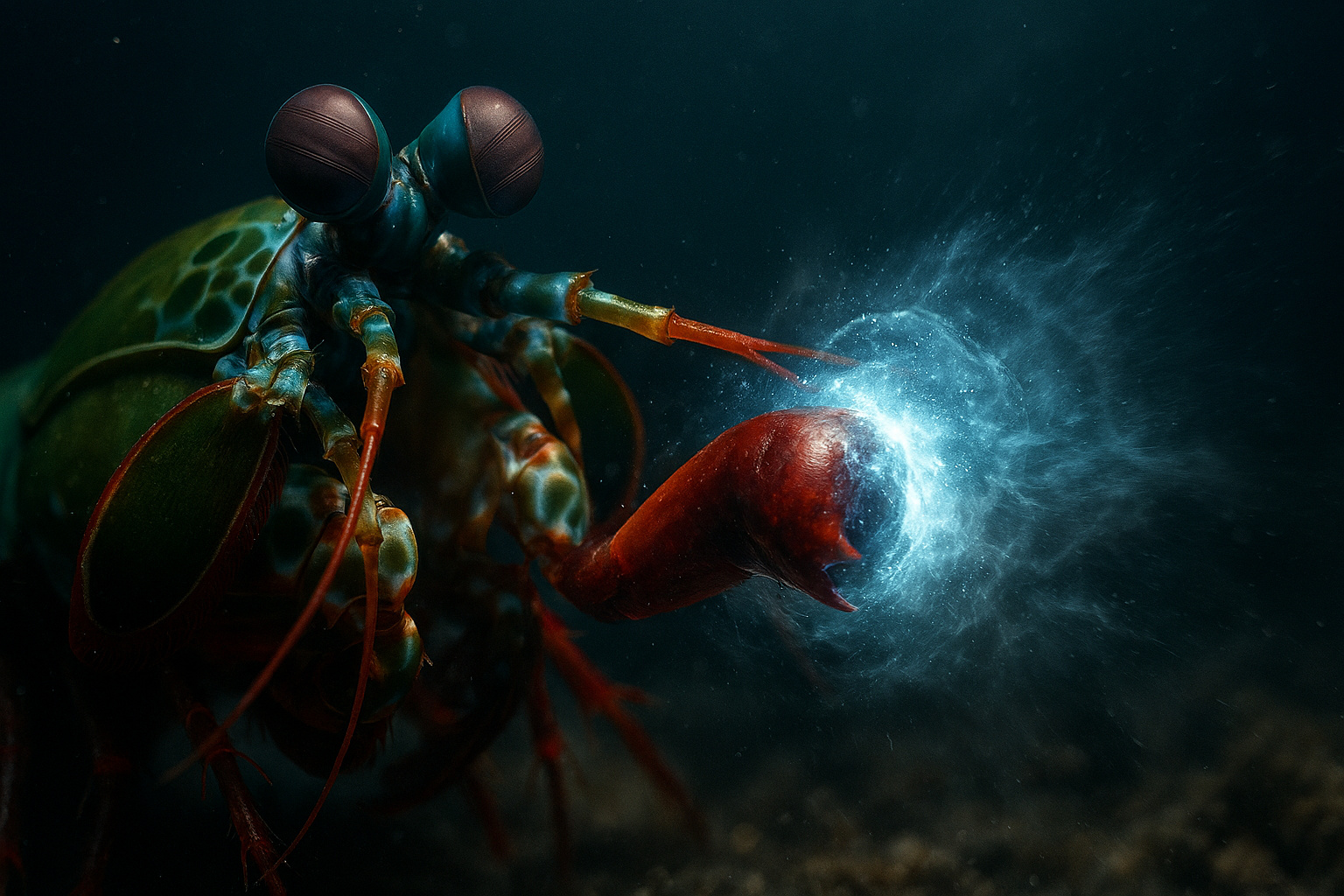
With Ultra-Fast Strikes Creating Shockwaves and Subaquatic Light, the Mantis Shrimp Has the Most Powerful Attack in the Animal Kingdom; Understand How This Is Possible.
The mantis shrimp, despite its harmless name, is far from a common crustacean. Found mainly in tropical reefs and coastal areas of the Indo-Pacific, this small animal — many species do not exceed 15 to 18 centimeters — houses one of the most extreme attack mechanisms ever studied by biology and physics. Its “punch” is not only fast: it involves extreme acceleration, forces capable of breaking extremely hard shells, and a rare physical phenomenon known as cavitation, something that typically only occurs in ship propellers, torpedoes, or industrial equipment.
The scientific impact of this discovery was so great that the mantis shrimp became the subject of study in areas far beyond zoology, influencing research in materials engineering, robotics, and even weaponry.
The Fastest Strike in the Animal World
The attack of the mantis shrimp occurs in about 0.002 to 0.003 seconds. For comparison, a human blink takes approximately 300 milliseconds — over a hundred times slower.
-
A mother who worked as a recycler took money from her own food to put credit on her daughter’s broken-screen cell phone; now Débora has been accepted into medical school at two universities and wants to save hearts in the operating room.

-
A property that once had more than 1,000 hectares now operates with 73 hectares and invests in coffee, cattle, photovoltaic energy, and hydroponic corn to prove that a small farm can also be profitable.

-
Four thousand PET bottles became a 24m² house in the interior of São Paulo, as ten students proved that it’s possible to build a home from floor to ceiling with recycled plastic, spending 30% less than a brick construction.
-
Without ATMs, with social networks blocked and travel controlled by the government, Eritrea challenges the modern world and reveals why it is called the “North Korea of Africa.”





The speed of the appendage movement, known as the “club” or “hammer”, can exceed 20 meters per second over a very short distance, generating accelerations estimated at over 10,000 times the force of gravity.


In terms of energy, laboratory studies have shown that the force released on impact is sufficient to break crab shells, mussels, and even extremely resistant calcified shells, something that much larger predators would have difficulty doing. This capability gives the mantis shrimp access to prey that virtually no other animal of its size can exploit.
Cavitation: When Water “Explodes”
The most impressive aspect of the attack is not just the direct impact. When the mantis shrimp delivers the strike, it accelerates the surrounding water so violently that it creates a low-pressure bubble.
This bubble collapses almost instantaneously, producing a shockwave, a spike in temperature, and even a brief flash of subaquatic light, a phenomenon called sonoluminescence.
This implosion generates a second shock on the prey, independent of the initial physical contact. In other words, even if the strike does not directly hit the target, the resulting shockwave can be enough to stun, injure, or kill the prey.
That is why scientists compare the released energy to impacts equivalent to those of small caliber projectiles, such as .22, obviously on a subaquatic and localized scale.
Two Types of Mantis Shrimp and Different Strategies
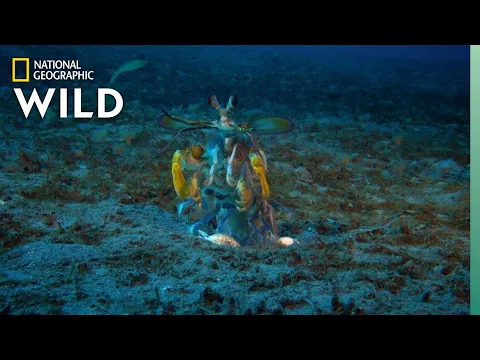
There are two main groups of mantis shrimp, classified by the shape of their front appendages. The so-called “smashers” have rounded and massive clubs, designed to crush hard prey like mollusks and crustaceans. On the other hand, the “spears” have long and pointed appendages, used to pierce soft-bodied fish with extreme precision.
The most famous group is the smashers, precisely because they are responsible for the strikes that generate cavitation and caught the attention of the scientific community. These animals generally live in burrows in reefs and attack from short distances, using quick and repeated ambushes.
A Biological System That Challenges Engineering
One of the biggest mysteries behind the mantis shrimp is how its body withstands such force without destroying itself.
The answer lies in the microstructure of the club’s exoskeleton. Research has revealed that it is composed of highly organized layers of mineralized chitin, arranged in helical patterns that dissipate energy and prevent the propagation of cracks.
This natural design has inspired studies for the development of ultrasturdy materials used in helmets, lightweight armor, and impact components. The mantis shrimp, in this sense, has become a true living laboratory of advanced engineering.
Complex Vision and Perception of the Environment
In addition to its absurd strength, the mantis shrimp is also known for possessing one of the most complex visual systems in the animal kingdom.
Some species have up to 16 different types of photoreceptors, while humans have only three. This allows for the detection of different wavelengths, including ultraviolet and polarized light.
Although this vision does not necessarily mean greater clarity, it offers advantages in rapid pattern recognition, communication between individuals, and identification of prey and rivals in visually complex environments like coral reefs.
Why This Animal Changed Modern Science
The study of the mantis shrimp has gone beyond biological curiosity. Its attack mechanisms are analyzed by physicists interested in cavitation, by materials engineers seeking more resistant structures, and by biomechanics researchers trying to understand how biological systems can operate so close to physical limits without failing.
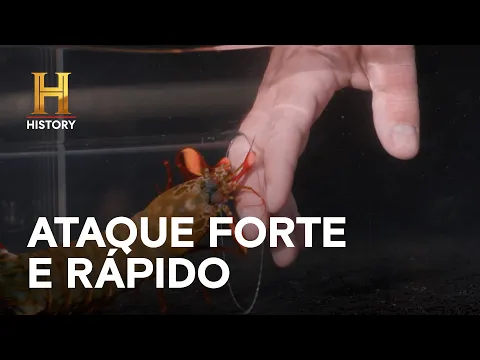
In laboratory tests, it has even been observed that these crustaceans can break aquarium glass when stressed, something that reinforces the magnitude of energy involved in their strikes.
Small in Size, Colossal in Impact
The mantis shrimp proves that strength is not necessarily linked to body size. Just a few centimeters long, it generates impacts, accelerations, and physical effects that rival industrial and military systems.
Not surprisingly, it is often cited as the holder of the most powerful strike relative to size in the entire animal kingdom.
More than an exotic curiosity, this crustacean represents an extreme example of how evolution can efficiently explore physical limits in an elegant and brutally effective way. For science, it is a reminder that some of the greatest secrets of engineering are still hidden in the most improbable organisms on the planet.


Be the first to react!