





 Portuguese
  English
  Spanish
  6 min of reading
  0 comments


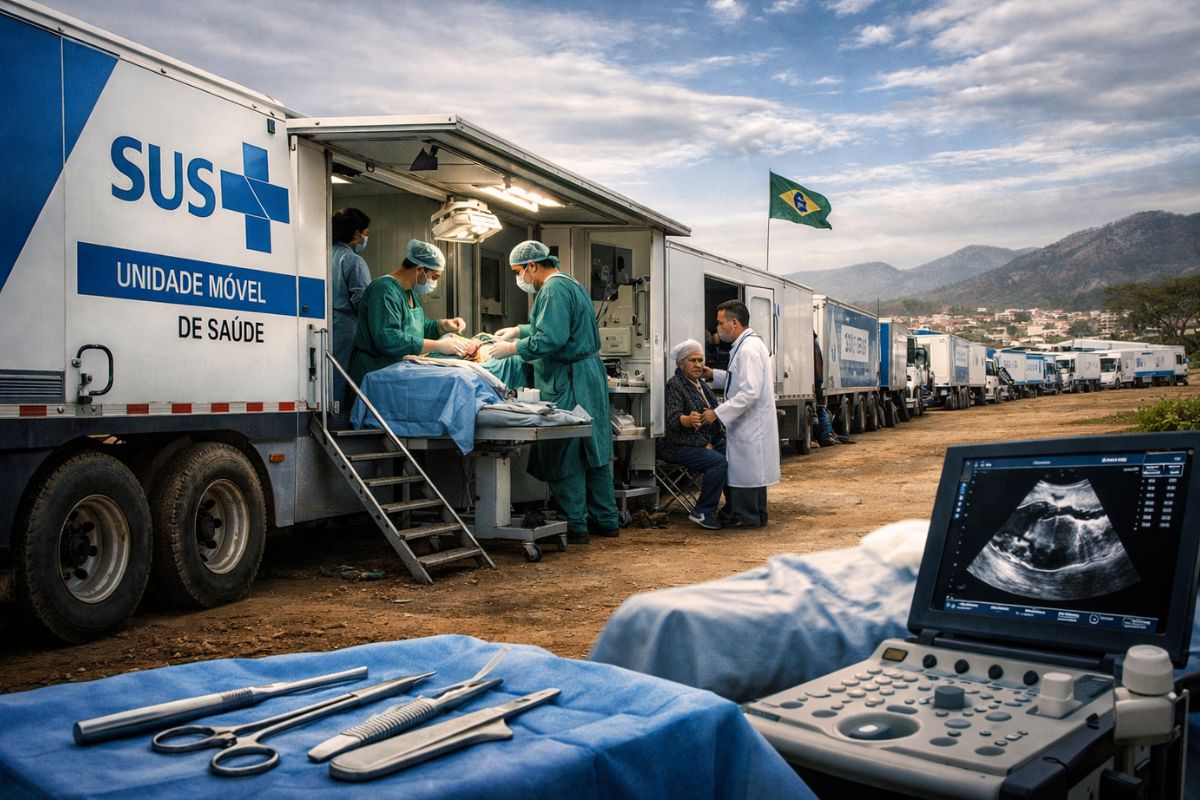
In Just Over Three Months, The Program Now Has Specialists That Brought Specialized Care Through The SUS To 100 Municipalities, With Women’s Health, Ophthalmology, And Imaging Exams. In At Least 15 Cities, Lines Have Started To Clear. The New Round Brings 47 Mobile Units To More 31 Cities This Week.
When The SUS Becomes A Road, The Promise Stops Being Abstract. In just over three months, trucks transformed into mobile clinical structures have started providing specialized care to 100 municipalities, reaching areas with accumulated demand and regions where the distance to medium complexity services usually pushes diagnoses to “later”.
The initiative, called Now There Are Specialists, appears as a response to an old bottleneck: the queue for specialties is not just a number, it’s time lost in the progression of diseases. With consultations, exams, and procedures in mobile units, the program aims to shorten the gap between clinical suspicion and the confirmation of the diagnosis, as well as to accelerate medical decisions that depend on imaging, ophthalmological evaluation, and targeted exams.
How The SUS Trucks Work To Provide Real Care
The logic is not “attend by order of arrival.” The trucks operate with patients scheduled and referred by local health management, connecting the mobile unit to the municipality’s network and reducing the chance of care becoming an isolated act, without continuity.
-
The largest food company on the planet, JBS, has just opened a 4,000 square meter laboratory in Florianópolis to develop customized proteins that modulate muscle mass gain, immune response, and metabolic performance.

-
After nearly 30 bids and competition among industry giants, a Spanish company purchases one of the largest airports in Brazil for almost R$ 3 billion and takes over the management of Galeão in a concession that will last until 2039.

-
The Federal Revenue Service now automatically cross-references everything you declare with data from banks, credit cards, brokerage firms, and insurance companies, and any discrepancy between your income and your expenses triggers an alert in seconds.

-
Amid global tensions, Brazil blocks the United States’ proposal at the WTO and paves the way for a trade crisis and possible retaliations.


This design matters because specialized care does not end with the exam. When a tomography, an ultrasound, or a women’s health evaluation detects something, the local network needs to absorb the next step, whether it’s follow-up, referral, treatment, or reevaluation.
It is in this fit, between the truck’s schedule and the territory’s capacity, that the “hospital on wheels” stops being a promise and becomes a care flow.
The Milestone of 100 Cities and What Changed With The New Round
The announcement of the milestone of 100 municipalities served was celebrated in Mauá, where the Minister of Health Alexandre Padilha announced the continuation of the movement of the units. The central message was to maintain expansion where access is more difficult and where the queue weighs more.
Starting Friday (30), Mauá and 31 other cities from 20 states will enter the route with already structured services.
In Mauá, a imaging exam truck was announced with regional impact: in addition to local residents, the structure was indicated as capable of serving people from surrounding areas, such as Santo André, São Bernardo do Campo, São Caetano do Sul, Diadema, Ribeirão Pires, and Rio Grande da Serra.
When care becomes “regional,” the SUS tries to reduce dependence on long travel for essential services.
What These Units Do: Consultations, Exams, Surgeries, and Early Diagnosis
The initiative describes three fronts with different structures, but with the same goal: reduce waiting time and unlock care stages. The trucks offer specialized consultations and, depending on the type, perform exams and procedures that are usually the “bottleneck” in the queue.
The women’s health units perform mammograms, pelvic and transvaginal ultrasounds, and even biopsies for early diagnosis of breast and cervical cancer.
The ophthalmological units conduct evaluations for babies, children, and adults, as well as ultrasounds and cataract surgeries. The imaging units offer tomographies and ultrasounds, supporting the definition of medical conduct. In practice, the SUS tries to save time where the delay changes prognosis.
47 Trucks In Operation Now And The Goal Of 150 By The End Of The Year
With the entry of new units, the program informs that there are already 47 trucks in operation, with a multiprofessional team and complete structure of supplies and equipment.
The declared focus is on hard-to-reach locations, regional hubs, and areas with high unmet demand.
The announced goal is even greater: by the end of the year, 150 trucks should bolster care in the public network. This number becomes a thermometer of ambition and at the same time a logistical challenge, because expanding the fleet requires maintaining staff scale, supplies, maintenance, scheduling, and integration with local referral systems.
Queues That Started To Drop And Why “Clearing” Is Not Just A Slogan
The program claims that queues have been cleared for specialized services in at least 15 cities, citing municipalities like Brasiléia, Santana do Ipanema, Tauá, Crato, Ceilândia, Cariacica, Taiobeiras, Princesa Isabel, Garanhuns, Paracambi, Urucânia, Parnamirim, Ariquemes, Canoinhas, and Ribeirão Preto.
In Ribeirão Preto, the program reports that cataract surgeries restored vision for more than a thousand people.
“Clearing the queue” may sound definitive, but the real effect depends on two things that do not always appear in the debate: which part of the queue was treated (consultation, exam, surgery) and whether there is capacity to sustain the pace after the truck leaves.
In other words, the mobile unit solves a piece of the problem, but the sustainability of the result requires continuity in the network and control of the backlog so the queue does not recompose.
Where The Trucks Go Now And Why This Affects Entire Cities
In the new round, the trucks arrive in Tarauacá, Guarapari, Tartarugalzinho, Ribeira do Pombal, Barreiras, Acopiara, Quixadá, Porangatu, Caxias, Coxim, Acará, Mamanguape, Sapé, Telêmaco Borba, Sepetiba, Cacoal, Itabaiana, Guaraí, Mazagão, Cruz das Almas, Mauriti, Inhumas, Camanducaia, Cajazeiras, Mafra, Serra Talhada, Santa Cruz, Salinas, Eunápolis, Várzea Grande, and Porto Velho. It’s a broad map, distributed by regions, which tends to shake up local routines because it concentrates exams and consultations in short time windows.
This generates a dual effect: on one side, it accelerates clinical responses that were stagnant; on the other, it pressures municipal organization to refer, schedule, and ensure follow-up.
The “hospital on wheels” does not replace the network; it provokes it to function at a different pace, and that’s where entire cities feel the change, both through logistics and the expectations of those who have been waiting for months or years.
Permanent Infrastructure Also Counts: UPAs, Polyclinics, And Maternities
In addition to the trucks, the announcement in Mauá included decrees that authorize the transfer of more than R$ 13 million to assist in the construction of three Emergency Care Units (UPAs) in the municipality. The funds will be transferred to the Municipal Health Fund, responsible for management and accounting to the Ministry of Health.
In Guarulhos, the construction of a polyclinic was announced with resources from the New PAC, with a federal investment of R$ 30 million, with R$ 17 million for construction and R$ 13 million for the acquisition of equipment.
There were also mentions of authorizations for a polyclinic in Nova Iguaçu and a maternity hospital in Águas Lindas de Goiás, as well as new maternity hospitals in Japeri and Várzea Grande. The technical reading here is simple: trucks relieve short-term issues, while construction tries to support long-term needs, and the combination targets the same bottleneck of the SUS: waiting for timely care.
What The Citizen Sees On The Ground And What Needs To Be Clear
For those in line, the most tangible change is not the speech, it’s the time. Tomographies and ultrasounds are cited as essential exams for the early discovery of diseases and the definition of medical conduct.
Mammograms, biopsies, and gynecological exams fall into the same urgent package, where prolonged waiting can cost a late diagnosis.
But there is a sensitive point: specialized care requires coordination and reliable information. Since the trucks attend to scheduled and referred patients, the citizen depends on local guidance to know if they will be called, when, for which type of unit, and with what follow-up flow.
The clearer the communication from the municipal network, the less room there is for rumors, useless trips, and frustration.
SUS trucks turning into hospitals on wheels do not solve everything, but they affect what hurts the most: the line that drags on and the feeling that specialized care never arrives.
With 100 municipalities already served, 47 mobile units in operation, and plans for expansion, the hope is to accelerate diagnoses, exams, and surgeries that were stalled, while construction and investments attempt to keep the momentum in the territory.
Now I Want To Hear The Part That Rarely Appears In Announcements: In Your City, Have You Or Someone In Your Family Ever Been Stuck In A Specialty Queue At The SUS? What Else Held Up, Consultation, Exam, Or Surgery? And If A Truck Were To Arrive There Tomorrow, Which Service Would Make A Real Difference: Ophthalmology, Women’s Health, Or Imaging Exams?








-

Uma pessoa reagiu a isso.