





 Portuguese
  English
  Spanish
  5 min of reading
  0 comments


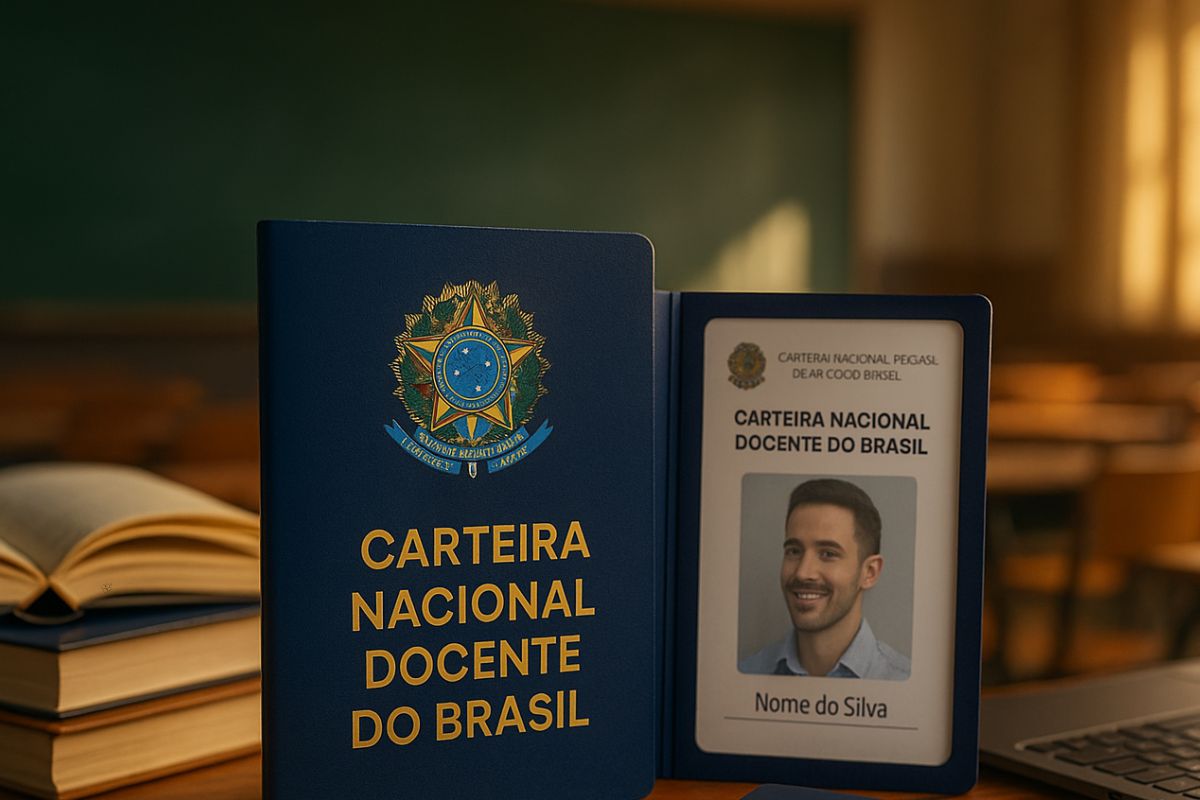
National Teacher Wallet Applies to Public and Private Networks, Reaches Basic and Higher Education, and Integrates the Federal Career Appreciation Program; Proposal Aims Official Teacher Identification, Benefits, and Continuing Education, According to Analyses by Prof. Rodrigo Rodrigues.
The National Teacher Wallet was sanctioned to officially recognize those who teach in Brazil — both in the public and private sectors and at all levels, from early childhood education to higher education. The measure, introduced under the More Teachers for Brazil program, seeks standardized identification, easier access to services, and an incentive for continuing education. According to Prof. Rodrigo Rodrigues, the wallet will be digital and free of charge, with issuance expected by Gov.br.
In basic education, the potential universe exceeds 2.3 million teachers; in higher education, it includes professors from colleges, university centers, and universities. Prof. Rodrigo Rodrigues emphasizes that the National Teacher Wallet nascends as part of a broader strategy for attraction, training, and appreciation of the teaching profession — in response to the decline in interest in teacher education programs and the shortage of professionals in various networks.
What Is the National Teacher Wallet and Why Was It Created
The National Teacher Wallet is an official professional identification document for practicing teachers.
-
The narrowest house in the world is only 63 centimeters wide, but inside it can accommodate a bathroom, kitchen, bedroom, office, and even two staircases.

-
In the middle of the sea, these enormous concrete and steel structures, built by the British Navy to protect strategic maritime routes, look like they came straight out of a Star Wars movie.

-
For years, no one could cross a neighborhood in Tokyo because of the tracks, but an impressive solution changed mobility and completely transformed the local routine.

-
With 15 floors, an unusual building in Curitiba uses concrete, pilasters, and exposed roofs to create the effect of stacked houses.


According to Prof. Rodrigo Rodrigues, its purpose is to standardize proof of teaching in everyday situations — from discounted admission to cultural events to formalization of academic ties — without relying on pay stubs, individual declarations, or institutional badges.
The creation of the document aligns with More Teachers for Brazil, a federal strategy that organizes selection, attraction to teacher education programs, placement in areas with shortages, continuing education, and appreciation.
In Rodrigo Rodrigues’ view, it is an institutional infrastructure piece: simple, free, and digital, but capable of unlocking access, discounts, and registrations that previously depended on scattered bureaucracies.
Who Will Have Rights: Public, Private, Basic, and Higher
According to the design presented by Prof. Rodrigo Rodrigues, the wallet excludes no networks or stages: it reaches teachers from the public network (municipal, state, and federal) and from the private network, both in basic education (early childhood education, elementary school’s initial and final years, and high school) and in higher education.
This broad scope resonates with the reality of the teaching profession in Brazil, where many professionals work in more than one network and at different levels.
By centralizing verification in the same digital document, the National Teacher Wallet tends to streamline the functional life of those who transition between schools and higher education institutions.
How It Will Be Issued: Digital Format, Validation, and Cost
According to Prof. Rodrigo Rodrigues, issuance will be done by Gov.br, in digital format, with a QR Code for verification.
The National Teacher Wallet will be free — without application fees or monthly charges — and can be exported for presentation in services that require official proof.
Online identification reduces time and paperwork, in addition to standardizing verification by cinemas, theaters, museums, educational networks, and private partners.
For the teacher, the gain is practicality; for those verifying, security and real-time validation.
Expected Benefits: Discounts, Education, and Access to Credit
According to points outlined by Rodrigo Rodrigues, the wallet connects to three fronts:
Recognition and Benefits
The proposal provides for partnerships for discounts — Rodrigo cites the intention of agreements with hotel networks that could reach up to 15%, depending on the partnered network. The wallet would act as a key for eligibility. Important: operational details still depend on partner adhesion and official disclosure of terms.
Continuing Education
The training portal of More Teachers gathers free courses (with varied workloads) on topics such as school management, active methodologies, and learning. The wallet would serve as an identifier to facilitate enrollments and tracking of the training path.
Access to Credit
According to Rodrigo Rodrigues, discussions are underway to facilitate access to no-fee cards and credit lines in public banks (like BB and Caixa). Just like the discounts, the final design will depend on the agreements and rules that are published. The wallet would be the official proof for eligibility of benefits.
Relationship with “More Teachers for Brazil”: The Five Pillars
Prof. Rodrigo Rodrigues details five pillars of the program that underlie the wallet:
Selection for Teaching Entry: includes the idea of a National Teacher Exam (a “National High School Exam for Teachers”) as a unified stage in competitions.
Attractiveness for Teacher Education Programs: scholarships to encourage enrollment and completion of teacher training degrees.
Placement in Areas with Shortages: incentive scholarships for working in regions with a shortage of teachers.
Teacher Education: platform with free courses offered by universities and institutes for continuous development.
Appreciation: actions for social recognition of teachers — wherein the National Teacher Wallet fits as a mark of professional identity.
For Rodrigo, the wallet does not solve structural challenges (such as minimum wage, career, workload, and mental health), but organizes the foundation to attach benefits, education, and services into a unique verified identity.
Base Data: How Many Teachers, Where They Work, and Why It Matters
In basic education, there are more than 2.3 million teachers.
When including higher education, the reach increases even further.
The potential impact of the National Teacher Wallet is systemic: it standardizes the proof of bonding for millions, facilitates training policies, and provides a showcase for partnerships that benefit the teaching profession.
For public management, the document helps to size who is effectively in duty, an essential element for planning and funding.
For the teacher, it reduces frictions in day-to-day activities — from entry into programs to discounted admissions — with quick and secure validation.
Limitations and Next Steps: What to Observe in Regulations


Prof. Rodrigo Rodrigues highlights points that deserve attention when the complementary norms are released:
Issuance Calendar on Gov.br and eligibility criteria (proof of teaching practice).
Terms of Agreements (e.g.: composition of discounts and private partnerships).
Integration of the wallet into training portals and potential points for progression.
Data Governance (privacy and responsible use of teacher information).
While the operation is finalized, guidance is to follow the official channels and the updates released by education authorities.
The National Teacher Wallet is an institutional step: unique, digital, and free identity, with the potential to simplify functional life, connect benefits, and boost education.
As Prof. Rodrigo Rodrigues reminds, it does not replace historical agendas (minimum wage, career, working conditions), but helps organize the foundation for other deliveries.
And you, teacher: do you already use any standard document to prove your teaching? What do you hope to see integrated into the National Teacher Wallet (training, discounts, banking services, academic mobility)? In what situations would the wallet make your day-to-day easier? Share in the comments — your feedback helps map real priorities of the category.








Seja o primeiro a reagir!