





 Portuguese
  English
  Spanish
  4 min of reading
  0 comments


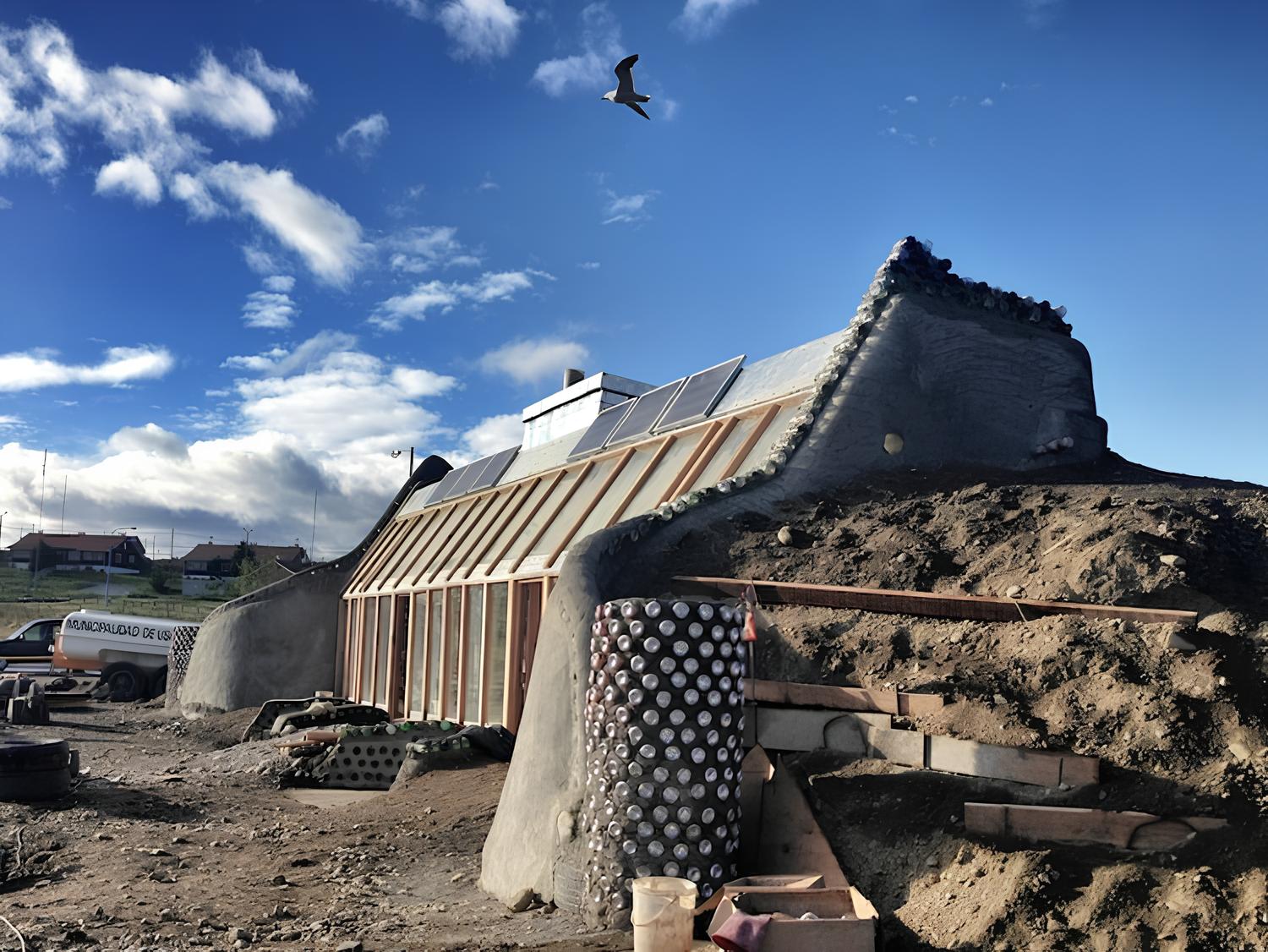
In The Far South Of Argentina, A House Built With 333 Tyres, 3,000 Cans And 5,000 Bottles Demonstrates How Urban Waste Can Turn Into Efficient And Permanent Thermal Housing.
In Ushuaia, Tierra del Fuego Province, Far South Of Argentina, a residence built with 333 tyres, around 3,000 aluminum cans, and approximately 5,000 glass bottles has become an international reference in sustainable architecture. The project was developed in the early 2000s within the concept of the so-called Earthships, a model created by American architect Michael Reynolds, founder of Earthship Biotecture. The name of the project: “Tol-Haru, la Nave Tierra del Fin del Mundo”.
The house was built to withstand one of the harshest climates in South America, with temperatures often below zero in winter and strong winds coming from the Beagle Channel. The goal was clear: to prove that urban waste could be transformed into a permanent, functional, and thermally efficient structure.
The Earthship Concept And Adaptation To Extreme Climate

The Earthship model emerged in the 1970s in the state of New Mexico, United States, and is based on three main pillars:
-
The lack of welders, electricians, and operators becomes a structural threat in 2025, with the construction industry and manufacturing already suffering from delays, cost pressures, and labor shortages in Brazil.
-
Brazil and Paraguay are just 46 meters away from a historic union on the bioceanic bridge that promises to revolutionize trade between the Atlantic and the Pacific.

-
With 55 km over the sea, a cost of US$ 20 billion, and enough steel to build 60 Eiffel Towers, China’s largest project has connected Hong Kong, Zhuhai, and Macau in a colossal bridge that defies the logic of engineering.

-
A trick with joint compound transforms a Styrofoam ceiling into a plaster-like ceiling: leveled panels, wires and mesh at the joints, sand, paint, and change the environment while spending little today.

- Waste recycling
- Energy self-sufficiency
- Passive thermal comfort
In the Argentine case, the challenge was greater than in desert regions. Ushuaia has a subpolar oceanic climate, with long winters, high humidity, and few hours of sunlight during part of the year. To address this, the project utilized:
- Tyres filled with compacted earth forming structural walls
- Bottles and cans integrated into internal walls as elements of insulation and natural lighting
- Strategic solar orientation to capture heat during the day
- High thermal mass to store energy and release heat slowly
333 Tyres As Main Structure
The tyres were used as structural blocks. Each tyre was filled with compacted earth manually until it reached high density. This process creates an extremely heavy and stable “brick”.
The great advantage lies in the thermal mass. During the day, the walls absorb heat. At night, they slowly release this energy, stabilizing the internal temperature.

In cold regions like Tierra del Fuego, this characteristic is essential. The construction drastically reduces the need for constant artificial heating.
3,000 Cans And 5,000 Bottles As Insulation And Lighting
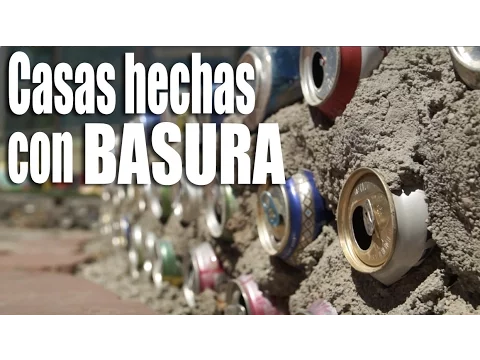
The aluminum cans and glass bottles were incorporated into the internal walls. In addition to recycling discarded material, this technique offers two technical benefits:
- Reduction in the use of conventional concrete or bricks
- Improvement in thermal and luminous performance
The bottles allow the passage of diffuse natural light, reducing the need for electric lighting during the day. The cans create air pockets that contribute to thermal insulation.
Thermal Performance In Subpolar Climate
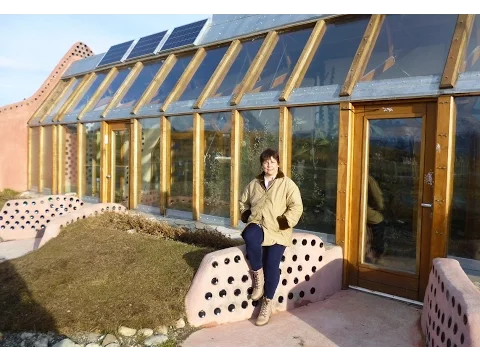
Ushuaia records average winter temperatures close to 0 °C, with snow occurrence. The thermal efficiency of the residence has become one of the main points of interest in the project.
Thanks to the combination of:
- High thermal mass
- Appropriate solar orientation
- Insulation with recycled materials
- Controlled ventilation
the house maintains a stable internal temperature with significantly reduced energy consumption.
This type of architecture demonstrates that waste can play a real structural and thermal role, not just a symbolic one.
Partial Self-Sufficiency And Integrated Systems
The model also integrates principles of sustainability:
- Rainwater harvesting
- Simple greywater treatment systems
- Reduced use of conventional energy
Although not all Earthship units are completely independent of the electrical grid, the concept is to minimize external dependence as much as possible. The case of Argentina has become emblematic for two factors:
To prove that the model works in extreme climate
To demonstrate that urban waste can be converted into permanent infrastructure
Discarded tyres represent one of the greatest global environmental challenges. They can take hundreds of years to decompose and accumulate standing water, favoring disease vectors.

By transforming them into structural walls, the problem becomes a solution.
Urban Waste As A Constructive Asset
The project in the far south of Argentina shows that:
- Waste is not necessarily an environmental liability
- It can be structural raw material
- It reduces the cost of conventional materials
- It decreases environmental impact
The experience reinforces a growing concept in sustainable engineering: the circular economy applied to construction.
In the far south of Argentina, the house built with 333 tyres, 3,000 aluminum cans, and 5,000 glass bottles is not just an architectural curiosity. It is a concrete proof that urban waste can transform into permanent, efficient housing adapted to one of the harshest climates in South America.
The project shows that, with proper technical planning, waste can cease to be an environmental liability and become real habitable structure.









-

-

-

-

-

-

79 pessoas reagiram a isso.