





 Portuguese
  English
  Spanish
  5 min of reading
  0 comments


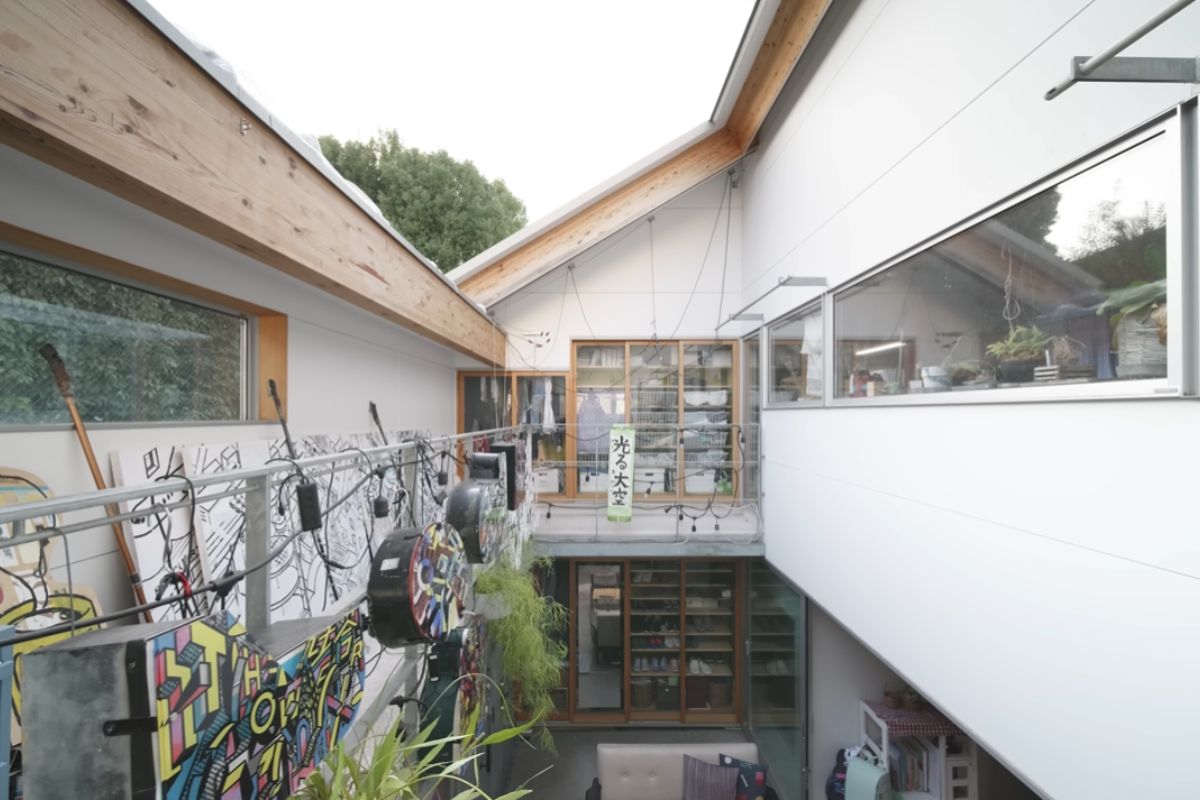
In Suginami-ku, Tokyo, the outdoor family house of artist and architect Zajirogh features a central patio without a roof, protected by a retractable sail-type canopy, and organizes an L-shaped kitchen, balconies, and two bathrooms in just 57 m², betting on the climate as a year-round design.
In a neighborhood where new constructions coexist with strict size regulations, the outdoor family house became an architectural response that seems contradictory: removing the roof from the main area to gain usable space. What sounds like improvisation is calculated here, with drainage, materials, and routines designed for rain, wind, and privacy.
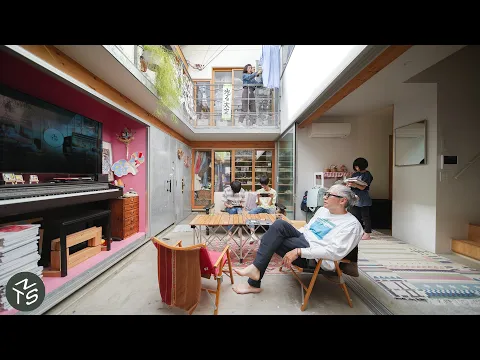
The routine of the family of five makes it clear why the central patio is not a decorative “void.” It operates as a living room, entrance, and social area, with camping furniture that can get wet and be moved quickly. The outdoor family house functions as equipment, not as a showcase, and this changes the perception of every detail.
Where The Urban Rule Becomes Design And The Central Patio Becomes Living Room

The house is located in a residential area of Tokyo and was designed to navigate building area limits without sacrificing daily use.
-
A strong earthquake in Indonesia affects houses and schools, causes panic, triggers a tsunami alert, and records a rise in sea level of up to 30 centimeters in some areas.

-
The Argentine government celebrates the lowest poverty rate in 7 years, but experts warn that the methodology has changed, real wages have fallen, unemployment has risen, and the number of people on the streets of Buenos Aires has increased by 57% since Milei took office.

-
7.8 magnitude earthquake in Indonesia frightens the population, triggers tsunami alert, and hits an island with over 200,000 inhabitants this Thursday.

-
Google will finally let you change that embarrassing Gmail address you created in your teenage years without losing any accounts, logins, or old emails: the feature is already available in the United States.


Instead of stacking closed rooms, the design concentrates life in the central patio, making circulation simpler and reducing the common sense of tightness in 57 m².
This central patio also resolves a typical practical bottleneck of Japanese entrances, usually small and congested when everyone exits at the same time.
Here, the entrance blends with the living area, with a subtle line on the floor separating functions and a drainage system on the perimeter to channel rainwater.
Retractable Canopy, Wind, and Rain as Part of the Method

The technical heart of the outdoor family house is the retractable canopy, installed like a sail and operated from the upper balcony.
It allows for a switch between open sky and quick coverage, reducing exposure when the weather turns and maintaining the feeling of being outside when the climate is favorable.
However, the retractable canopy does not solve everything alone.
For socializing to work, sensitive objects are protected behind sliding glass and steel doors, and the open room receives flooring and finishing solutions that withstand water.
The central patio requires a maintenance pact, where cleaning, storage, and quick reaction are part of the “manual” of the house.
L-shaped Kitchen and The Design of Routine in 57 m²
When the glass door opens, the L-shaped kitchen stitches the interior with the central patio and transforms dinner and conversation into a single scene.
The ceramic countertop and stainless steel sink withstand intense use, while the gas stove, hood, and fish grill reinforce the logic of a compact house that does not forgo a real kitchen.
The L-shaped kitchen also organizes what is not visible in the photo: open storage for utensils, yellow doors to hide less attractive items, and use of space under the stairs.
In an outdoor family house, every square meter is contested, and the L-shaped kitchen becomes a logistical center for food, circulation, and organization.
Bathroom, Heating, and Drainage in a Roofless House

The lack of a roof in the main area does not mean giving up thermal comfort.
In summer, with the retractable canopy closed, the air conditioning cools the open area; in winter, the heated floor warms the concrete to make it comfortable for bare feet.
Comfort here is engineering applied to habit, not a decorative luxury.
The bathroom follows the Japanese “wet bathroom” standard, with space for a shower and bathtub, and a window facing the central patio.
The vanity separated from the bathing area helps reduce schedule conflicts in a family of five, and the presence of two bathrooms shows that the outdoor family house prioritizes daily flow, not just form.
Balcony, Work, and The 1 m² “Sanctuary”
Upstairs, bedrooms, study, and work areas are distributed with the help of large windows and high shelves to maximize walls.
The balcony frames the emptiness of the ceiling and functions as a technical walkway to open and close the retractable canopy, in addition to creating a place where the resident can paint without fear of making a mess.
The balcony also reveals the most intimate side of the project: the 1 m² office, described as a “small sanctuary,” concentrates creativity in a minimal space.
For the children, the room with a loft, a large shared table, and a shelf that doubles as a ladder points to a future where the space can be divided into three, keeping the outdoor family house adaptable to age and privacy.
The Invisible Detail That Determines Whether It Becomes Tradition or Experience
What dictates the outcome is not the color of the walls nor the aesthetics of concrete, but the sequence of discreet decisions between openness and protection.
Sliding doors, drainage, hidden storage, and the discipline to move furniture when the rain arrives determine whether the central patio becomes a functional room or just a constant risk.
For this reason, the outdoor family house matters beyond architectural curiosity.
It exposes a housing model that treats climate, urban rules, and routine as variables of the same system, with a retractable canopy, L-shaped kitchen, and balcony operating as parts of a daily mechanism.
In your daily life, would you accept an outdoor family house with a central patio without a roof, relying on the retractable canopy and balcony to control the climate, or does that seem like a practical limitation? What detail do you think most determines the success of this type of project: drainage, storage, or discipline of use?








-

-

-

4 pessoas reagiram a isso.