





 Portuguese
  English
  Spanish
  8 min of reading
  0 comments


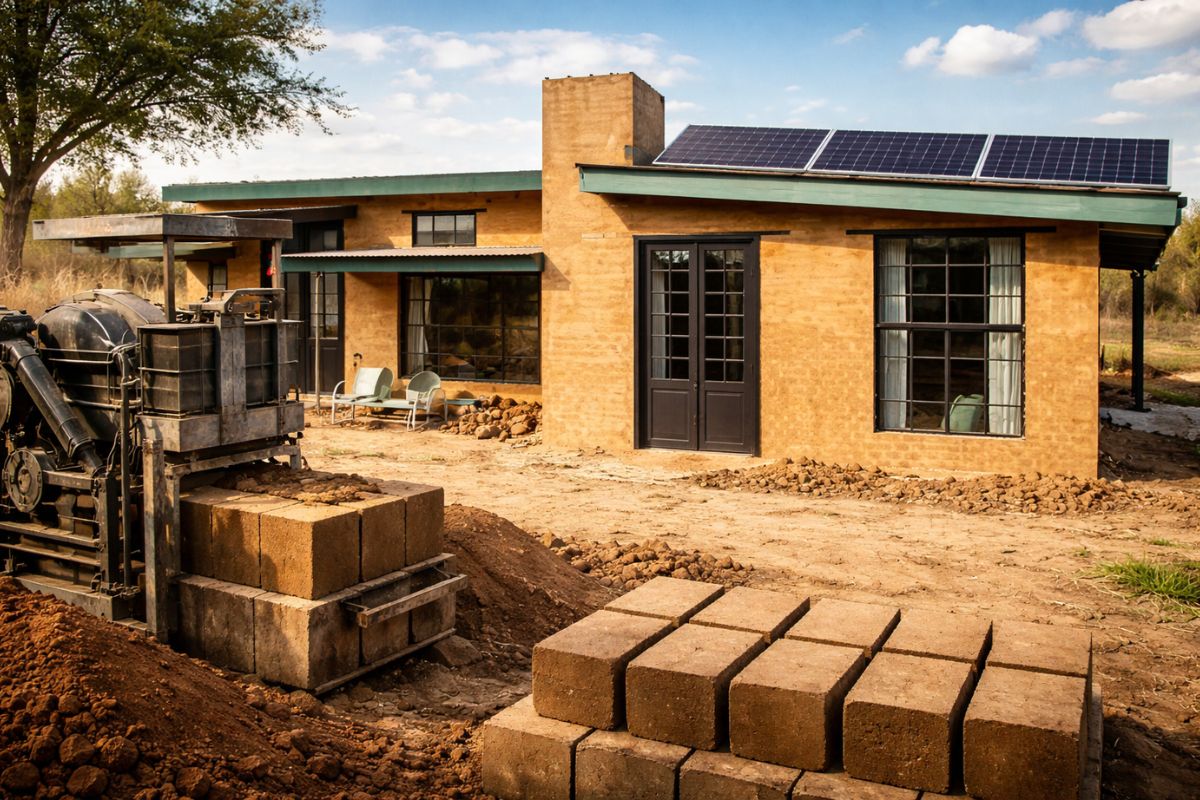
The Proposal for a House Made With Compressed Earth Blocks Uses the Soil From the Site Itself, Requires Adequate Clay Content or Small Cement Stabilization, Reduces Transport, Provides High Thermal Mass, and Allows for the Erection of Dense, Natural, Durable, and Visually Striking Walls With Almost Zero Carbon Footprint on the Site
The idea of a house made with the soil from the land seems, at first glance, like an old solution dressed up as new. But what lies behind this system is a combination of soil, mechanical engineering, and high-density compression capable of transforming the ground of the construction site into structural blocks used to erect resistant, stable, and visually striking walls.
In practice, this house is born from a simple and powerful logic. Instead of relying on long supply chains and large-scale industrial materials, the technology takes advantage of what already exists on-site, processes the soil with specific machines, and creates blocks that can function simultaneously as structure, insulation, and finish. It is a proposal that combines construction, thermal efficiency, and low emission into a single system.
How the Soil From the Land Becomes a Block and Then a House
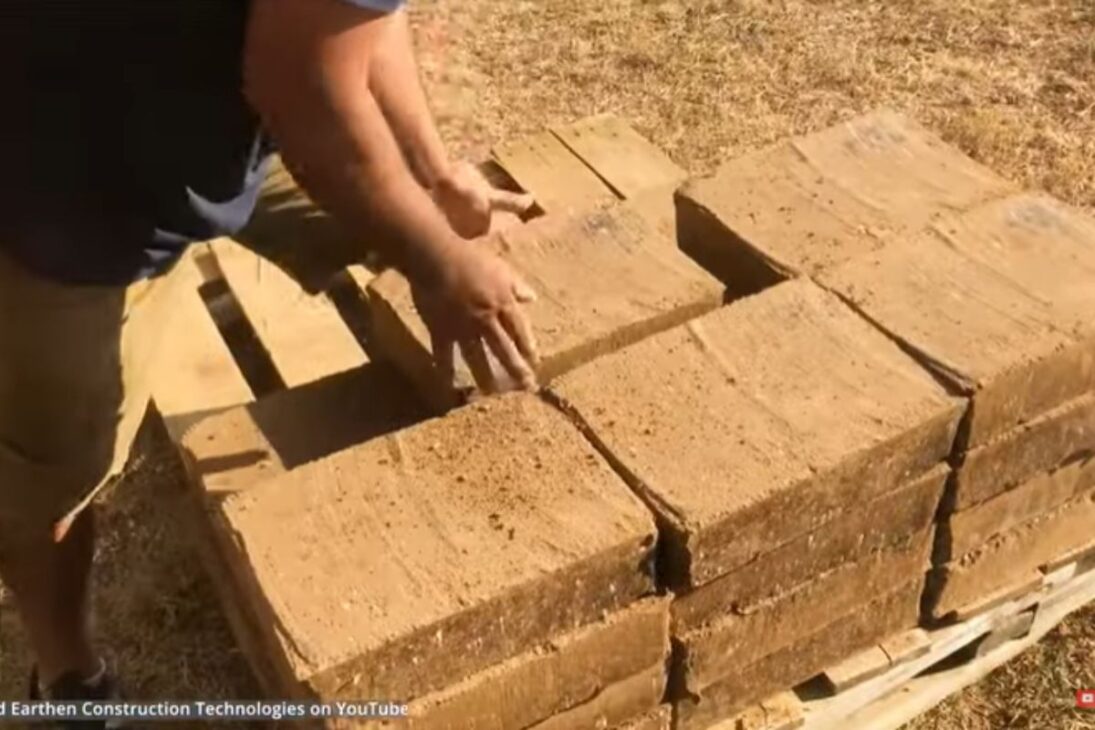
The starting point of this house is the soil itself. According to the technology presented, any soil with between 10% and 30% clay can work for producing compacted blocks. Within this range, clay acts as a natural binder, giving cohesion to the material after compression. This completely changes the logic of construction because the land stops being just a base and becomes part of the raw material.
-
This is the cost to build a simple 60 m2 house in 2026, including contingencies, foundation, finishing, labor, and hidden fees.
-
Amphibious houses with a floating dock system gain global attention by revealing technology that allows homes to rise with floods and avoid losses in high-risk areas.
-
Between tunnels, bridges, and billions in investment, Istanbul is preparing to receive a 125-kilometer railway that crosses continents, enhances the circulation of goods and passengers, and changes the strategic outlook of Turkish transportation.

-
China completes the most critical section under the Yangtze River with the intelligent tunneling machine Linghang, excavating 11.32 continuous kilometers at depths of up to 89 meters and transforming the Chongming-Taicang tunnel into a landmark that redefines the scale of high-speed rail engineering in the 21st century.

When the natural composition does not exactly meet the desired performance, stabilization comes into play. The process can include about 7% Portland cement or lime, while the rest remains soil. This adjustment makes the block waterproof and expands its possibilities for use. The result is a house that can be built with predominantly natural material, but with significantly more predictable technical behavior.
There are also two main ways to work with this system. Unstabilized blocks, made solely with suitable soil, can work very well when they receive external protection, such as lime plaster or large eaves.
On the other hand, stabilized blocks can remain exposed, preserving the natural texture and color of the soil. This gives the house a raw yet sophisticated appearance, without necessarily requiring conventional finishes.
How Much Soil Really Works and Why Clay Is So Important
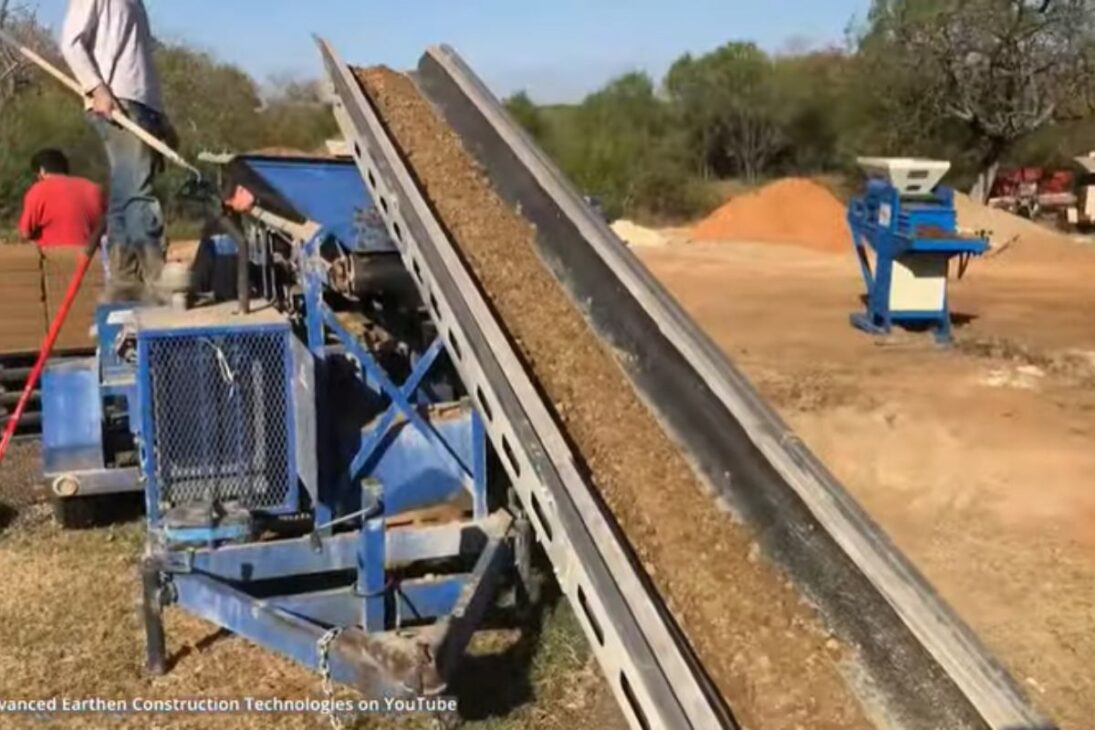
Not all soil is the same, but the technology claims that about 70% of soils tested around the world are suitable for this type of construction. This data helps explain why the proposal has expanded to so many countries.
The decisive element is the presence of clay in sufficient proportion to bind the particles after compaction. Without it, the block loses performance; with it in excess, the adjustment can be made by adding sand.
This means that soil selection is not improvised. The soil needs to have behavior compatible with compaction, drying, and the final strength expected for the house. The quality of the block begins before the machine, in understanding the soil itself.
When there is a balance between clay and aggregates, the soil stops being just an abundant resource and becomes a high-value technical component.
This logic also helps reduce waste. Instead of removing soil, discarding part of it, and importing other material to raise the walls, the system integrates the land into the construction process. Even when the local soil is not used entirely, the alternative can be to buy soil from nearby quarries, which keeps transportation short and avoids a significant part of the footprint associated with traditional inputs.
The Machines That Transform the Construction Site Into a Block Factory
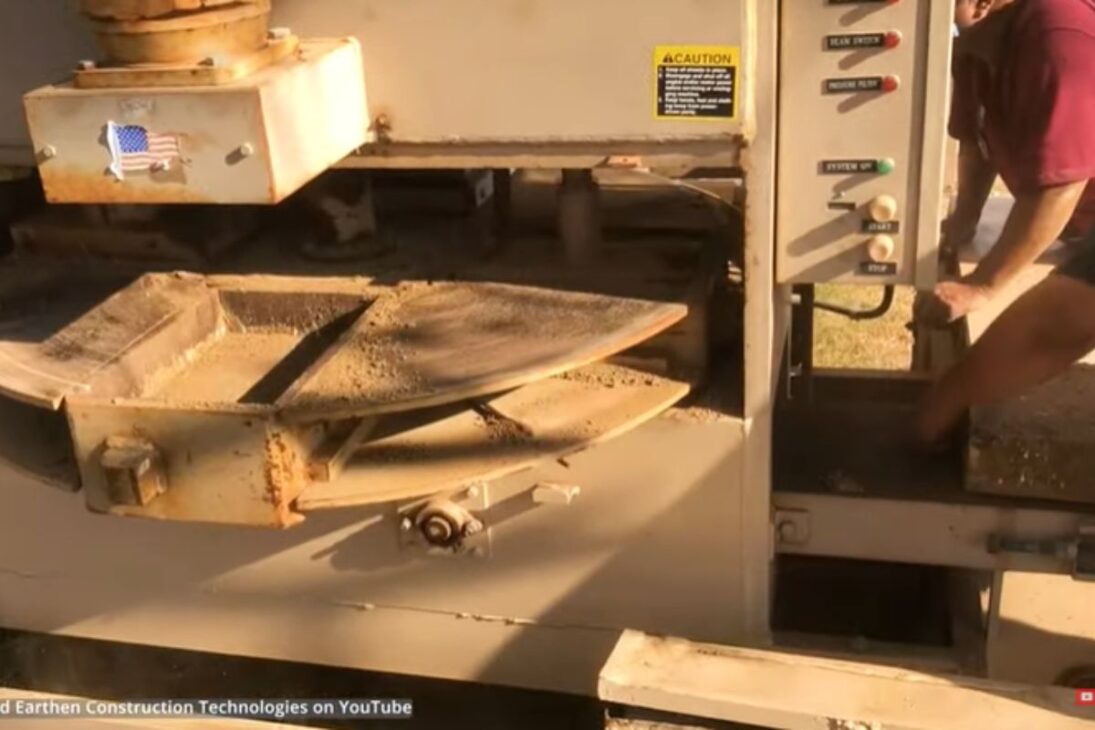
The efficiency of this house directly depends on the machines that make compressed earth blocks. Ryan Runge, presented as president of the company Advanced Earthen Construction Technologies, states that the company has been operating for 31 years and has sold equipment to 51 countries.
The scale is attention-grabbing because it shows that the technology has moved from the experimental field and started to operate in different construction contexts around the world.
One of the cited pieces of equipment is the MX-20 soil mixer, described as capable of processing 20 yards of material per hour. In a larger system, with this mixer and two large block machines, the production capacity can reach nearly a thousand blocks per hour. This changes the perception that building with soil is necessarily slow, artisanal, and limited to small isolated experiences.
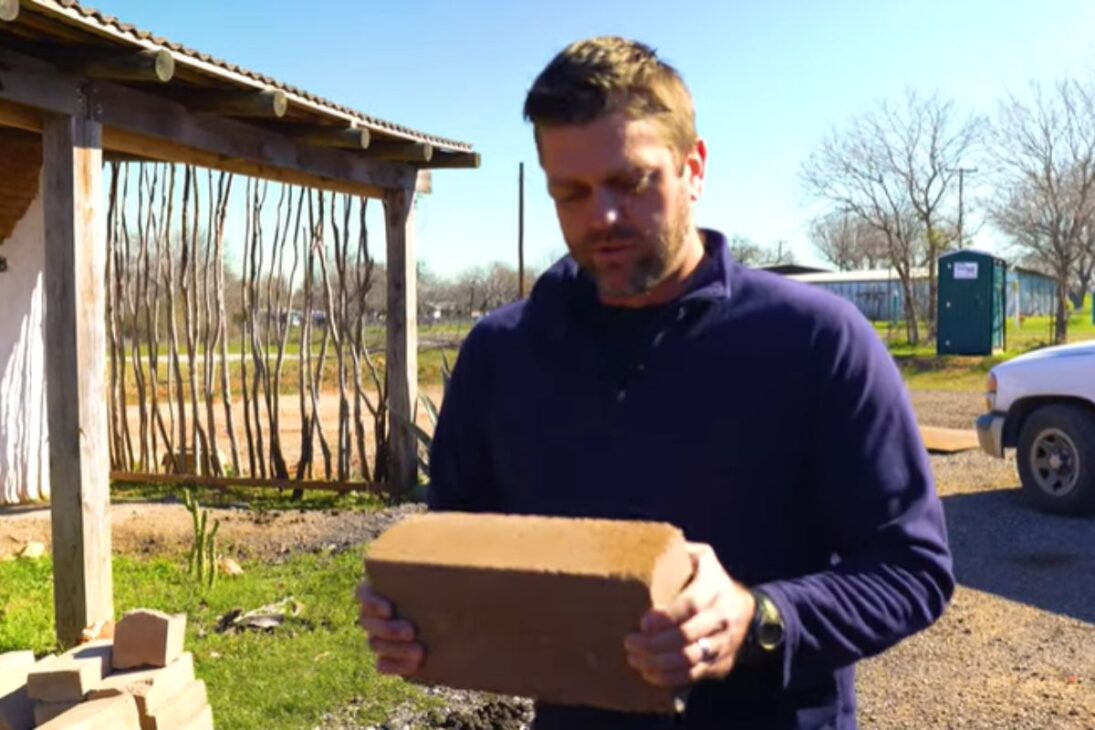
The machine called 3500 is presented as the largest model from the manufacturer. Fully automatic, it receives the material load, feeds the hopper, compresses the block, and repeats the cycle every six or seven seconds.
The produced block measures 10 by 14 inches, weighs about 36 pounds, and is described as extremely dense. On another front, the Impact 2001 model produces about 300 blocks per hour, at a rate of one block every 12 seconds, potentially reaching 2,000 to 2,500 blocks per day.
There is also an interlocking system, the BP714, which produces pieces with holes and fittings, facilitating stacking and the passage of rebar, conduits, electricity, and plumbing.
This solution is relevant because it brings the earth house closer to a more rational construction site, where structure and installations can be thought of in an integrated way. The technology stops being just a different block and becomes a complete construction method.
Why This House Is Noteworthy for Resistance, Comfort, and Finish
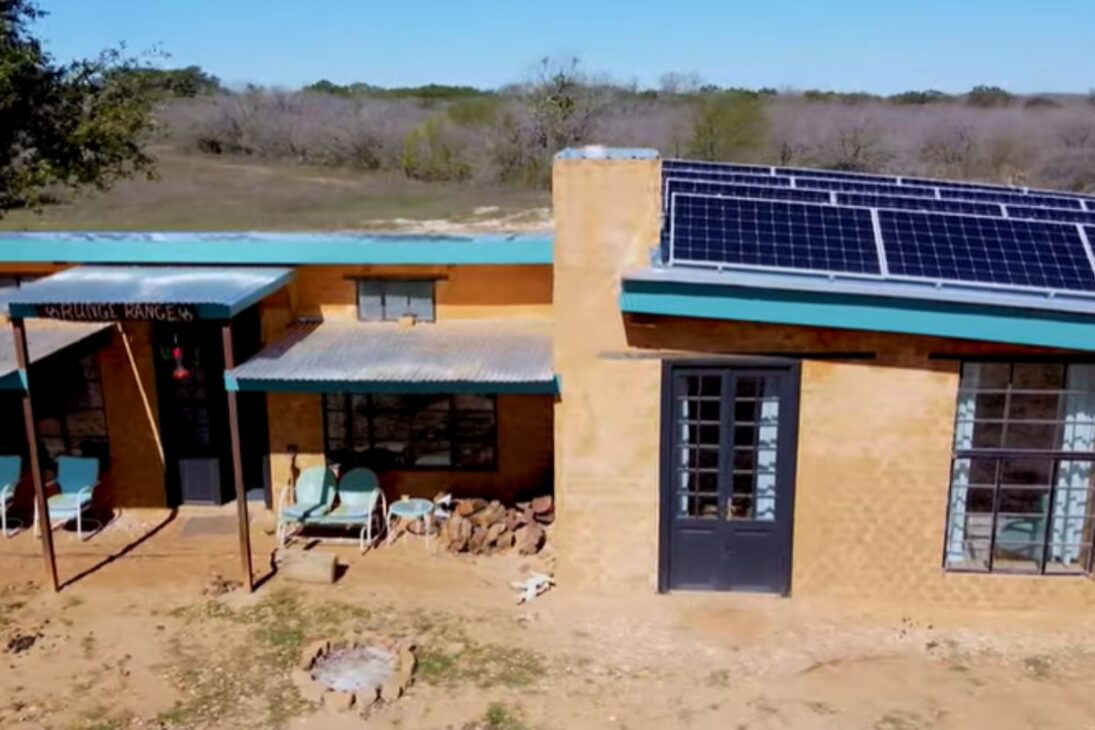
The technical discourse surrounding this house does not only revolve around sustainability. One of the central arguments is resistance. The blocks are compressed to about 1,200 psi, and the presentation claims that they withstand fire, tornadoes, and even bullet impacts.
Although this type of performance always depends on the final design and execution, the reported density helps explain why the system is treated as something much more robust than a temporary or fragile solution.
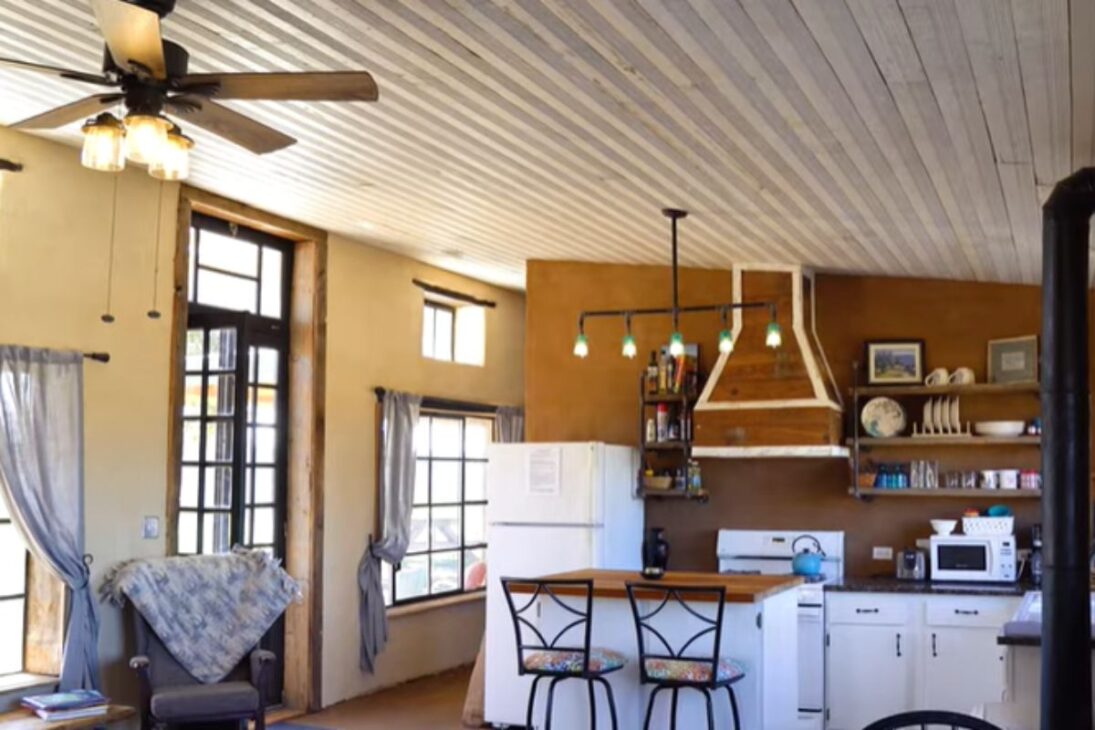
Thermal mass is another strong point. Since the blocks are dense, the house tends to absorb and release heat slowly. In the example cited in Texas, this helps keep the interior cool during the summer for a longer time, in a condition compared to the climatic feel of a cave. It’s not just about raising walls, but about building an environment that responds better to temperature variations.
The finish also takes center stage. The blocks can take on structural functions, contribute to insulation, and still serve as internal and external finishes when left exposed. This reduces layers, simplifies steps, and values the natural aesthetics of the soil, with its own color and texture. For many, this look makes the house more authentic and less dependent on cladding materials that weigh down the cost and logistics of the construction.
Durability is included in this package as a decisive argument. The report itself mentions compacted soil blocks kept submerged in a jar of water for 20 years without signs of erosion.
It also recalls earth constructions still standing in regions like Afghanistan and Iraq, as well as the historical association with large structures built from compacted soils. The message is clear: when properly worked, soil is not synonymous with precariousness, but with permanence.
Where This Technology Is Already Advancing and Why It Has Not Yet Become Standard
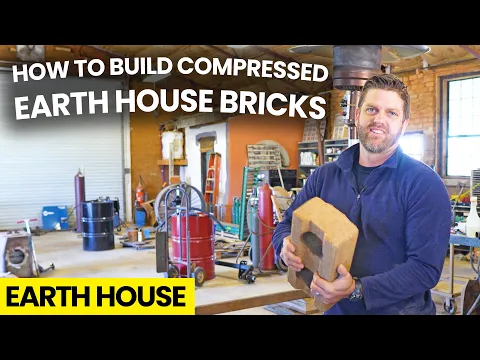

The international circulation of the machines indicates that this house has already surpassed the localized curiosity phase.
The company claims to operate in 51 countries, and one of the concrete examples cited is in Haiti. There, a South African couple linked to the use of the BP714 reportedly completed the hundredth house in a humanitarian mission and was preparing to ramp up production with the goal of reaching more than a thousand units. This shows that the technology is also seen as an alternative for contexts of housing need.
At the same time, the presentation itself admits the main brake on expansion. According to the report, the biggest obstacle is not safety, cost, or material health, but the lack of wide acceptance in codes and regulations. Governments and construction authorities often do not yet treat this system as a standard, not because it is prohibited, but simply because it is not fully incorporated into the usual sector rules.
This barrier helps explain why the compressed earth house appears more in rural areas, in independent projects, and in self-build initiatives.
In San Antonio, a group cited as the Earth Block Building Initiative works precisely to expand recognition of the method and facilitate its regulatory insertion. The technology already exists, works at scale, and sparks interest, but still competes for space with the dominant construction culture.
Almost Zero Carbon and Short Logistics Change the Logic of Construction
The environmental promise of this house is not just in the use of the soil but in the reduction of transport and the low industrial processing level. When the block is produced with the soil from the land itself, the construction drastically shortens its supply chain.
Even in cases where the soil needs to come from a local quarry, the example cited involves about three or four miles of freight, keeping the displacement much lower than the standard for conventional materials.
In the mentioned stabilized block, about 93% of the composition is soil and 7% is Portland cement. This proportion helps understand why the carbon footprint tends to be much lower than that of systems more intensive in cement and transport.
In this case, the house does not just arise from the soil, but from a concrete attempt to build with less emission and less dependence on distant inputs.
There is also an operational gain. One of the machines cited has a tank smaller than a gallon and can work all day, reinforcing the idea of local production with contained consumption.
This does not mean a total absence of impact, but shows a leaner construction site, where the site takes on a productive role and reduces part of the hidden energy costs associated with traditional logistics.
In the end, the strength of this proposal lies precisely in the combination of factors. The compacted earth house brings together local raw material, high-productivity machinery, thermal comfort, physical resistance, and natural aesthetics in a single system. It is not just an engineering curiosity. It is a solution that questions how the sector builds, transports, and consumes materials.
The house made with the soil from the land still faces acceptance barriers but has already shown that it can unite performance, scale, and low emission in a way that is hard to ignore.
Would you live in such a house if it offered resistance, thermal comfort, and less environmental impact, or is there still a lot of distrust when the wall comes from the very earth?









Seja o primeiro a reagir!