





 Português
  Inglês
  Espanhol
  7 min de leitura
  0 comentários


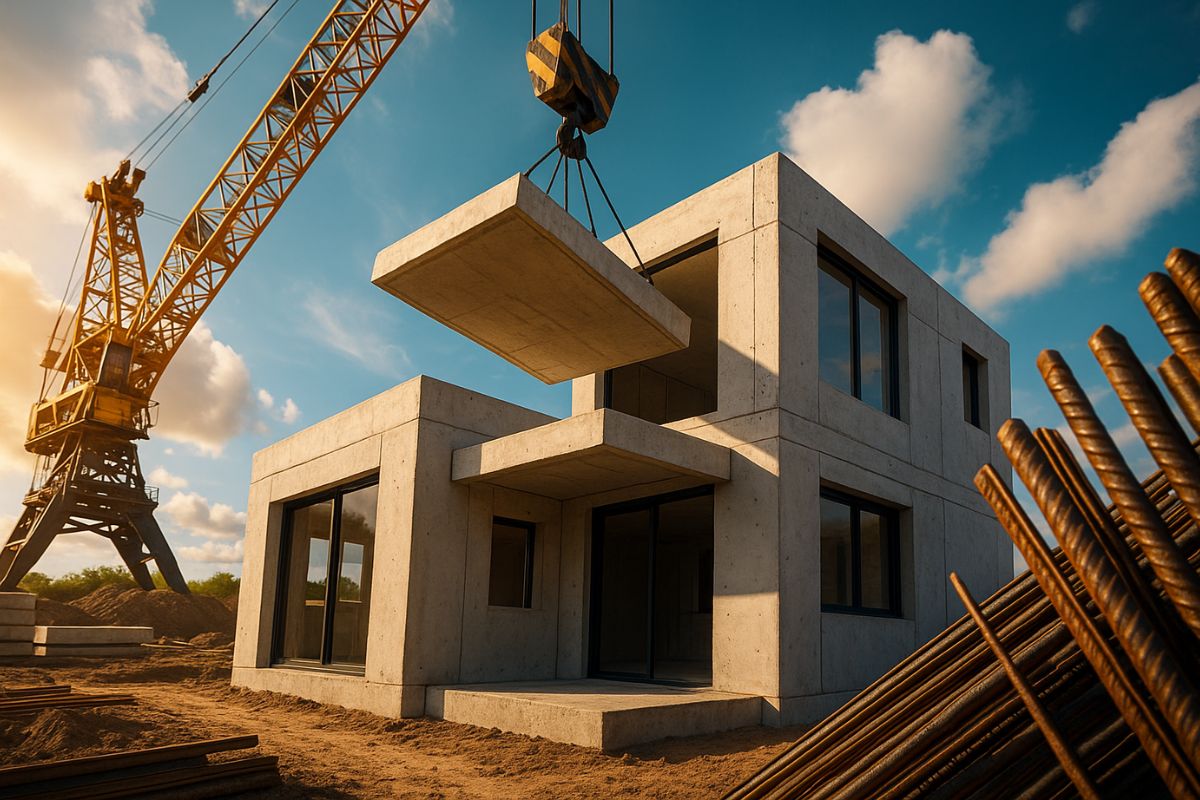
Modular Concrete House Uses Prefabricated PC Parts, High-Strength Concrete, Mechanized Rebars, Controlled Curing in Factory, and Quick Assembly with Crane Directly on Site
The modular concrete house has shifted from a distant promise to an industrial product with timelines counted in days, not months. In this model, the same house that would require weeks of formwork, manual rebar work, and onsite concreting is assembled like a set of Lego blocks, with each piece produced in a controlled environment, tested, and cleared for transport. The result is a high-precision structure, completed in about two weeks, without sacrificing the robustness typical of reinforced concrete.
In this process, the modular concrete house is born far from the construction site, in a production line dedicated to PC components (prefabricated concrete). Laser-cut metal molds, rebar tied with automatic machines, high-strength concrete vibrated and cured under controlled temperature and humidity comprise a system in which each stage is designed to reduce human error, shorten timelines, and ensure structural performance from the first piece to the final assembly with a crane.
Where the Modular Concrete House Is Born: From Design to Precision Mold

The cycle of the modular concrete house begins with the detailed design of the PC molds. In an industrial unit in Gangwon-do, the technical drawing defines shapes, dimensions, connection points, and lifting hooks that will be used later at the construction site.
-
In a silent race, Shopee signs a mega contract in Guarulhos and accelerates the e-commerce war with faster deliveries, pressured shipping, and a new threat to rivals in Brazil.

-
Oil surged to $115 a barrel due to the war in the Middle East, and diesel in Brazil has already risen to R$ 7.45 per liter, while the United States…

-
Brazilian city bets on the business environment to generate jobs and attract investments in the energy sector — secretary reveals strategy at Macaé Energy 2026.

-
50 viaducts, 4 tunnels, 28 bridges, and 40 kilometers of bike paths: BR-262 in Espírito Santo will receive 8.6 billion reais for the largest engineering project in the state’s history, inspired by the Immigrant Highway in São Paulo.


The molds are produced in metal, laser cut, and machined with precision. The quality of the modular concrete house directly depends on the accuracy of these molds, which must ensure flat surfaces, well-defined edges, and minimal gaps at the joint points. After fabrication, the bottom mold is positioned, the metal structure is assembled, and the top mold is rigidly fixed.
Before receiving concrete, the mold is treated with a release agent, reducing adhesion and facilitating the removal of the piece after curing. Everything is designed for repetition: the same metal mold is used to produce dozens of PC members with identical dimensional patterns, something difficult to achieve in traditional open-air construction.
Mechanized Rebars: Quick and Uniform Reinforcement
With the molds ready, the internal reinforcement phase begins. Steel bars arrive at the production line and are positioned according to the design. Instead of manual tying with wire, the modular concrete house benefits from using mechanized rebar tying machines, which tighten the connection points in seconds, maintaining the correct spacing and compactness of the reinforcement.
This mechanized process reduces worker fatigue, standardizes tightening, and increases productivity. At the points where the PC member will be lifted by the crane on-site, integrated lifting hooks are installed in the reinforcement. These hooks are critical: all future movement of the piece depends on them, from loading onto the truck to precise placement on the foundation.
At the end of this stage, the metal structure is ready to receive the high-strength concrete, with rebars, anchoring points, and hooks positioned according to the structural behavior predicted in the design.
High-Strength Concrete, Internal Vibration, and Controlled Curing
The modular concrete house utilizes a different concrete from the usual onsite cast structures. Since they are elements that will be assembled as structural modules, a formulation that meets higher strength values and has performance compatible with transportation, lifting, and assembly stresses is required.
The concrete arrives in mixer trucks and is poured into the molds while operators use internal vibrators to eliminate air bubbles. Without this vibration process, internal voids would remain, reducing strength and compromising the durability of the modular concrete house. With vibration, the material densifies, the voids are expelled, and the piece gains greater density.
After pouring, the surface is carefully leveled. The assembly is then covered with plastic and subjected to heating and humidity control to optimize curing. This industrial “greenhouse” ensures constant conditions, something impossible to maintain in the open field. When the curing reaches the planned level, the plastic is removed, the greenhouse dismantled, and the piece is demolded with the aid of a crane and forklift. The result is a PC component ready for use, with uniform faces and predictable performance.
From Factory to Site: Logistics, Berm, and Foundation
While the factory produces and stores the PC members, the site of the modular concrete house progresses in parallel. This simultaneous execution allows the structure to be completed in about two weeks, drastically shortening the construction schedule.
On-site, the first step is the excavation and leveling of the soil. Next, a PE film is applied to form a moisture-proof layer before the pouring of the concrete berm. Since the mixer truck often cannot directly access the dumping point, the concrete is transferred to a concrete pump, which carries the material through pipelines to the correct area.
Even being a “berm,” this stage is not treated as surplus concrete. The material is leveled and poured with a minimum thickness of about 100 mm, serving as a solid base for the foundation. After curing, the PC base plates are installed, which will be aligned and stabilized with guide steel. From this point, the site is prepared to receive the assembly of the structural modules.
Assembly of the Modular Concrete House with Crane: Plates, Beams, and Slabs in Sequence
With the foundation stabilized, the PC base plates are lifted and positioned with a crane, using the hooks integrated into the elements themselves. Next, grounding beams and other foundation components are installed and joined with non-shrink concrete, contained by small polyurethane foam forms that eliminate the need for later disassembly.
The modular concrete house progresses in layers:
First, the base plates and foundation beams
Then, the placement of additional rebar, floor slabs, and concrete for the ground slab
From there, the PC columns for the first floor begin to arrive, each with a lifting hook on top and a connection bar at the base.
The columns are lifted, fitted into the foundation reinforcements, and carefully aligned with measuring instruments. Verticality is checked rigorously, as any deviation would propagate to the upper beams and slabs. Once the columns are stabilized, the floor beams are lifted, fixed to the metal supports, and distributed around the perimeter of the house.
Prefabricated stairs arrive ready, eliminating the need for formwork and concreting on site. Half slabs are installed as the second-floor flooring, and additional reinforcement is positioned before the final concreting. At several points, non-shrink grout is injected into pre-designed spaces to ensure a perfect connection between steel bars and PC members.
The same process is repeated on the second floor: columns, beams, half slabs, rebar, and concreting. The roof slab completes the structure, also prefabricated and supplemented with reinforcement and concrete poured on site. In approximately two weeks, the modular concrete house reaches the stage of a complete structure, ready to receive internal closures, installations, and finishes.
Insulation, Continuous Slab, and Thermal Performance
In the flooring and foundation stage, the system includes thermal insulation made of EPS (expanded polystyrene), with compression resistance and durability superior to common products. This material is installed over the moisture-proof layer, before the reinforcement of the foundation slab and grounding beams.
Reinforcement bars connect the slab, beams, and PC elements into a single structural assembly, reducing weak joints and enhancing the overall performance of the modular concrete house. Support bricks ensure the proper covering of the reinforcement and prevent displacement during concreting.
The result is a rigid, continuous base that is thermally more efficient, with insulation integrated into the structure. The combination of high-strength concrete, EPS, and mechanical bonding between rebars and PC creates a robust floor, ready to support loads from the superstructure and daily use.
Freedom of Internal Layout and Large-Scale Repetition
As the resilient structure is concentrated in PC columns and beams, the internal walls do not need to function as structural elements. This means the modular concrete house offers more flexible internal layouts, with long spans and the possibility of rearranging partitions throughout the property’s lifespan.
At the same time, repetitive elements like stairs, walls, slabs, and panels can be modularized and produced in series, favoring designs with high degrees of repetition, such as apartments, schools, and hospitals. The same logic applied to the modular concrete house also applies to larger buildings, as long as the project is designed from the outset for the PC method.
On-site, the gain is twofold: fewer onsite formwork and reinforcement processes and less exposure of the work to the weather. With more critical stages performed in the factory, the risk of delays due to rain, temperature variations, and execution failures is reduced.
Why the Modular Concrete House Points to the Future of Construction
In the final balance, the modular concrete house brings together four strategic fronts of contemporary construction: industrialization, quality control, timeline reduction, and usage flexibility. By moving most stages to a controlled environment, the system reduces typical variables of traditional construction and transforms the site into an assembly area, not a manufacturing one.
The combination of prefabricated PC parts, high-strength concrete, mechanized rebars, controlled curing, and crane assembly shows a clear path for those seeking faster, more predictable works with better structural performance, especially in projects with repeated modules.
And you, if you had the chance to choose, would you live in a modular concrete house assembled in two weeks or would you still prefer traditional construction done from scratch on-site?










-

2 pessoas reagiram a isso.