





 Portuguese
  English
  Spanish
  7 min of reading
  0 comments


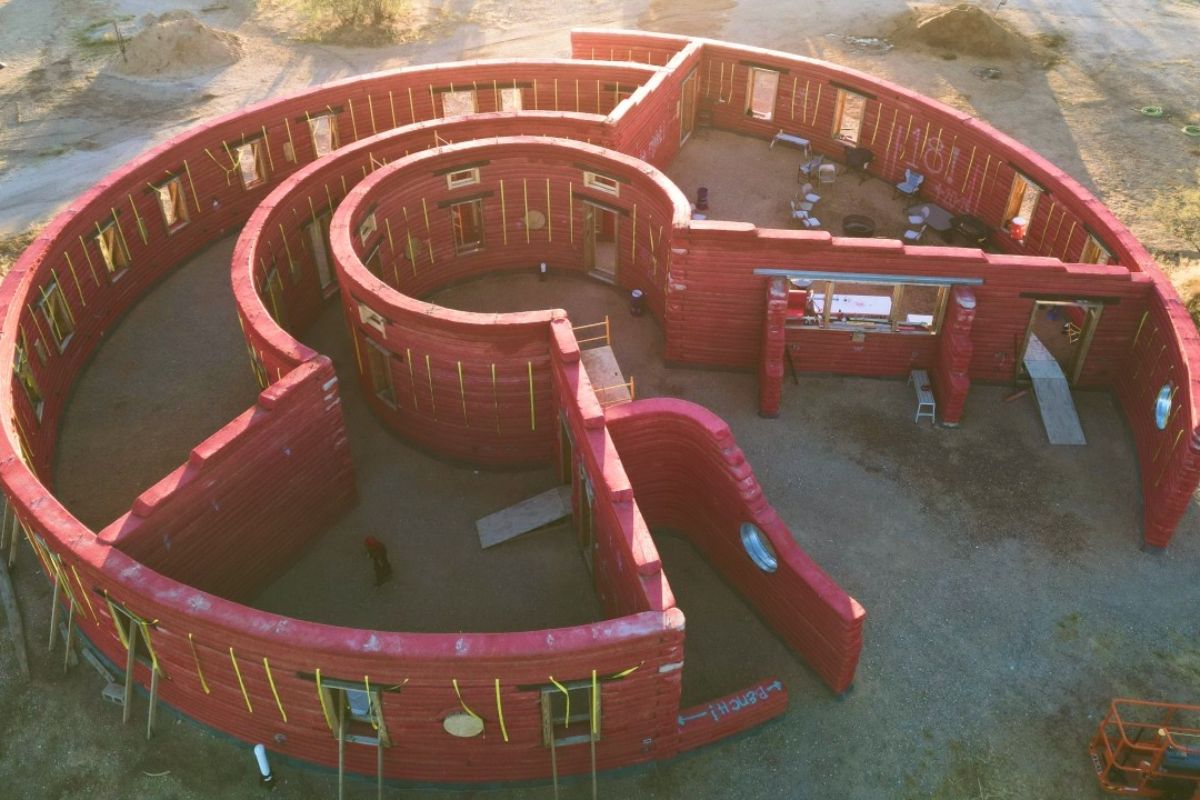
A House of 450 Tons of Earth in the Desert: A Couple Says the House Can Withstand Fire, Monsoons, and Centuries, While Four Children Grow Up Inside a Bed That Seems Impossible Since 2020 in the United States, in the Arizona Desert, Building Layer by Layer.
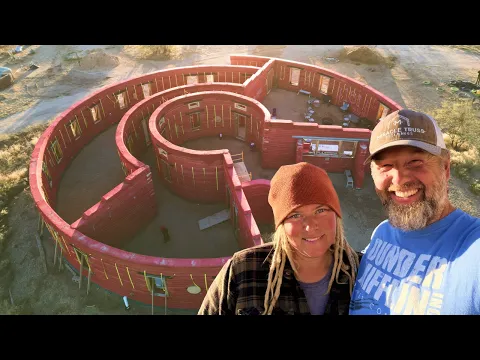
A family moved more than 450 tons of earth to build a circular house in the desert, relying on thick walls and a method called Hyper Adobe. The house is not finished yet, but it has already withstood strong winds, harsh winters, and monsoon summers without losing the ambition: to last for centuries.
The story revolves around a house made with compacted earth inside meshes and layers, as if each row were a giant “brick” hand-molded. The promise is simple and provocative: a house that does not rely on luxury to be strong, but on engineering, planning, and persistence.
Why an Earth House Becomes News When It Weighs 450 Tons

A house that reaches this weight ceases to be an “alternative project” and becomes a scale test. The family describes two years of construction and a routine of physical repetition, with earth being piled and compacted layer by layer. The central point is not just to build a house, but to prove that the method can support its own size.
-
Neither the Pyramids nor the Great Wall of China, this gigantic construction in Spain is the human mark on planet Earth that intrigues the most when seen in images from space.
-
Surrounded by cliffs, mist, and chilling stories, the ancient Hotel del Salto has been reborn as a museum while still unable to shake off its reputation as a haunted place.

-
This star-shaped fortified construction, hidden near the border of Spain, may be the largest fortress on the planet.

-
Congonhas receives the monorail promised for the 2014 World Cup after more than a decade of delays and becomes the first airport in Brazil with integrated subway.

The setting also weighs on the story: desert, strong winds, harsh winter, and monsoons. A house in this environment needs not only to stand, but it must withstand extremes without collapsing, soaking, or becoming a structural problem.
The choice of earth, instead of large-volume industrial materials, is a bet on mass, thickness, and technical simplicity, even when the work is brutal.
Hyper Adobe, Superadobe and the Logic of Earth Bags Without Barbed Wire

The basis of the method is construction with earth bags, popularized in fire-resistant and earthquake-resistant dome structures, with layers filled, moistened, and compacted.
The house uses this logic, but with a variation: Hyper Adobe, which prioritizes vertical walls using mesh fabric, similar to that used in fruit packaging.
This mesh, being open, allows the lower layer to “grip” the upper layer, reducing the need for barbed wire between rows.

In practice, the house becomes an almost mechanical process, yet human: fill, position, compact, repeat. The comparison the family makes is direct: it resembles a 3D printer, but the house is printed with hands and time.
Hyper Adobe uses less plastic than many might imagine: the entire house would have consumed nine rolls, about 360 pounds of material, and the fabric is treated to resist UV, remaining protected when the house is covered and plastered.
Foundation, Compaction and Stability: How the House Supports Its Own Weight

To prevent a house of earth from “sinking” or losing performance due to water and soil movement, the narrative begins with the foundation. They describe the arrival of 300 tons of AB mix to level and compact the base, raising the house about one foot, as protection against typical shallow floods from monsoons.
Next, they dig 18-inch trenches where the walls will stand, put in large-diameter gravel for drainage and compact, creating what they call a “rubber trench.”
The wall itself becomes part of the structural “foot.” Instead of relying on a conventional footing, the house uses initial layers of the earth-sack system, with AB mix inside, stabilization with Portland cement, and compaction above and on the sides to form a large “brick.”
In critical areas, such as the lower bags and the top bag, they increase the percentage of cement to gain a margin of resistance. The house does not rely on a single trick; it depends on redundancy: drainage, compaction, moisture protection, and union between layers.
A Circular House with 24 Windows: The Design That Blends Curves and Straight Walls

The circular shape is not an empty aesthetic. A round house benefits from the structural behavior of curves because gravity tends to “pull” inward, and the shape stabilizes the wall itself. This allows for large diameters without relying on as many extra supports.
At the same time, the house mixes circles and straight walls to create flat and functional areas, considering furniture and circulation instead of a wholly organic space.
The described plan features 24 windows, distributed doors, a narrow corridor, and several areas defined by internal framed walls. The house grows in layers until it reaches the heights of doors and windows, receives lintels to distribute load over the spans, and continues to rise to form the roof with an mentioned slope of 112 degrees.
In the kitchen, the house features a highlight: a large window (11 ft) with a metal solution to span the gap, and an 11-meter planned island to reflect the view. The house tries to be monumental without turning into a maze: curved on the outside, practical on the inside.
Modern Life Off the Grid: Water, Energy, Internet, and Two Bathrooms in an Earth House

The question that always arises is the same: how does an earth house become a family home without “survival living”?
The answer is planning before the wall exists. They design the plan with all the plumbing points and install drains and vents into the foundation before raising the rows. The house accommodates passages, conduits, and solutions to avoid crushing pipes, with the earth itself “embracing” and distributing weight around.
In areas where there is risk, they install larger metal pipes as extra protection when the plumbing passes under a wall.
Regarding water, the house focuses on rainwater collection, with a metal roof designed to gather volumes during monsoon events and direct them to a 30,000-gallon above-ground tank.
The internal distribution includes pressurization, filtration, and organization by manifold, in addition to infrastructure for electricity and network. In terms of energy, the house goes off-grid with large numbers: LFP storage of 60 to 90 kWh, AC power of 10,000 to 20,000 watts at 240 volts, and about 20,000 watts in solar panels.
To reduce complexity, the house also plans to use propane in some appliances, balancing consumption without requiring an even larger “power plant.” The idea is clear: a different home in structure, but recognizable in routine.
Heat of 110 and Cold Near 7: How the House Tries to Master Desert Temperature

The promise of comfort in a house in the desert involves understanding thermal mass. Earth technically is not a high R-value insulator, but it acts as mass that absorbs and transfers heat slowly.
In a 16-inch wall, this “delay” can reach about 12 hours, allowing for synchronization of heat and shade. The house attempts to use this with solar orientation, eaves to shade in the summer and allow solar gain in the winter, as well as high windows (transoms) to release accumulated heat at specific points.
However, the mass alone does not solve everything. The house relies on a well-insulated roof and a floor with a “thermal break” to avoid losing energy to the ground in the cold.
As the variations are significant (110 in summer and 10 in winter, with reports of 7 in harsher years), the house provides mini splits for climate control by room and heating alternatives in the social area, such as masonry heaters or wood stoves. The ambition is not to “zero out” equipment, but to make the house require them as little as possible.
What Is Still Missing for the “Impossible” House to Become a Home and Last Centuries
A house of this type only becomes a real home when it dries, closes, and protects itself. They describe the current stage as the concreting of a bond beam at the top of the walls, with reinforcements and anchors to tie the roof to the structure.
The logic is to transform the top of the house into a rigid and connected structure, capable of handling strong winds and distributing efforts, especially at the junction between the wall and the roof.
The plan also shows why the “end” seems far away: first the metal roof, then the floor, then the complete closure with doors and windows, and only then the fine work of installations and finishes. There is a specific concern with rain: if the floor is done and heavy rain comes before the roof closes, water can reach sensitive points above the planned barriers.
This is why the house moves forward in stages that seem slow but are defensive. A house that wants to last centuries cannot hurry as if it were a weekend renovation.
The story is not just about a large house, nor just about a different method. It is about the kind of risk that a family accepts when they decide to turn their own house into an experiment: testing a technique on the scale of “one million pounds,” withstanding extreme weather while still fulfilling the promise of a modern, functional, and durable home.
Would you live in an earth house if it were designed to withstand fire and time? What would hold you back first: the idea of physical work, fear of maintenance, confidence in the structure, or living with a long-term project in daily life? And, if you could choose, would you prefer such a house in the countryside or one adapted for the city?







Seja o primeiro a reagir!