





 Portuguese
  English
  Spanish
  7 min of reading
  0 comments


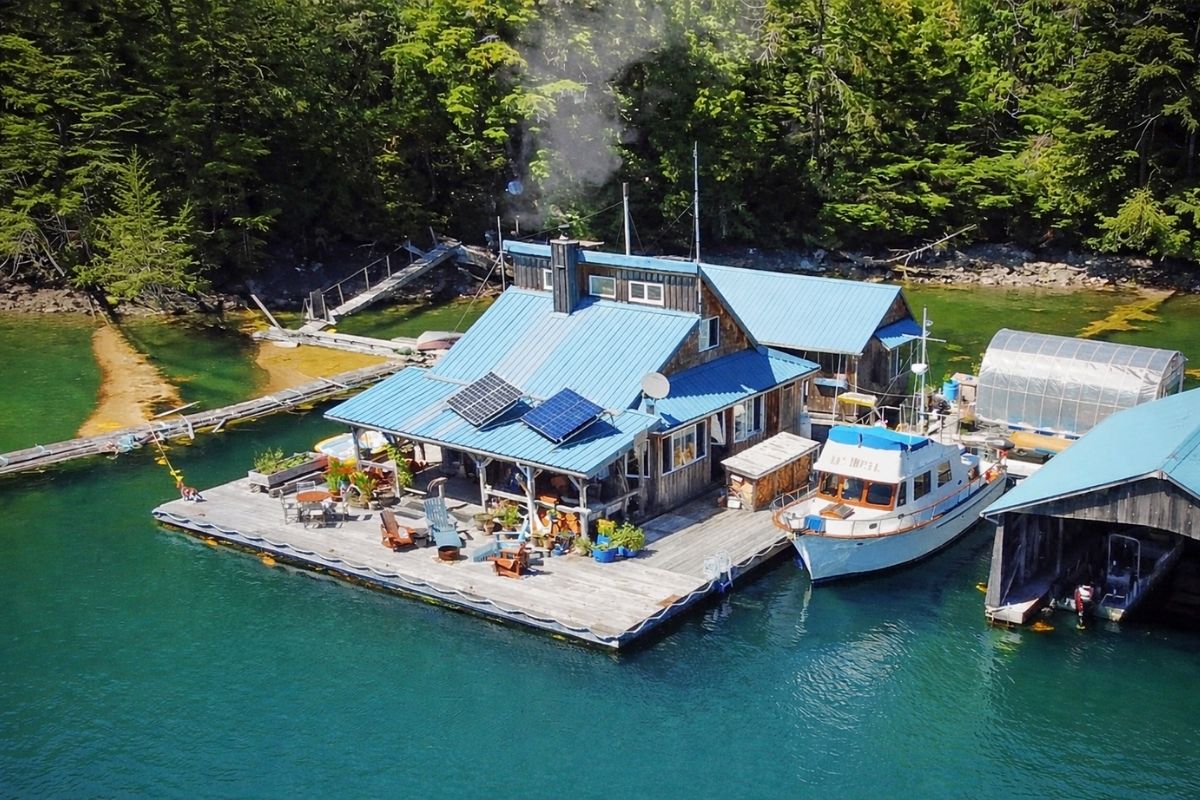
Couple Builds and Expands, Over 30 Years, an Off-Grid Floating Home Accessible Only by Boat or Plane, Generates Its Own Energy, Captures Water from a Lake in the Mountains, Grows Part of Its Food, and Learns to Coexist with Storms, Strong Winds, and Long Periods Without Being Able to Leave.
In a protected arm of the sea on the west coast, they are the only year-round residents, surrounded by seasonal fishermen and an untouched landscape. Living in an off-grid floating home there is not a “romantic retreat,” but a real-life engineering project that demands planning, physical strength, and a constant relationship with the climate and water.
A Home That Has Floated for Three Decades
Charlie built his own house about 30 years ago in a sheltered canal with direct access to the ocean. Over time, what began as a simple cabin grew, gaining structure and comfort.
Today, the off-grid floating home has approximately 900 square meters of area spread across two levels, all made of wood, primarily cedar.
-
How 5,000 Indian dabbawalas manage to deliver around 200,000 lunchboxes a day in Mumbai for over 130 years using bicycles, crowded trains, and a manual system that continues to operate with impressive accuracy.

-
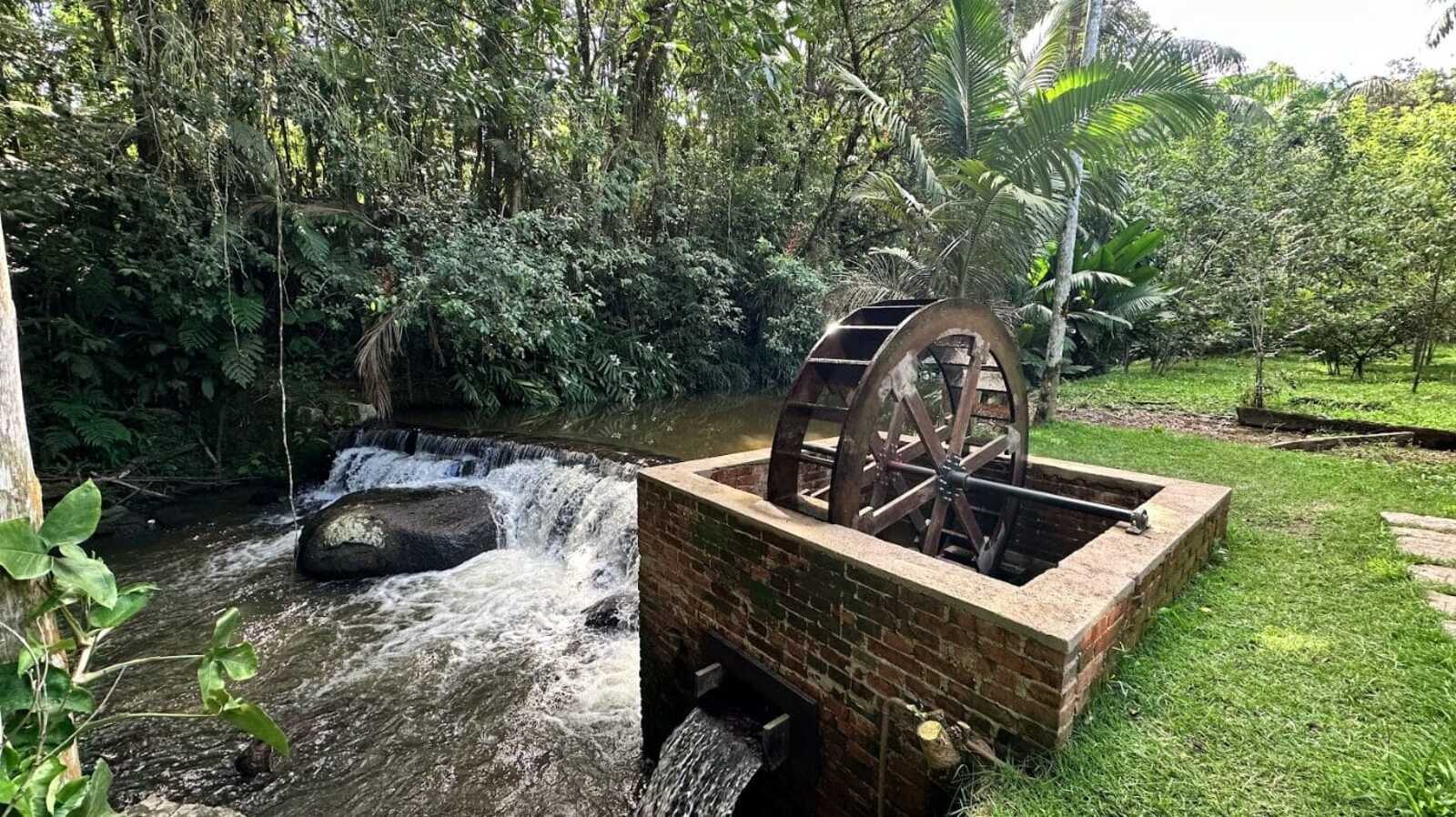
While restoring a historic mansion from 1910, a brick structure with an old turbine that generated energy from the Rio do Testo emerged, along with a hidden door and a rare floor concealed under layers of wax.
-
Italian researchers have detected what appears to be a second Sphinx buried under the sands of Egypt, and satellite scans reveal a gigantic underground megastructure hidden beneath the Giza Plateau for over 3,000 years.

-
There are 4,223 drums and 1,343 metal boxes concreted with 50-centimeter walls that store the radioactive waste from Cesium-137 in the worst radiological accident in Brazil, just 23 kilometers from Goiânia, with environmental monitoring every three months.


On the lower floor are the master bedroom, an integrated kitchen and living room, and a full laundry room with a gas washer and dryer. On the upper floor, two additional bedrooms and a storage area ensure space for visitors and for storing supplies that need to last weeks.
Inside, the off-grid floating home offers nearly everything a “normal” house would, while outside, it depends entirely on the stability of the water and how it was anchored.
A wide deck about 12 feet wide surrounds the main cabin. It is here that the couple stores dry firewood, organizes the space for outdoor meals, and maintains the habit of ending the day sitting facing the canal, watching the tide and the fish hiding under the floating structure.
Structure and Ties: What Keeps an Off-Grid Floating Home Stationary

Under the structure, foam blocks form the flotation base, a solution that, at the time it was built, was considered the quality standard.
Today, Charlie acknowledges that he would use a different system, such as robust plastic blocks encapsulating the foam, but the current structure continues to fulfill its role.
The off-grid floating home does not float freely in the canal. It is tied to a “tie up” system: a kind of grid made of logs tied together, extending out in front of the house.
At each end, smaller logs enter the woods and are anchored to stakes driven into the rock. On the opposite side, cables stretch to trees and stable stumps on the shore.
Additionally, there are anchors on the bottom of the canal that help keep the position. The result is that the off-grid floating home moves very little, even when the wind picks up; only during more severe weather does the motion become more noticeable, but even then, without a real sense of danger.
To complement the setup, Charlie built a floating shed to protect the open boats, essential for those who rely on navigation in any condition.
The couple’s main boat, a fiberglass model from the 1970s, is their safe vessel for facing rougher seas and traveling in bad weather.
Energy and Water: Discreet Engineering Behind the Perfect View
The autonomy of the off-grid floating home directly depends on the energy system. On the roof and nearby structures, a set of solar panels with around 2,000 watts of power fuels daily needs.
In summer, when sunlight is strong, the panels can meet most demands, lighting, water pumps, household appliances, and lighter tools.
When it is necessary to power heavier machines or when the sky is overcast for many days, the combustion generator steps in, supplementing solar production.
In winter, off-grid solar power needs to be supplemented with more hours of generator use, but even so, it significantly reduces dependence on external fuel.
Water comes from a small lake above the house, connected to a stream that flows down the slope. A collection system carries the water to reservoirs with a capacity of about 2,000 gallons, positioned high enough to provide natural pressure to the house.
Sequential filters remove larger particles, and in the kitchen, an additional filter prepares the water for direct consumption.
Gray water (sinks and shower) returns to the canal, which is about 12 meters deep and is renewed by the tides; a significant portion of the volume refreshes with each cycle. The waste from the toilet is treated in a composting system, reducing the load on the environment.
Garden, Shellfish, and Firewood: Food and Heat Off the Grid
Living in an off-grid floating home also means reducing dependence on supermarkets. The couple maintains a robust garden in boxes and beds on the deck: there they grow kale, carrots, peas, beans, zucchini, cucumbers, broccoli, arugula, garlic, and other seasonal vegetables. In summer, around half of the vegetables consumed come directly from this garden.
From the water in front of the house comes protein. A single crab trap, placed just off the deck, yields generous-sized Dungeness or Red Rock crabs when the season and local regulations allow. It is a fresh food source that complements the long-lasting stocks brought from town.
To heat the home and hot water, the solution is a wood stove. The firewood, in many cases, arrives floating: loose logs carried by the tide are rescued with ropes, tied together, and towed to the off-grid floating home. Later, they dry in a specific spot on the deck before being cut and split.
As the wood has spent time in saltwater, there is a buildup of salt that accelerates the corrosion of the stove. Instead of fighting against it, Charlie accepts it as part of the system: he estimates that each stove lasts around ten years before being replaced. The process of cutting and splitting firewood is labor-intensive, but a hydraulic splitter helps reduce physical effort.
Living in Isolation: Weather, Logistics, and Longing

Despite having a full structure, the off-grid floating home is not an entirely self-sufficient island. The couple still relies on nearby towns for boat fuel, gas, groceries, and plastic recycling.
The difference is that trips to town are rare; if nothing urgent happens, they can go up to six weeks without leaving, depending on deliveries made by friends or a boat that comes to an intermediate point for a supply exchange.
In winter, the weather dictates the schedule. Strong winds and high waves in the open sea can cancel trips for an entire week.
During these times, any plan to go to town needs to be revised and rescheduled according to windows of calm weather. Living in an off-grid floating home means accepting that the weather rules more than personal schedules.
Connectivity is limited, but it exists. A satellite phone system, associated with the internet, allows them to catch up on news, talk to family, and work on some remote activities. Even so, the feeling of isolation is real, especially for those who are more extroverted.
For her, who defines herself as someone who enjoys contact, the hardest part isn’t the lack of shops or restaurants, but the distance from her children, grandchildren, siblings, and loved ones. Visits happen infrequently and require complex travel logistics.
The Body Pays the Price of the Off-Grid Floating Home
For many years, the couple lived there full-time. She worked in healthcare as a hospital director before permanently moving; he left the forestry industry after three decades and made the off-grid floating home his new center of life and work, providing services, building structures for neighboring canal residents, and even leading nature tours.
Over time, however, daily physical effort began to take its toll. Lifting loads, handling firewood, getting on and off the boat, managing cables, maintaining the structure—all of these require muscles, joints, and balance that do not remain the same with age. Chronic pain, arthritis, and mobility limitations have become part of the equation.
Therefore, the couple decided to buy a second house on solid ground, to which they are gradually moving and where they have easier access to healthcare services and infrastructure.
The connection to the off-grid floating home, however, remains deep; he describes the place as an extension of himself, a challenge that became an achievement and, after decades, part of his identity.
For them, the time spent on the floating home was not a passing “experiment,” but an entire chapter of life. A chapter that, at some point, will need to be closed or adapted, whether by passing the house on or by reducing the time spent in the canal.
In the end, the question that their story throws back at us is: would you dare to live in an off-grid floating home accessible only by boat, generating your own energy, water, and part of your food, in exchange for absolute silence, intense storms, and an extreme isolation that relies on your body and willingness every day?







-

-

-

-

10 pessoas reagiram a isso.