





 Portuguese
  English
  Spanish
  5 min of reading
  1 comment


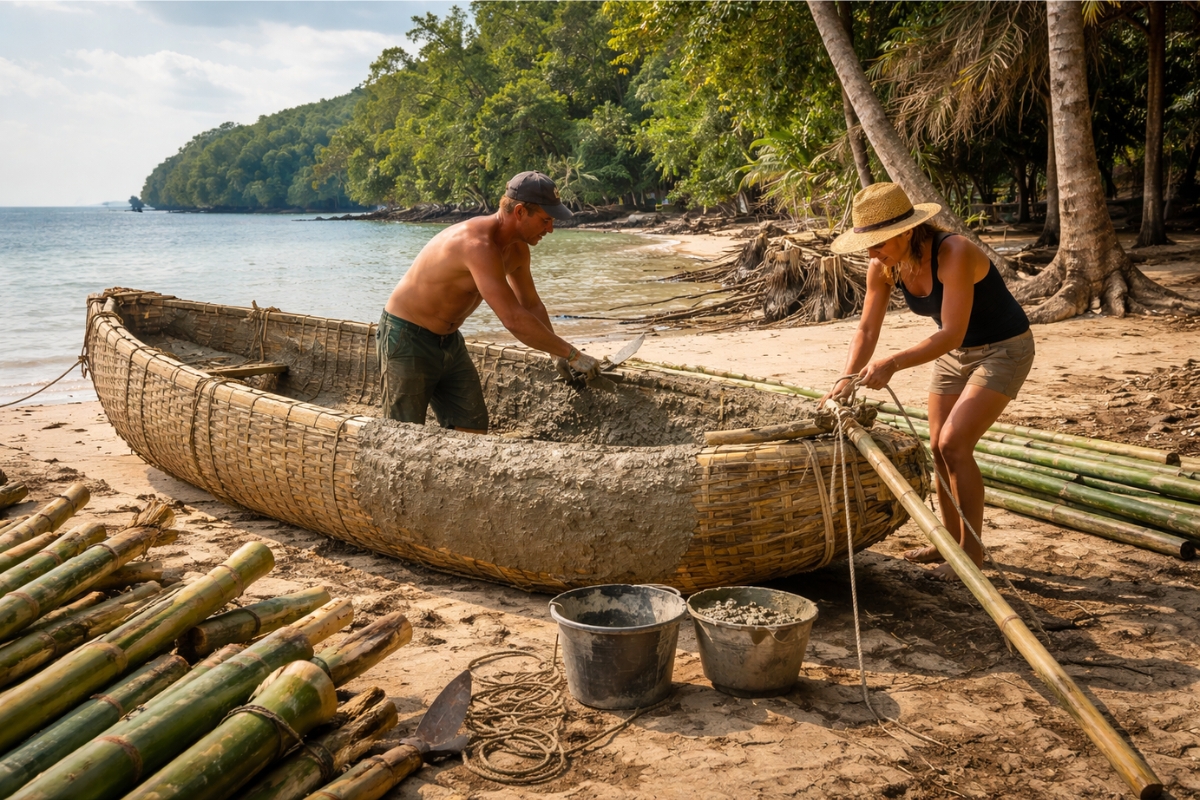


With Manual Technique and Well-Defined Stages, a Vessel is Born from the Combination of Woven Bamboo and Mortar, Revealing a Simple, Progressive, and Totally Functional Construction Method
The advancement of constructive solutions made with plant materials and manual techniques has shown practical ways to create functional structures outside of a conventional construction site. Among the most striking cases is the construction of a vessel made from bamboo, with a closure of mortar applied directly over a woven base. What stands out is not an isolated trick, but the logic of execution in layers, the repetition of work, and the control of the hull shape.
The assembly begins with the preparation of long poles, moves to the production of panels with thin interwoven strips, and evolves into a coating phase, where the surface changes in texture and rigidity. The process is conducted by two people, alternating tasks with a constant rhythm and simple organization around the work area.
In practice, this type of construction is interesting because it reveals how bamboo, woven strips, wood, and mortar can form a continuous shell when the sequence is well controlled. It also highlights critical execution points, such as alignment, tying, edge reinforcement, and smoothing, which determine the final result.
-
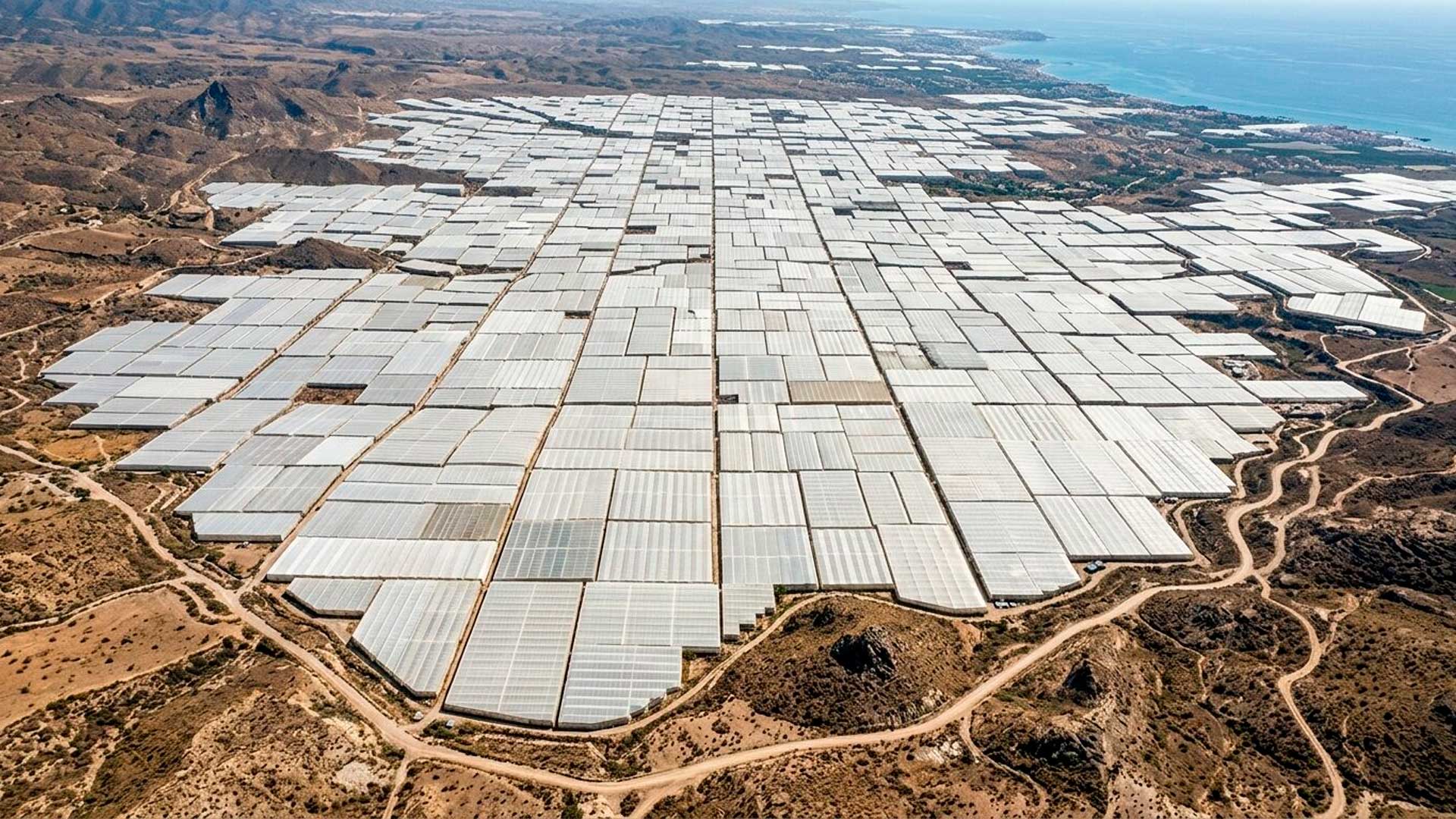
Neither the Pyramids nor the Great Wall of China, this gigantic construction in Spain is the human mark on planet Earth that intrigues the most when seen in images from space.
-
Surrounded by cliffs, mist, and chilling stories, the ancient Hotel del Salto has been reborn as a museum while still unable to shake off its reputation as a haunted place.

-
This star-shaped fortified construction, hidden near the border of Spain, may be the largest fortress on the planet.

-
Congonhas receives the monorail promised for the 2014 World Cup after more than a decade of delays and becomes the first airport in Brazil with integrated subway.

Preparation of Bamboo in the Ground: Cutting, Selecting, and Standardizing Parts

The initial stage takes place in an open area, with exposed soil and many bamboo poles spread out and aligned. The visual impact is in the volume of raw material and the manual selection of parts, separated by length and straightness to reduce differences in fitting.
The execution involves cutting the ends and adjusting specific poles, using gloves and a measuring tool. The bamboo is supported on the ground, rotated, and repositioned, while smaller pieces accumulate around, indicating the repetition of cutting until an acceptable standard is reached.
As a direct consequence, the poles begin to behave more predictably during assembly, with less apparent twisting. Standardization facilitates the creation of reference lines and reduces the need to force the material during the joining process.
A striking detail is the constant presence of tools near the cutting point, reinforcing a continuous flow of production of parts, without unnecessary displacements.
Woven Bamboo Strip Panel: Flexible Base that Becomes a Coating Support

With the material prepared, a stage emerges that defines the behavior of the surface. Thin strips of bamboo are interwoven in a crisscross pattern, forming a dense and regular panel. What captures attention is the uniformity of the weave, with parallel strips and repeated crossings.
The execution is done by hand, pulling and adjusting each strip to keep the fitting tight. A thicker bamboo appears as a border, locking the assembly and preventing the weave from opening, while the crossings remain aligned to distribute the effort.
The practical effect is the creation of a continuous base that can receive load and coverage, functioning as support for the mortar. The weave closes gaps, reduces free spaces, and creates a surface that accepts manual pressure during the application of the paste-like material.
A noticeable point is the care with the edges of the panel, where the fastening is reinforced to avoid fraying and loss of tension in the weaving.
Structure and Reinforcements: Tying, Joining Poles, and Geometry Control

The assembly progresses with the joining of structural elements. Bamboo poles are positioned and tied, forming a mesh that shapes the hull. The impact is the emergence of a more defined outline, with sides and base starting to function as a cohesive unit.
The execution uses visible ties at meeting points and sequential locking, preventing one piece from moving while the other is adjusted. Wooden elements with holes and metal hooks also appear, along with gray plastic tubes, indicating auxiliary structural or support components.
As a result, the vessel gains stability to receive the coating without easily deforming. The geometry is controlled by locks and ties, reducing displacements during handling and allowing people to work on the surface without dismantling the assembly.
A relevant detail is the repetition of ties at similar intervals, suggesting a distribution pattern of fastening points to maintain rigidity along the length.
Preparation of Mortar and Direct Application: Layer that Closes Gaps and Hardens the Hull

The coating phase changes the character of the construction. A gray, pasty mixture appears over the woven base, applied with a trowel and also with manual pressure. The contrast between the light weave and the dark mortar highlights the transition to a closed shell.
The execution consists of spreading the material in portions, pressing against the surface to fill gaps in the weave. The movement is repetitive, with constant smoothing to reduce steps and ensure continuous contact between mortar, bamboo strips, and structural edges.
The immediate result is a noticeable increase in rigidity and surface continuity. Where the mortar covers, the texture ceases to be porous and begins to function as skin, with fewer visible openings and a more monolithic appearance.
What stands out is the care in distributing the mass without leaving uncovered areas, reinforcing transition points and edges, which tend to concentrate effort during use.

Why This Technique Stands Out in Practice: Simple Sequence and Material Control
Three pressures are clearly evident in this type of manual construction: reducing stages, utilizing available materials, and ensuring a closed surface that does not rely on ready-made parts. The observed method responds with a straightforward logic, where structured bamboo, woven mesh, and mortar form a layered system.
The execution does not depend on heavy machinery. What supports the process is repetition, measurement, cutting, and consistent application, with task division between two people. This reduces interruptions and keeps the work progressing with a visible advancement in shape and rigidity.
The final effect is a vessel that transitions from a set of loose poles and strips to a continuous hull, with a smoothed surface and reinforced edges. The case also highlights that the outcome depends less on improvisation and more on execution discipline, particularly in tying and closing with mortar.


What is observed is a construction that evolves through well-defined layers, where the woven mesh resolves the superficial support, and the mortar provides closure and rigidity. The most decisive technical factor is the control of the fitting between strip panel, bamboo edges, and uniform application of the mass, avoiding visible failures in continuity.
On a broader impact, the case reveals how an organized manual process can transform simple materials into a functional structure, with progressive finishing and repeated adjustments until stabilizing shape and surface. The technique exposes a practical construction path through sequence, where each stage prepares the next, and the result appears as a direct consequence of the method.







Como usar cimento vivendo em uma ILHA totalmente ISOLADA?