





 Portuguese
  English
  Spanish
  9 min of reading
  11 comments


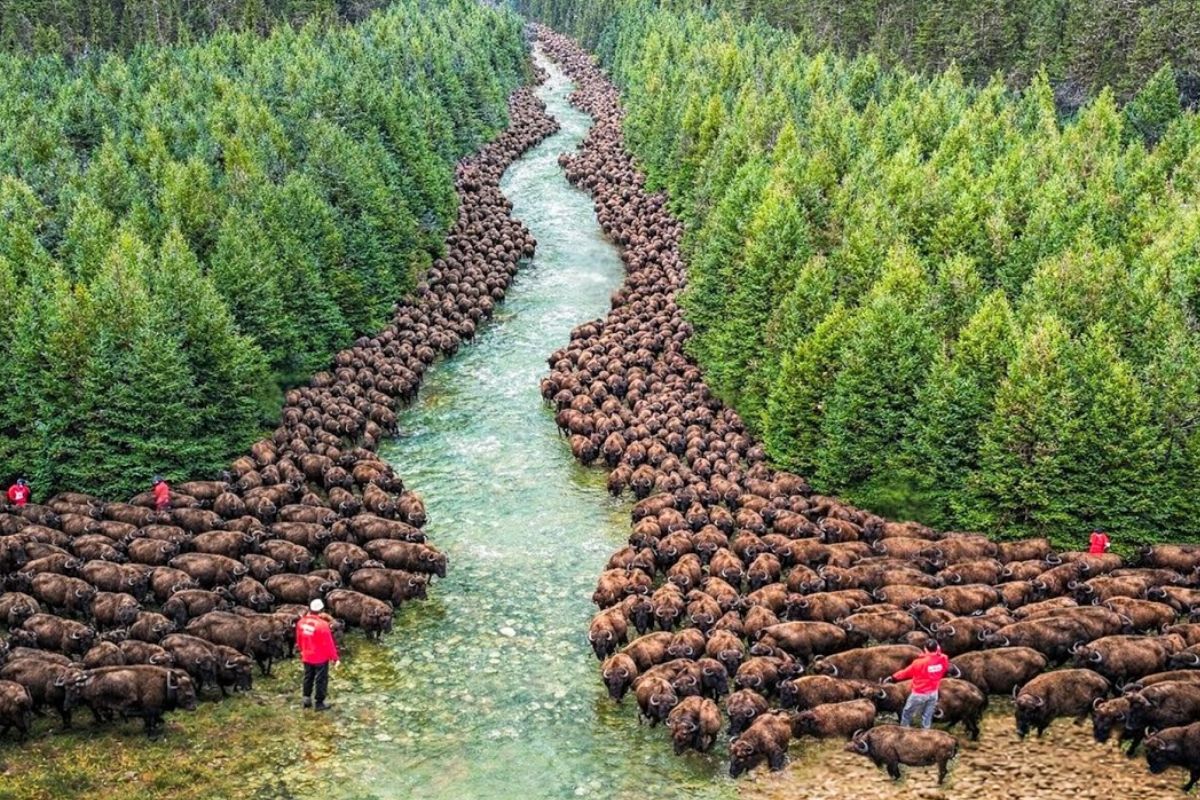


On May 17, 2014, 17 bison began the reintroduction in a 15-hectare enclosure in the Tarcu Mountains. After two years, they were released, and new releases occurred in 2018. By 2021, there were already more than 100, spread over 200 km, with 30% more plants with living together challenges.
The bison returned to be released in the Tarcu Mountains, Romania, as part of a direct response to the ecological emptying that Europe experienced in record time: in just 150 years, more than 90% of large mammals disappeared from the natural landscape, with cascading impacts on biodiversity, soils, and ecological cycles that had functioned for thousands of years.
The reintroduction seems a last resort precisely because it attempts to recover not just a species, but the “links” that made the landscape function internally. In about a decade, the plan formed a self-sustaining herd and changed the environment with an increase of 30% in plant richness, but it also brought real conflicts, fear, and negotiation with communities that live and work in the region.
The Void Left When The Bison Disappeared
Europe tried various strategies to restore forests, but the central problem was not just at the tops of the trees. What disappeared were ecological connections that maintained the functioning of the territory. In certain landscapes, planting trees does not restore what was interrupted, because the ecosystem relies on interactions, movements, and herbivory pressure that reorganize the environment.
-
The most famous volcano in the world could paralyze one of the largest metropolises on the planet: Japan accelerates emergency plans for the eruption of Mount Fuji, which could bury Tokyo in ash for over two consecutive weeks.

-
The United States has a serious problem with its F-35s: China is already producing fighters at a pace that exceeds American capacity and could manufacture up to 300 aircraft per year before the end of the decade, shifting the global military balance.

-
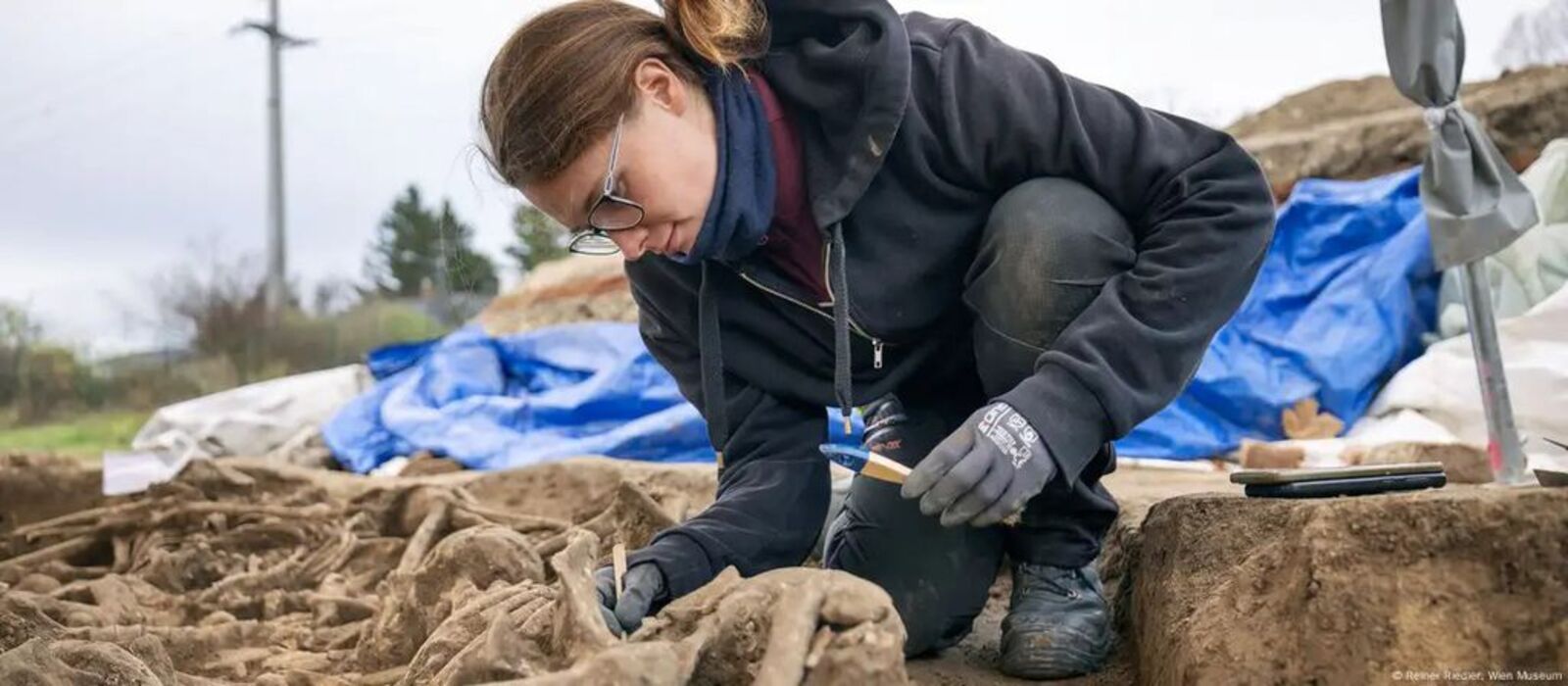
Remains with battle wounds of over 100 soldiers from the Roman Empire are found beneath a football field in Vienna, leaving everyone surprised.
-
Elon Musk notes Brazil and lowers the price of his internet, Starlink, promising to connect all corners of the country with affordable plans, 10,000 satellites, and 1 million active users in the national territory!


It is at this point that bison enter as a piece of natural engineering: by occupying territory, they reintroduce movement and variation in the landscape, creating conditions for different forms of life to find space again.
From Ubiquitous Animal to Extinct in Nature in a Few Decades
The contrast is brutal. A few centuries ago, bison roamed large areas of Europe: from the Iberian Peninsula to Scandinavia, from the Atlantic to the Caspian Sea. The historical population may have reached hundreds of thousands, even millions of individuals.
The decline did not come from a single event. Bison had been hunted since the hunter-gatherer era, but the turning point occurred with the expansion of agriculture.
The combination of excessive hunting and large-scale deforestation eroded, century after century, the available habitat. They were not decimated all at once; they were slowly suffocated by the expansion of civilization.
By the early 20th century, environmentalists already saw an almost inevitable fate. A species that survived the glacial era and thousands of years of climatic upheavals seemed unable to withstand a single century of modern human pressure: hunting, habitat loss, and fragmentation. World War I appears as the final blow to a population that was already hanging by a thread: bison were hunted for meat, hides, and horns in chaos and occupation.
After the war, only two small herds remained. Nine individuals in the Biova forest in eastern Poland were hunted to the last, with the last one killed in 1921.
The other herd, hidden in the remote mountains of the western Caucasus, was found and killed six years later. The result was straightforward: the European bison was officially extinct in the wild.
And, as a symbolic landmark, in 1919 the last wild European bison was killed without ceremony, without the majority realizing what that meant: the largest terrestrial animal in Europe had disappeared from the wild.
The Problem That Almost Killed The Species in Silence: Genetics
When the species no longer existed in nature, what remained were animals in captivity. There were just over 50 individuals, and this created an extreme genetic bottleneck. The risk of inbreeding ceased to be a hypothesis and became almost inevitable.
Many scientists believed that, even without an immediate extinction, bison would gradually weaken, lose reproductive capacity, and disappear in silence. The threat was not just to “die,” but to cease to sustain themselves as a viable species.
The Institutional Turn: Saving Bison with Coordination and Traceability
A small group of environmentalists refused to accept the collapse. Polish zoologist Yan Schultzman pushed for urgent action.
Alongside him were Hines Hec, director of Munich Zoo, and his brother Lutz Hec, director of Berlin Zoo. They coordinated efforts to gather the remaining bison from zoos and private reserves.
The group formed an international society for the protection of the European bison and presented a plan at the International Nature Conservation Conference in Paris in 1923.
The next step was technical and decisive: in 1932, the European bison pedigree book was created to register each individual and manage breeding decisions, aiming to avoid genetic collapse.
This moment redefined the discussion. The question was no longer just whether the species would survive, but in what way it would survive: as a wild animal or as a permanently managed population.
The First Return and The Central Question: Would Bison Remember How to Live Free?
In 1929, the first European bison were released back into the wild. The population grew slowly and expanded to other large forests in Poland, but one question persisted for decades: would a species that lived for generations behind fences still have sufficient behavioral “memory” to survive outside of them?
When the numbers reached hundreds, the question became more pressing: would the return to nature be real or just symbolic?
Why Tarcu Became Europe’s Toughest Test
The answer was to find a place that did not mask vulnerabilities. The Tarcu Mountains are described as one of the last remaining wild landscapes.
The logic behind the choice is simple and relentless: if bison could not survive there, they would not survive anywhere.
In 2012, Rewilding Europe and WWF Romania launched a project in the region, presented as vast, with primary forests, river valleys, and alpine pastures.
The goal was to put bison back in a territory where natural pressures would truly return, without the buffer of an excessively controlled environment.
The Reintroduction in Detail: 15 Hectares, 17 Bison, and a Controlled Beginning
On May 17, 2014, European bison returned to the Romanian Carpathians for the first time in over 200 years.
The start was planned to reduce immediate risks: an acclimation enclosure of 15 hectares was built to protect the first herd of 17 bison.
This setup allowed researchers to monitor health-related behaviors and reinforce prevention against illegal hunting.
The premise was clear: before releasing, it was necessary to prepare the herd for transition and at the same time protect the project from an immediate human shock.
The First Years Were Difficult: Predators, Cold, and Social Stress
The initial phase did not turn into a success story. Many calves were killed by predators. Weaker individuals did not survive harsh winters.
Within the herd, hierarchical relationships constantly changed, generating conflict and stress.
Still, one point began to emerge as a turning point: learned behavior. Calves born in the wild did not carry the memory of captivity.
They learned to read the landscape, avoid danger, and move in rhythm with the forest. It’s the kind of learning that cannot be “programmed”; it only happens when real life starts happening again.
After two years, the first herd was fully released. Subsequent reintroductions occurred in 2018. Not all releases were completely successful, but each step added data, experience, and confidence that bison would be able to sustain themselves.
The Turnaround in a Decade: Self-Sustaining Herd and Territorial Expansion
By 2021, more than 100 European bison lived freely in the Tarcu Mountains. They were not hundreds or thousands, but the number was deemed sufficient to demonstrate something more important than volume: the formation of a self-sustaining population.
These individuals spread well beyond the original release area. Their presence was noted over an extent greater than 200 km.
They were not confined and began to determine territory on their own, a crucial sign that the species had returned to its original ecological role.
Here lies the point that gives weight to the project: it’s not just about releasing animals; it’s about seeing them occupy the landscape autonomously.
The Most Visible Effect: 30% More Plants and a Mosaic Landscape
The presence of bison quickly generated measurable changes. Plant species richness increased by about 30%.
Forests that were considered monotonous were gradually “dismantled” ecologically and replaced by mosaic landscapes, where grasses, shrubs, and young forests coexist.
The described mechanisms are tangible. Bison wallows retained water. The dung enriched the soil.
Their thick fur carried seeds by the dozens of kilos. And the strongest idea behind this is simple: there was no order, nor direct human coordination.
Bison did not “restore” nature as a finished work. They gave the necessary push for nature to do the rest.
Why Bison Change Ecosystems: Size, Speed, and Behavior
Before their disappearance, European bison were described as animals of extraordinary size, taller than humans and weighing almost as much as a car.
Even so, they could move three times faster than an adult and jump obstacles that seem improbable for such a massive body.
At first glance, this power intimidates. In practice, bison are presented as calm and fully herbivorous, tending to avoid conflicts.
The ecological effect comes from how they live: by feeding in forests and mixed landscapes, grazing on grasses, shrubs, and young branches, they create clearings and structural variation in the environment.
Where bison pass, the habitat ceases to be uniform, and this diversity opens up space for a chain of life.
The Inevitable Conflict: Human Coexistence, Harvest, and Safety
The return of bison did not occur in a social vacuum. Local communities worry about damage to crops, and questions about safety arise.
The reintroduction turns into negotiation because retracing is never just ecological. It’s about reorganizing coexistence, expectations, and land use.
One episode summarizes how modern Europe reacts when wildlife returns to act as wildlife.
A male bison traveled farther than any individual before him, swam across the Odor River, and crossed the Polish-German border, becoming the first free bison to do so in over a century.
What could have become a symbol of return ended in tragedy: a few hours later, in Germany, local authorities, out of fear and uncertainty, shot the animal.
The reading of this case is harsh: although poaching still exists, the greatest threat to bison today is not the hunter in the dense forest. It is the conflict between wildlife and the ways humans use the land.
The Practical Response: Compensation, Dialogue, and Adaptation from Both Sides

Therefore, conservation cannot stop at release. Organizations are pressured to establish compensation funds, train local guides, and open direct channels of dialogue with communities.
Even when recorded damages are low, fear does not disappear simply with statistics.
Adaptation needs to occur from both sides. Humans need to overcome fear, understand the gentle nature of bison, and recognize the ecological services they provide.
And bison also need support to learn to move safely through settlements and agricultural lands in an increasingly fragmented continent.
The Game-Changing Side Effect: 2 Million Euros Per Year in Ecotourism
At the same time, a new form of value began to emerge. Bison-centered ecotourism began attracting around 2 million euros per year to the region.
Guesthouses, restaurants, guiding services, and local crafts developed gradually.
Not everyone benefits equally, but the shift in perception is relevant: for the first time in decades, the wild nature is no longer seen solely as an obstacle to development, but becomes part of the local economy. When the landscape becomes an asset, the conversation changes.
The Return on a Continental Scale: 9,000 Bison and the Limits of European Space
Tarcu is not an isolated case. Ten years after the first reintroductions, consolidated data from the European bison pedigree book and the IUCN showed a continental-scale return.
Poland and Belarus host the largest populations in the world, with over 2,000 individuals in each country, serving as origin centers for many reintroduction projects across Europe.
Beyond these two poles, bison have reappeared in countries like Germany, the Netherlands, France, Denmark, Spain, Romania, Ukraine, Slovakia, Russia, and Balkan states. With updated data in 2024, Poland alone hosts approximately 2,800 European bison.
In total, the population of European bison reached about 9,000 on the continent.
But this number raises the most difficult question: how much space does Europe still have for large animals when roads, agriculture, settlements, and even renewable energies compete for the same territory?
Retracing is not going back in time to an untouched Europe. It is about redistributing space, accepting friction, and recognizing that this choice comes with a cost.
The story of the European bison appears, at once, as an extraordinary achievement and as a plan to bring large species back. And also as a maturity test: if nature truly returns, how far are humans willing to step back?
Do you think the release of bison in wild areas is worth it even when it requires compensation, negotiation, and coexistence with perceived risks from local communities?







Vale a pena sim
Sim, não só com esta espécie, mas com todas. A introdução de animais é muito importante, mas com plantas també.
SI A SU PREGUNTA