





 Portuguese
  English
  Spanish
  7 min of reading
  3 comments


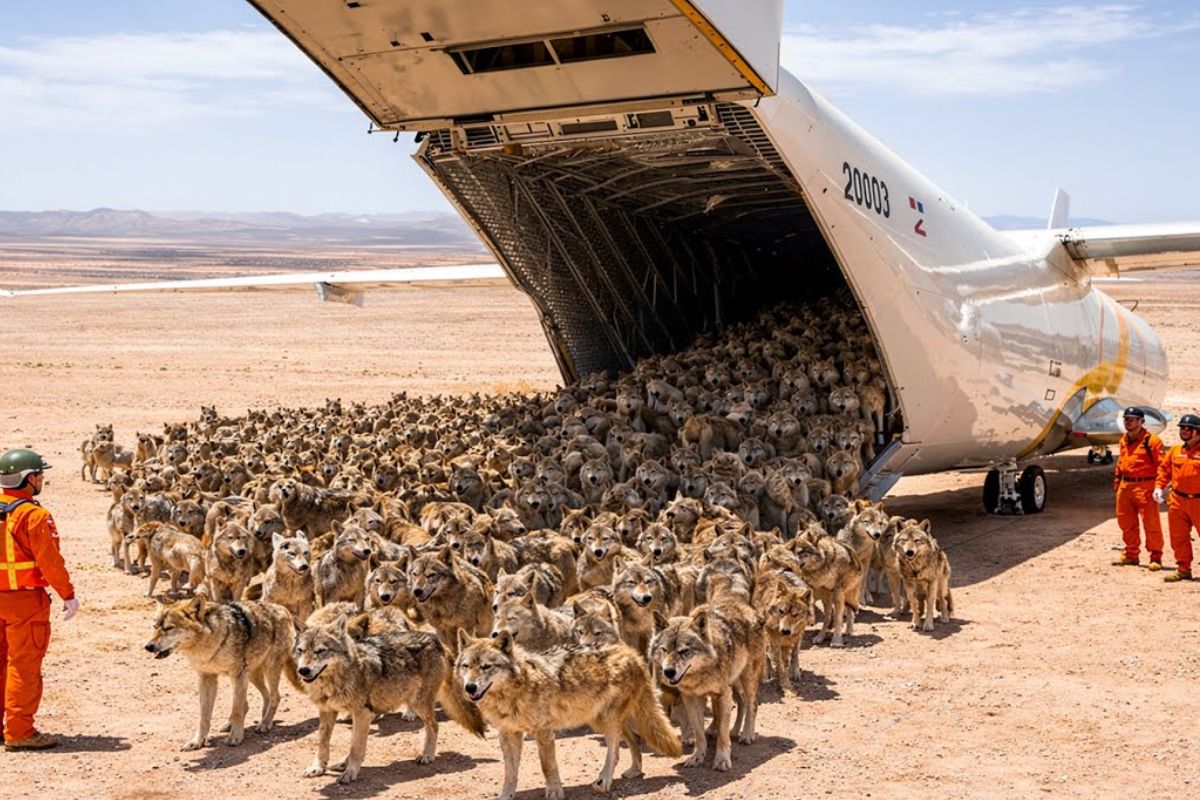


Program Started In 1998 Released 13 Wolves In The Blue Range Between Arizona And New Mexico And Reached 195 Animals Freed Until 2023. With At Least 286 Individuals In 2024, Hundreds Of Wolves Returned To The Field In The Region, But Generated 111 Attacks On Cattle In 2023 And 99 In 2024.
Hundreds of wolves threatened with extinction began to howl again in Arizona after decades when predator elimination was treated as a policy to protect people, livestock, and the order imposed in the field.
The return of the Mexican wolf, initiated in 1998, reintroduced a top predator into rural communities and livestock areas, reigniting an old conflict while simultaneously opening space for profound changes in the balance of ecosystems.
The Extermination Campaign That Removed Wolves From The Map For Over A Century

For over a century, wolves were shot, poisoned, trapped, and eliminated with bounties that spanned generations in the American West.
-
Seen from space, a colossal volcano nearly 5,000 meters high in Russia has released 1,600 km of smoke over the Pacific, forming “devil’s horns” of lava and revealing the brutal force of the Ring of Fire.

-
Expedition 501: Scientists drill into the ocean floor and discover a giant reserve of fresh water hidden beneath the sea, extracting nearly 50,000 liters and revealing an invisible system that could reshape the map of water scarcity.

-
Archaeologists find an intact tomb over 2,500 years old, with more than 100 preserved objects, weapons, jewelry, and human remains never touched.

-
Volcanic lava transforms into threads as fine as human hair that travel over 30 kilometers by wind and fall like cutting rain on roofs and backyards in Hawaii and Iceland.

This was not an isolated dispute, but an organized logic to reduce economic risk and impose control over territory.
A landmark of this escalation occurred in 1915, with the creation of the Biological Survey, a precursor to the current federal wildlife service, explicitly mandated to eliminate predators seen as threats to livestock and development.
From then on, hunting ceased to be a choice and became a strategy, helping push wolves to remaining scattered in remote regions.
The Mexican Wolf Almost Disappeared And Became A Symbol Of Collapse
Among the hardest-hit populations, the Mexican wolf became the most emblematic case. The smallest subspecies of the North American gray wolf and the most southern, it lived in the deserts, mountains, and forests of southern Arizona, New Mexico, and Texas, adapted to arid climates but vulnerable to organized persecution.
By the 1940s, the subspecies was nearly completely eliminated in the United States. By the end of the 1960s, reports of sightings became rare.
In 1970, the last wild Mexican wolf disappeared in New Mexico, ending the existence of the subspecies in the wild in American territory and consolidating the sense of “victory” for part of the country.
The Ecological Vacuum: Without A Top Predator, The Landscape Began To Deform
The elimination of the Mexican wolf did not create an immediate dramatic silence, but triggered gradual changes. Without a top predator, populations of deer and elk increased and spent decades under low natural predation pressure.
The first shock appeared in the vegetation. In river valleys and low areas, herbivores concentrated, consumed sprouts, and hindered the regeneration of species like willow, aspen, and birch.
With fewer young plants, riparian forests thinned, vegetation cover decreased, and banks lost stability. Erosion advanced, river flows became more unstable, and the quality of aquatic habitats degraded.
Cascading, other species lost space, especially beavers, animals that help regulate water and create wetlands. With the decline of beavers, ponds and swamps shrank, groundwater levels fell, and the landscape lost its ability to retain water.
It was in this accumulation that the absence of the predator began to be read as a rupture of a basic mechanism of ecological control.
From Seven Founders To The 1998 Decision: The Planned Return Of Hundreds Of Wolves
Hope came from south of the border via a capture decision. Between 1977 and 1980, the last wild remnants of Mexican wolves were captured to form a captive breeding program.
The detail that would shape the future is harsh: the reconstruction started with just seven founding individuals.
In 1998, the federal government made the move that contradicted a century of eradication: it deliberately reintroduced the Mexican wolf into the wild. Thirteen wolves were released in the Blue Range area, which spans Arizona and New Mexico.
It was the first time in almost three decades that howling returned to this type of landscape, and the step placed the country before a practical question: how to coexist with a predator in areas where there are people, livestock, and competition for land every day?
From there, the program continued steadily. Until 2023, 195 wolves were freed in 67 different groups.
By the end of 2024, the population of Mexican wolves in the United States had grown to at least 286 individuals, including animals born in the wild. Hundreds of wolves, therefore, ceased to be a hypothesis and became a real presence in the field.
The Conflict With Cattlemen: Attacks On Livestock Became A Metric Of Fear And Cost
For some rural communities, the debate does not start with the returning vegetation or the stability of riverbanks. It starts with the loss of animals and the feeling that control of the territory slips away.
In areas with the presence of Mexican wolves, there were 111 confirmed incidents of livestock attacks in 2023 and 99 in 2024.
The very process of confirmation tends to be difficult in large open areas because determining the exact cause of animal deaths is not always simple. Still, the number is enough to fuel tension, especially where cattle ranching is the economic base and local identity.
When it comes to direct threats to humans, fear usually grows faster than records. Ecological reports do not list wolves as the main cause of attacks on people, but the image of a predator with prey near settlements is enough to generate discomfort. In this environment, hundreds of wolves become a symbol, not just an animal.
The Reintroduction Changes Prey Behavior And Begins To Redraw Rivers And Forests
The return of the Mexican wolf did not produce instant turnarounds, but began changes through prey behavior.
With the return of wolves, deer and elk no longer moved and fed with the same freedom. They began to avoid river valleys and open areas where the risk of predation is higher.
This behavioral change, more than an explosion of deaths, opened space for vegetation to recover.
On riverbanks, young plants that were consistently consumed gained a chance to grow. Balances that seemed blocked for decades began to appear again, with more visible regeneration of willows and aspens.
Banks became more protected, erosion decreased, and river flow began to stabilize.
This is where the reintroduction shows why hundreds of wolves do not mean just “more of a species.” They mean the return of a control mechanism that reverberates through plants, water, soil, and habitats.
The Genetic Bottleneck: The Biological Cost Of Rebuilding A Species From Seven Animals
The most silent challenge of the current population is genetic. Every Mexican wolf alive in the United States descends from just seven founders, creating a genetic bottleneck with diversity reduced to dangerously low levels.
The consequences do not appear all at once, but accumulate: lower reproductive success, weaker immunity, and a higher risk of genetic defects.
The problem grows when groups in the wild become dispersed, making it difficult to find non-related partners and maintaining cycles of inbreeding.
To address this, human intervention deepened. One strategy is the fostering of pups: pups born in captivity are placed in dens of wild wolves when they are a few days old, to be raised by wild adults.
By 2023, 83 pups had been successfully fostered and raised entirely in the wild. The paradox is inevitable: to restore a wild species, humans need to intervene more than they would like.
The Red Wolf Exposes How Science, Law, And Politics Can Determine Survival
The story of wolves in the country does not end in Arizona and New Mexico. The red wolf pushes the debate into an even more contentious field, where science, legislation, and politics collide.
Once present throughout the southeastern United States, the red wolf declined throughout the 20th century and was declared extinct in the wild in 1980. In 1987, reintroduction began at the Alligator River National Wildlife Refuge in North Carolina.
The program, however, faced decades of controversy that spilled over from academia to courts and public decision-making: whether the red wolf is a distinct species or a hybrid of the gray wolf and coyote.
By 2020, the wild population had fallen to around eight individuals, a level that brought the species close to a second extinction. In 2019, the recognition of the red wolf as a distinct species provided scientific basis for the program to advance.
By 2025, estimates point to 28 to 31 adult wolves and 10 to 12 pups in the wild, still a fragile level, but showing recovery.
A Country Divided Between Control And Coexistence
The stories of the Mexican wolf and the red wolf converge on the same question: what does a society do when it needs to correct an ecological error it has produced itself, even if it comes at an immediate cost and social conflict?
Hundreds of wolves represent progress for those who measure success by restored species and ecosystems reassembling natural processes.
For those who live from cattle ranching and see the predator as a daily threat, the same presence is a concrete risk, economic loss, and psychological insecurity. Between conservation and subsistence, neither side sees a simple solution, and the debate tends to remain heated as the howl spreads again across the territory.
Are you in favor of keeping hundreds of wolves in Arizona even with the conflict with cattlemen?









Buenas noches, conocer que durante décadas los lobos fueron baleados, envenenados y asesinados con trampas por la raza humana demuestra que somos indignos de considerarnos civilizados, estoy casi ultra seguro que esos repugnantes asesinos, iban todos los domingos a los templos cristianos a rezar y a glorificar a su dios. Merecemos que ellos paguen con cárcel sus crímenes. Ojo por ojo, diente por diente.
Comienza el cambio x ti y en tú familia, se un factor de valores y principios siendo ejemplo x ahí se empieza a cambiar y aportar al cambio en la sociedad no con críticas, hagamos que esto suceda x medio de nosotros..
Saludos y excelente día.
Caceria de indocumentados. Comida para los lobos. Es como los cocodrilos en el río bravo…