





 Portuguese
  English
  Spanish
  6 min of reading
  5 comments


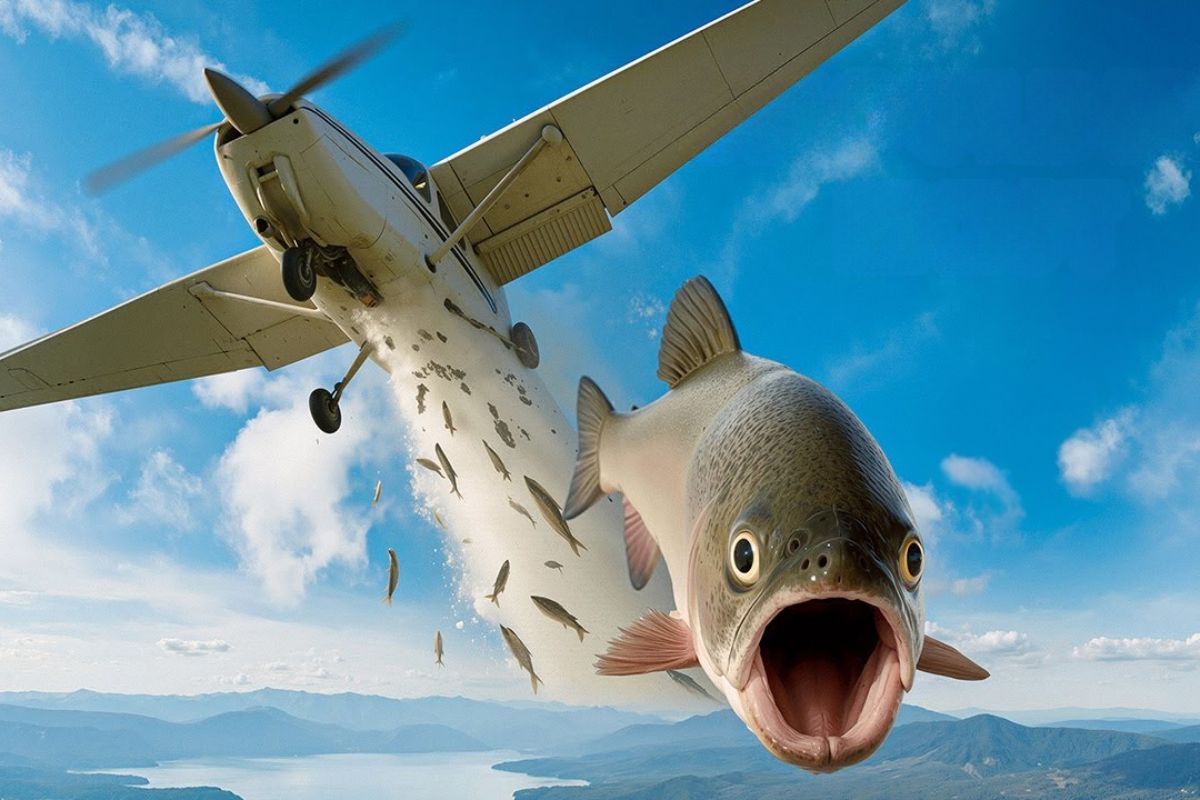


Thousands Of Fish Fall From Planes In The USA Every Summer To Supply High-Altitude Lakes, Where Trails And Mules Delayed Repopulation. With Custom Tanks, Flights At 50 To 150 Feet And Lightweight Fry, The Fall Becomes Controlled And Surpasses 95% Survival Since The 1950s.
Since The 1930s, Thousands Of Fish Fall From Planes In The USA As A Response To A Practical Bottleneck: Restocking Remote Lakes Required Long Hikes, Mules, And Heavy Cans Weighing 18 To 23 Kilograms, Which Stressed The Animals And Caused Many To Arrive Dead. The Technical Turn Occurred In Maine In The 1940s And Solidified In The Early 1950s.
The Operational Milestone Mentioned Is 1956, When The First Aerial Restocking Flights In Utah Showed Scale: A Pilot Could Reach Seven Or Eight Lakes In One Morning. The Method, Supported By Low Flights And Lightweight Fry, Came To Coexist With Other Aerial Management Operations, Including 1948 In Idaho, 1960 In Borneo, And Rescues In 2019 In Australia.
Why Dropping Fish From The Sky Became A Logistical Solution

The Original Problem Was Transportation.
-
While restoring a historic mansion from 1910, a brick structure with an old turbine that generated energy from the Rio do Testo emerged, along with a hidden door and a rare floor concealed under layers of wax.
-
Italian researchers have detected what appears to be a second Sphinx buried under the sands of Egypt, and satellite scans reveal a gigantic underground megastructure hidden beneath the Giza Plateau for over 3,000 years.

-
There are 4,223 drums and 1,343 metal boxes concreted with 50-centimeter walls that store the radioactive waste from Cesium-137 in the worst radiological accident in Brazil, just 23 kilometers from Goiânia, with environmental monitoring every three months.

-
Giant Roman treasure found at the bottom of Lake Neuchâtel in Switzerland reveals an advanced trade system, circulation of goods, and armed escort in the Roman Empire about two thousand years ago.

To Supply Lakes In Mountainous And Wilderness Areas, Teams Carried Fish In Heavy Containers, Reported To Be Milk Cans Weighing 18 To 23 Kilograms, Tied To Pack Animals, On Trails That Could Last For Hours Or Days.
This Long Route Produced Two Effects: Delay In The Restocking Calendar And High Mortality Due To Stress And Fatigue In Transport.
The Practical Consequence Was Direct.
Some Lakes Went Without Replacement For Years, Not For Lack Of Intent, But Because The Logistics Consumed Time, Personnel, And Depended On Weather And Access Conditions.
In This Scenario, Aviation Entered As A Shortcut: Reducing Travel Time, Shortening Fish Exposure To Transport, And Reaching Locations Where Terrain Imposed Barriers.
From Adirondack To Maine: The Origin And The Turn To Become Standard

The Account Indicates The Beginning Of Experiments In The 1930s, In Private Fishing Clubs In The Adirondack Mountains Of New York.
Initially, The Plane Was Used For Transporting, Not For Releasing.
The Next Step Came In Maine In The 1940s, When Park Rangers Dealt With Hundreds Of Wild Ponds That Required Canoeing Or Backpacking For Days.
It Was In This Context That The Central Point Was Observed: Small Fish Could Survive The Fall When Released At The Correct Height And Speed.
From The Early 1950s, The Innovation In Maine Became Standard Management In The American West, As The Plane Multiplied Range And Frequency Of Restocking.
The Scale Example Appears In Utah In 1956: A Pilot Visiting Seven Or Eight Lakes In One Morning, Something A Mule Train Could Not Accomplish In An Entire Season.
Today, The Account Describes The Practice As Routine In Several States, “From Maine To Utah,” Also Referencing New Hampshire, Wyoming, Idaho, And Montana.
Cited Programs: Maine, Colorado And The Annual Volume Of Restocking

The Routine Is Not Described As Occasional, But Repetitive And Measurable.
Maine Is Cited As Maintaining More Than 150 Restockings Per Year In Wild Area Ponds, Using Seaplanes.
Colorado, In Turn, Appears With One Of The Largest Aerial Programs, Introducing 380,000 Native Cutthroat Trout In About 300 High-Altitude Lakes To Restock Declining Populations.
These Numbers Explain Why Thousands Of Fish Fall From Planes In The USA And Why The Method Has Not Been Restricted To One State.
The Central Argument Is Efficiency: Reaching Many Points In A Short Time, Repeating The Operation With Species And Destination Control.
Physics Of Controlled Fall: Why The Fry Do Not “Burst” When Falling
The Operational Basis Described Is Low Flight.
The Aircraft Typically Fly Between 50 And 150 Feet Above The Water.
At This Height, The Physical Explanation Enters: The Fry Reach Terminal Velocity Almost Immediately, Stopping Acceleration And Falling At A Constant And Controllable Speed.
The Relevant Detail Is Weight.
The Loads Are Composed Of Tiny Fry, Weighing A Few Grams, Which Reduces Impact Energy Upon Hitting The Water.
The Reported Result Is A Survival Rate Exceeding 95% With Each Fall, Supporting The Idea That The Fall, Under These Conditions, Is Less Aggressive Than It Appears At First Glance.
Precision Operation: Custom Tanks, Compartments And Quick Check
The Report Describes Current Missions As Precision Operations.
The Planes Have Custom-Made Tanks Divided Into Compartments, Each Dedicated To Species Intended For Specific Lakes.
A Single Plane Can Carry Up To 84 Pounds Of Fry, Plus Hundreds Of Pounds Of Water To Keep Them Alive During The Flight.
There Are Also Preparation Protocols.
The Fish Go Without Food For Two Days Before Boarding To Reduce “Mess” During Transport.
Each Batch Is Counted And Weighed To Ensure The Correct Species Reaches The Correct Lake.
Post-Fall Validation Appears As A Field Practice: Biologists Check Survival With Surveys Using Nets Minutes After Release.
The Operational Comparison Also Matters.
Land Transport On Mountain Roads Is Described As More Aggressive, Because Constant Impacts And Difficulty Maintaining Oxygen Increase Mortality.
In Practice, The Technical Argument Is That Controlled Falls Can Be More Stable Than Prolonged Shaking In A Truck.
Why They Do It: Recreational Fishing, Licenses And Conservation
The Main Motivation Described Is Recreational Fishing, But The Report Also Includes The Connection To Conservation.
A Relevant Point Is Historical And Geographical: Many High-Altitude Lakes Would Naturally Be Fishless, Because After The Retreat Of Glaciers, The Ponds Became Isolated By Waterfalls And Slopes, Without Natural Colonization.
The Cited Economic Gear Is Large: Almost US$ 1 Billion Per Year Would Be Generated By Fishing, And 100% Of The Revenue From Licenses Would Go To State Wildlife Conservation Programs.
These Programs Include Habitat Restoration, Research, And Educational Initiatives.
In This Logic, Thousands Of Fish Fall From Planes In The USA To Maintain Fishing Opportunities In Remote Waters, Which Supports The Revenue That Finances Environmental Projects.
The Report Also Records An Ecological Control Mechanism: Non-Native Species Are Often Sterile Hybrids, Uncapable Of Reproducing.
The Purpose Is To Prevent Overpopulation And Reduce The Risk Of Spread To Downstream Waters, Competing With Native Species.
When The Sky Became A “Bridge” To Other Actions: Beavers, Cats And Food In 2019
The Practice Of Releasing Fish Is Positioned As Part Of A Larger Family Of Aerial Management Operations.
In Idaho, In 1948, The Beaver Drop Operation Occurred, With 76 Live Beavers Dropped In Boxes With Parachutes To Restore Remote Watersheds In The Frank Church Wilderness Area.
The Aim Was To Avoid Weeks Of Land Transport And Death From Stress, And The Described Result Was Dam Construction And Stream Restoration.
In 1960, In Borneo, The Cat Drop Operation Appears As A Response To A Side Effect Of DDT Spraying Against Mosquitoes: Local Cats Died, Rats Multiplied, And The Solution Was To Drop Cats From Parachutes In Remote Villages To Recover The Predator-Prey Balance.
The Report Also Cites 2019 In Australia, When Wildfires Led To Another Aerial Mission: Planes And Helicopters Dropped Thousands Of Pounds Of Sweet Potatoes And Carrots For Hungry Kangaroos Trapped On Isolated Rocky Outcrops, Where Ground Teams Could Not Reach.
Drones, AI And LIDAR: The Technological Continuity Of The Repopulation Logic
The Same Logic Of “Reaching Where The Terrain Prevents” Is Carried Forward With Drones.
The Report Mentions Drone Seeding In Burned Areas, With Seed Capsules, AI And GPS, Achieving Over 40 Hectares Per Hour.
The Site Selection Uses LIDAR Mapping To Identify Planting Points And Adjust Seed Mixes By Microenvironment.
This Sequence Helps To Understand Why The Fall Of Fry Is Not Treated As Improvisation, But As A Method With Decades Of Adjustments: From Milk Cans On Mules To Aircraft Guided By GPS Over 70 Years, Always To Overcome Distance, Risk, And Isolation.
The Set Of Data And Examples Describes A Method That Seems Strange At First Glance, But Operates With Defined Parameters: Low Flight, Lightweight Fry, Compartmentalized Tanks, Prior Preparation, Quick Check, And Survival Rates Above 95%.
At The Center Of This Is A Management Choice: When Trail Access Is Unfeasible, Thousands Of Fish Fall From Planes In The USA To Supply Remote Lakes And Sustain A System Blending Fishing, License Revenue, And Environmental Projects.
If You Follow Wildlife Management, It’s Worth Observing How Each Step Is Designed To Reduce Stress And Destination Error, Because The Operation Depends On Precision, Not Spectacle.
In Your Opinion, Thousands Of Fish Fall From Planes In The USA For A Real Necessity Of Conservation, Or Is Recreational Fishing The Main Driver Of This Model?








Fantastico , agora com drones a distribuicao sera melhor e a mortalidade com certeza reduzida .
Um exemplo a s’er seguido!)
Ambos são importantes, preservar e gerar renda para as populações locais via pesca esportiva .
Bruno Teles que espécie de sádico vc é?