





 Portuguese
  English
  Spanish
  5 min of reading
  2 comments


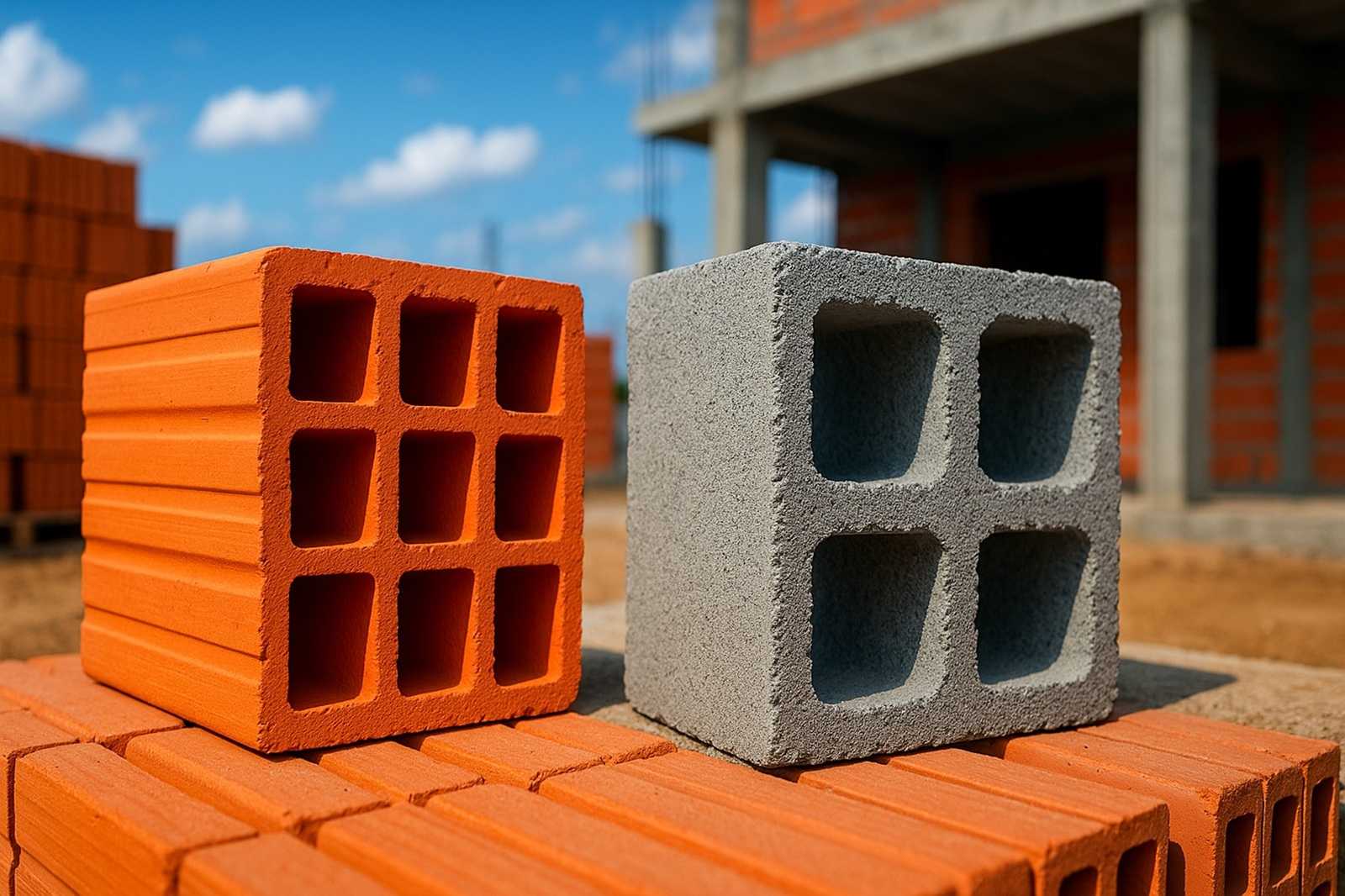


Comparing Ceramic And Concrete Blocks Is Essential For Those Who Are Building, As Each Material Provides Specific Advantages In Comfort, Strength, Cost, And Execution Speed, Directly Influencing The Final Outcome Of The Work
The choice of the type of block in masonry, whether concrete or ceramic, directly influences the cost, performance, and durability of a construction.
Among the most used materials in Brazil, ceramic blocks and concrete blocks have distinct characteristics that determine their ideal use.
Both serve fundamental functions in structure and sealing, but vary in composition, strength, and thermal comfort.
-
These living root bridges and ladders are over 700 years old and help indigenous people survive in one of the rainiest regions in the world.

-
From sertanejo star to international investor: Ana Castela invests millions in a mansion in the USA, creates a themed accommodation in Orlando, and shows that the “boiadeira” also wants to grow away from the stage.

-
The 10 most stunning motorhomes in the world: a $3 million trailer with a rooftop nightclub and garage for a Ferrari, “palaces on wheels” with Italian marble, private cinema, and five-star hotel luxury for billionaires.

-
Trump wanted to spend $400 million on the White House, but the courts prohibited the million-dollar construction.


Concrete Blocks: Strength And Precision

Made with cement, water, and aggregates like gravel and sand, concrete blocks are mixed, vibrated, pressed, and cured.
This composition ensures excellent mechanical strength, making them ideal for structural masonry. In this system, the walls support the weight of the construction, eliminating the need for beams and pillars.
These blocks can also be used in sealing masonry when the structure is supported by other elements.
They have geometric regularity and standard size, which facilitates alignment and placement. Being larger, they speed up the pace of the work and reduce material waste.
One of the main advantages is the flatness of the walls, which requires less finishing.
The interior can receive only plaster or a thin layer of mortar, reducing material consumption. Moreover, the acoustic performance is superior, improving the insulation between environments.
However, the heavy weight makes transportation and handling on the construction site difficult. The material also has lower thermal comfort and requires acrylic paint on the exterior walls to prevent moisture.
Technical Characteristics Of Concrete Blocks
The blocks are classified into classes A, B, and C (structural) and C (sealing), according to NBR 6.136 and NBR 15.961. The most common dimensions are 19 x 19 x 39 cm, 14 x 19 x 39 cm, 11.5 x 19 x 39 cm, and 9 x 19 x 39 cm. There are also variations such as half block, channel, and compensator.
The compressive strength ranges from 4 MPa to 30 MPa, and the average yield is 12.5 blocks per square meter.
When coated with 2.5 cm of mortar on each face, concrete walls meet the NBR 15.575 performance standard, achieving acoustic insulation of up to 50 dB.
These blocks can be applied in any type of building, including structures up to 25 floors. In sealing constructions, they are compatible with buildings of any height.
Advantages And Limitations Of Concrete
Among the main advantages are the good fit between pieces, dimensional tolerance, and low loss from breakage. The walls become modular, allowing for easy embedding of electrical conduits. Finishing can be applied directly, with thin layers of mortar or plaster.
However, the weight of the material reduces productivity. Concrete absorbs more water, requiring work to be halted on rainy days.
Another point of attention is the expansion joints, which should be smaller due to the movement of the material.
Even with these limitations, the cost-benefit ratio is attractive. The concrete block has a low cost in structural walls and an equivalent price to ceramic blocks when used only for sealing.
Ceramic Blocks: Lightness And Thermal Comfort

Made from clay fired at high temperatures, ceramic blocks are lighter and widely used in sealing masonry. Their main function is to close openings and divide environments, and they can be applied in steel, wood, or reinforced concrete structures.
The lightness facilitates transportation and handling, increasing productivity. Moreover, the thermal performance is superior, ensuring cooler environments. The expansion joints can be larger, as the material undergoes less movement.
However, the mechanical strength is lower, and the pieces are geometrically less regular. This demands more finishing and increases the chance of breakage during transportation. The acoustic insulation is also inferior to that of concrete.
Technical Characteristics Of Ceramic Blocks
Ceramic blocks vary in size and shape, meeting different project needs. The most common dimensions range from 10 x 20 x 20 cm to 20 x 20 x 40 cm, with a yield between 12.5 and 25 blocks per square meter. The weight depends on the size of the piece.
The compressive strength ranges from 3 MPa to 18 MPa, with minimum values of 3 MPa for structural blocks. The classification includes levels of 10 (1 MPa), 15 (1.5 MPa), 25 (2.5 MPa), 45 (4.5 MPa), 60 (6 MPa), 70 (7 MPa), and 100 (10 MPa). This diversity allows for choosing the suitable product according to the height and type of the building.
The thermal-acoustic performance is good, making the material preferred in colder regions. Additionally, the variety of colors and finishes results from different firing processes.
Light-colored bricks are fired and have a higher price, while dark-colored ones are re-fired and are cheaper.
Advantages And Disadvantages Of Ceramic
Among the advantages are the lower weight, good thermal comfort, and ease of transportation. These features help reduce the physical strain on workers and execution time. The water absorption is lower, which favors performance in indoor environments.
The disadvantages involve greater fragility and irregularity in the pieces, requiring more finishing to level the walls.
Acoustic insulation is lower, and the risk of breakage increases waste. On the other hand, the initial cost is about 13% lower than that of concrete blocks for the same area of structural masonry.
Transport And Productivity Comparison
To build 225 m² of masonry, a truck carrying ceramic blocks transports 1,728 pieces (12,614 kg) per trip, covering about 138 m².
In contrast, with concrete blocks, the same truck carries 1,000 pieces (12,000 kg), covering 80 m². Thus, about two trips are needed for ceramics and three for concrete.
This data shows that transporting ceramic blocks is more efficient, resulting in faster delivery and lower logistical costs.
Despite this, the final performance should be evaluated based on waste, strength, and finishing. In many cases, the concrete block compensates for the higher cost with less material loss and greater durability.
Types Of Mortar And Finishing
For concrete blocks, industrialized or site-produced mortar can be used with cement, lime, sand, and water. Normally, one layer is sufficient. The finishing can be done with up to 2 cm of mortar or 0.5 cm of plaster.
In ceramic blocks, mortars vary according to the type of stress that the masonry undergoes. The 1:1:6 mix is suitable for small constructions, while 1:4.5:0.5 is used in areas under tension, providing greater strength.
The finishes include roughcast, plaster, and render, applied in thin layers to regularize and finish the surface.
Material Choice And Quality
The choice between concrete and ceramic blocks depends on factors such as budget, type of building, and regional availability. Concrete stands out in structural and large-scale projects, while ceramic is preferred in residential and sealing works.
Regardless of the choice, it is essential to prioritize certified products, with the ABCP seal or equivalent, ensuring compliance with ABNT standards.
The use of quality materials ensures safety, durability, and adequate performance of the construction.
There is no single answer to which block is better. The concrete block offers greater strength, precision, and acoustic insulation, while the ceramic block provides lightness, thermal comfort, and lower initial cost.
Each material presents advantages and limitations, and the ideal decision should balance technique, economy, and functionality according to the specific demands of each project.









Fui diagnosticada com doença de Parkinson há quatro anos. Por mais de dois anos, dependi da levodopa e de vários outros medicamentos, mas, infelizmente, os sintomas continuaram piorando. Os tremores se tornaram mais perceptíveis e meu equilíbrio e mobilidade começaram a declinar rapidamente. No ano passado, por desespero e esperança, decidi experimentar um programa de tratamento à base de ervas da NaturePath Herbal Clinic.
Sinceramente, eu estava cética no início, mas, poucos meses após o início do tratamento, comecei a notar mudanças reais. Meus movimentos ficaram mais suaves, os tremores diminuíram e me senti mais firme ao caminhar. Incrivelmente, também recuperei grande parte da minha energia e confiança. Tem sido uma experiência transformadora. Me sinto mais eu mesma novamente, melhor do que me sentia há anos. Se você ou um ente querido está lutando contra a doença de Parkinson, recomendo muito que você considere a abordagem natural deles. Você pode visitar o site deles em www. naturepathherbalclinic .com
Faz um estudo com tijolo maciço de argila