





 Portuguese
  English
  Spanish
  4 min of reading
  0 comments


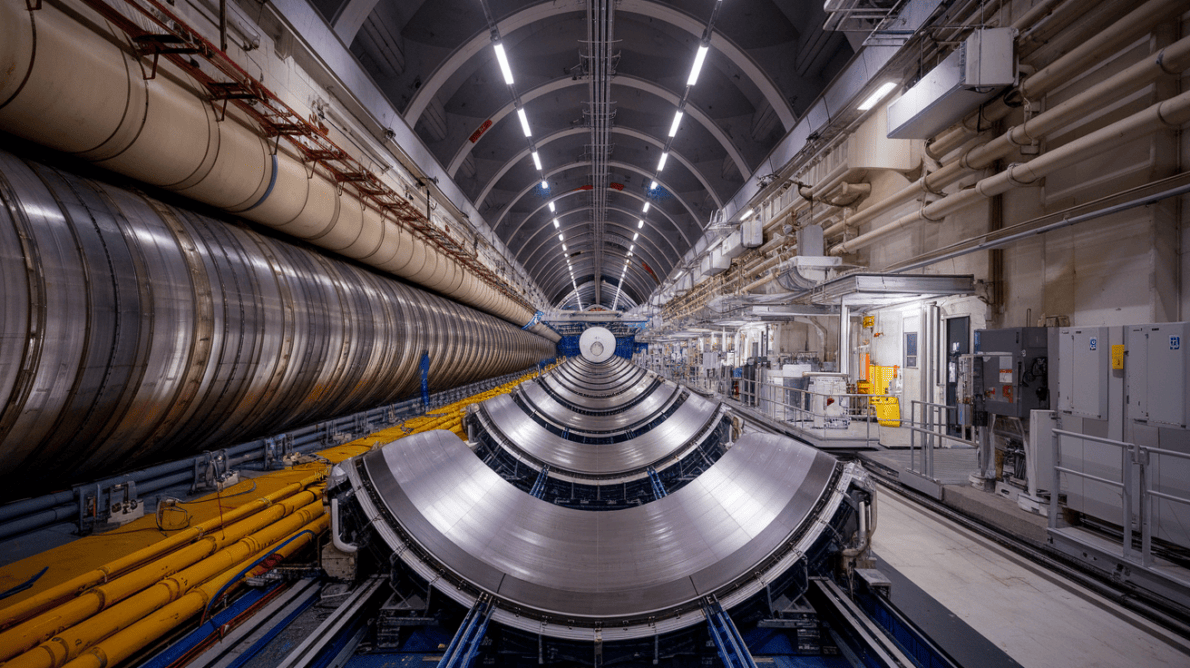
New Particle Accelerator Will Be Larger, More Powerful, and Efficient, With Construction Planned for the 2030s, Promising to Revolutionize Particle Physics.
The CERN (European Organization for Nuclear Research) officially revealed the project of a new particle accelerator that will replace the Large Hadron Collider (LHC), currently considered the largest particle accelerator in the world. The new equipment, called Future Circular Collider (FCC), promises to surpass its predecessor in size, capacity, and efficiency, with construction set to begin in the 2030s.
New Collider Will Be More Than Three Times Larger than the Current One
The LHC, which has been operating since 2008, has a circumference of 27 kilometers and is located about 100 meters deep between Switzerland and France. With advancements in research and limitations of the current structure, CERN engineers concluded that it is time to take a new step.
The new particle accelerator will have approximately 90 kilometers in circumference, more than three times the size of the current one. The accelerator will be built 200 meters deep, double that of the LHC. This new structure will allow for even more advanced experiments, contributing to the understanding of physical phenomena that current science cannot yet explain.
-
With a cost per shot close to zero, the DragonFire laser could change naval warfare in 2027 and provide British ships with nearly unlimited defense against drones.

-
A British startup creates tires that generate electricity in electric vehicles when passing over potholes, speed bumps, and cracks.

-
Scientists have created robots made with living cells that have their own nervous system, swim on their own, explore the environment, and self-organize without any genetic engineering, and now they want to do the same with human cells.

-
Students create a solar-powered ambulance that operates without a plug, without fuel, and still keeps medical equipment running in remote areas.




Feasibility Study Analyzed Over 100 Scenarios
To arrive at the final format of the project, the CERN engineering team assessed more than 100 different scenarios. The main focus was to find a solution that maximized scientific benefits while minimizing environmental and social impacts of the construction.
The study also takes sustainability into account. The proposal includes reusing the heat generated by the accelerators, which could be used to heat the water utilized by nearby villages. This measure is part of an eco-design policy that will be applied from conception to the dismantling of the structure.
Projected Investment is R$ 104 Billion Over 12 Years
The estimated budget for the construction of the new particle accelerator is 15 billion Swiss francs, equivalent to around R$ 104 billion. This amount will be distributed over 12 years and will largely come from CERN’s annual budget.
The organization, which represents an international consortium of countries, including France and Switzerland, has already begun discussions about the project with local representatives. The idea is to involve the public from the beginning to ensure transparency and support for future phases of construction.
FCC Stages Will Extend Until 2100
The plan is to divide the development of the new particle accelerator into phases. In the first phase, scheduled for the 2040s, the collider will allow collisions between electrons and positrons. These particles, when colliding at high speeds, help scientists study the fundamental forces of the universe.
In a second phase, around 2070, the equipment will be adapted to perform collisions between protons, similar to what happens today with the LHC. This change will allow a new generation of experiments and is expected to keep the FCC operational until the end of the century, with operations planned until 2100.
Technical Reviews and Final Decision Expected in 2028
Before construction, the project will undergo a series of technical analyses. The current report will be evaluated by independent expert committees and then submitted to the CERN Council.
The organization announced that the next meeting on the topic is scheduled for November this year. However, the final decision on the start of construction is not expected until after 2028.
According to an official statement, CERN reaffirms its commitment to sustainability and transparency.
“Any new project at the laboratory will be an example of sustainable research infrastructure, integrating eco-design principles in all phases of the project, from design to construction, operations, and decommissioning,” stated the organization.
Largest Particle Accelerator in the World Will Mark a New Era in Physics
With its size and capacity, the FCC will be the largest particle accelerator in the world. The expectation is that the equipment will allow for the discovery of new particles and help answer fundamental questions about the origin of the universe, dark matter, and the nature of the forces that govern the cosmos.
The project also reinforces CERN’s role as one of the leading scientific research centers on the planet. The construction of the new particle accelerator shows that, even after decades of advancements, science still has much to explore in the field of particle physics.
As the LHC approaches the end of its operational life, the next generation of scientists is already preparing to work on the FCC and advance studies that could transform our understanding of the universe.
Source: Olhar Digital








Seja o primeiro a reagir!