





 Portuguese
  English
  Spanish
  5 min of reading
  0 comments


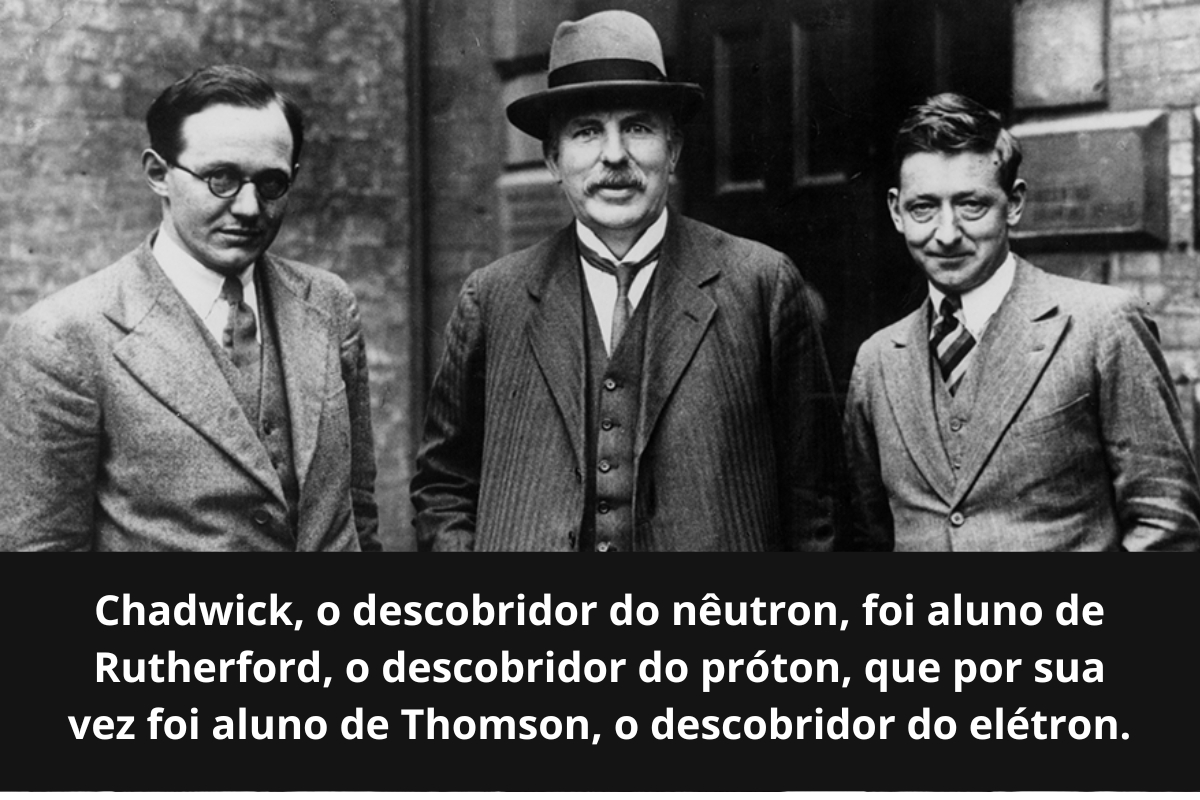
The Scientific Lineage Formed by Thomson, Rutherford, and Chadwick Unveiled the Electron, Proton, and Neutron in Just 35 Years, Inaugurating Modern Physics and Paving the Way for Advances That Shaped the Nuclear Age
The history of modern physics was born from an unlikely sequence: three scientists separated by generations but united by the same laboratory and the same determination to understand the structure of matter. In a span of just over three decades, this lineage formed by Joseph John Thomson, Ernest Rutherford, and James Chadwick unraveled the electron, proton, and neutron, putting an end to the mystery of the composition of the atom and initiating the nuclear age.
These three discoveries not only transformed science but also redefined the entire technological development of the 20th century. Reactors, accelerators, modern electronics, radiotherapy, communications, and even quantum computing derive, at some level, from the work initiated within the walls of the Cavendish Laboratory at the University of Cambridge. Rarely in history has knowledge advanced so quickly and profoundly.
Thomson and the Electron: The Beginning of the Atomic Age

When Thomson began his experiments with cathode rays, the very idea of a particle smaller than the atom seemed impossible. The prevailing view was that the atom was indivisible. In 1897, while observing the behavior of charges within the tubes, Thomson realized that there was something much lighter than any known atom.
-
Scientists use artificial intelligence to create nearly indestructible steel that does not rust and could change the way industrial energy and oil parts are produced.

-
Instead of buying new electric trucks, India is removing the diesel engines from old vehicles and installing electric propulsion for 40% of the price, and this simple idea could be the solution that polluted megacities around the world have been waiting for.

-
Circles in the Sahara plantations: ISS reveals Sharq El Owainat, in Egypt, irrigated by a center pivot with water from the Nubian Sandstone Aquifer, growing between 1998 and 2019, 290 km from the nearest city.

-
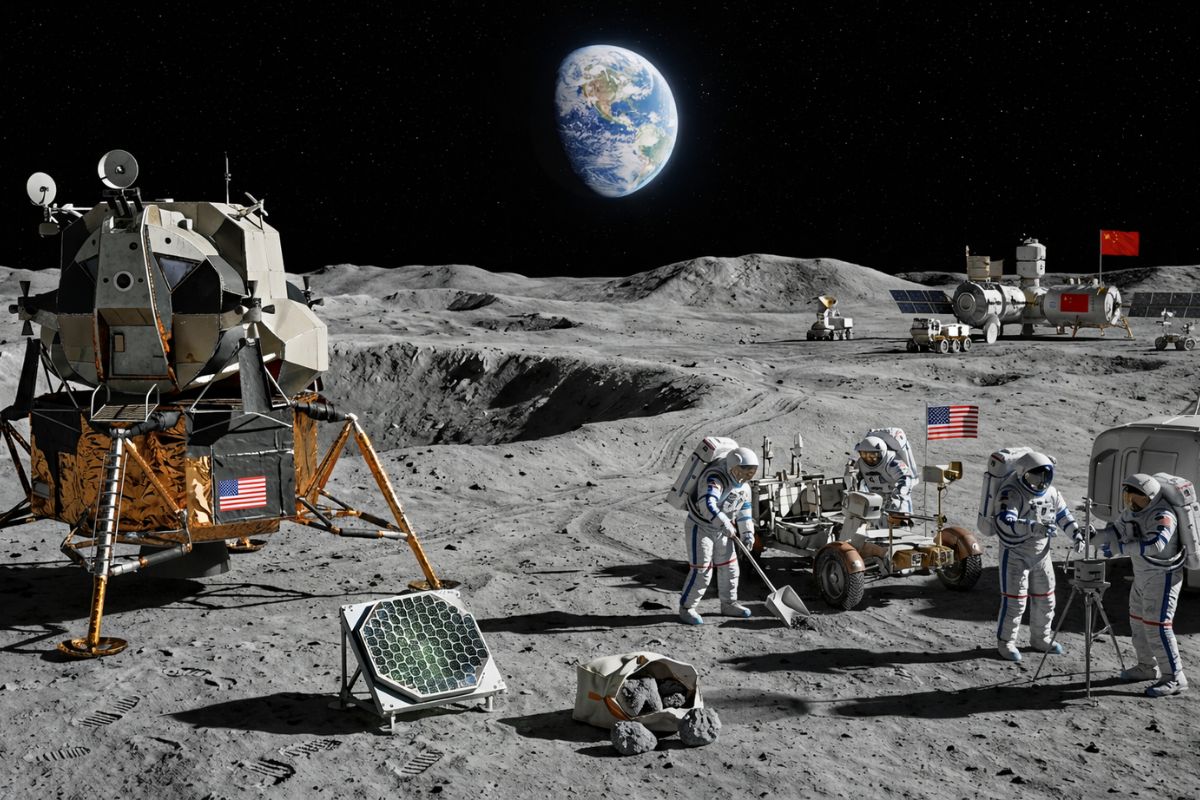
40% still call it a fraud: Soviets monitored Apollo, mirrors on the Moon still return lasers today and rocks confirm it; in 2026, 4 astronauts will return to lunar orbit and the race restarts against China.
It was at that moment that the electron ceased to be a hypothesis and became a scientific reality.
The impact was immediate. The discovery overturned the existing atomic model and opened the door to new questions: if the atom had internal parts, how were they organized? How did these particles behave? And what was the nature of the positive charge that held the electron to the atom?
It was within this atmosphere of discovery that a brilliant young man, freshly arrived from New Zealand, began working with Thomson. His name was Ernest Rutherford.
Rutherford and the Proton: The Nucleus Hidden in the Heart of the Atom

Rutherford arrived at the Cavendish as a student but quickly demonstrated a unique ability to conduct experiments. While Thomson focused on theory and the behavior of charges, Rutherford wanted to understand the physical structure of the atom.
He is responsible for one of the most famous experiments in history: bombarding a thin sheet of gold with alpha particles. The result contradicted everything that was believed. Some particles were deflected or even bounced back, something that would only be possible if the atom had an extremely dense central region.
Thus, the nuclear model was born, presented in 1911.
Just a few years later, in 1917, while analyzing reactions caused by alpha particles, Rutherford observed the release of a hydrogen nucleus. It was the proton, officially identified by him after repeated experimental confirmations. The second fundamental piece of atomic structure was in place.
But something was still missing. The total mass of atoms could not be explained only with protons and electrons. There was an invisible component that no one could identify. Rutherford, by then one of the greatest names in physics, entrusted this enigma to an equally brilliant student: James Chadwick.
Chadwick and the Neutron: The Piece That Completed the Puzzle

Chadwick arrived at the Cavendish already deeply influenced by Rutherford’s rigorous experimental vision. He knew there was a gap in the existing models. This gap became even more evident when scientists began observing enigmatic emissions from certain elements bombarded by alpha particles.
In 1932, while analyzing radiation from beryllium samples, Chadwick demonstrated that the material emitted extremely penetrating particles, with no electric charge but with a mass similar to that of the proton.
He had found the neutron.
The discovery completed the basic structure of the atom and opened the door to all the development of nuclear physics. Without the neutron, there would be no controlled fission reactions, no reactors, and no some of the most important medical treatments today. And, above all, there would be no modern understanding that the nucleus is made up of protons and neutrons, while electrons orbit around it.
The Scientific Lineage That Forever Changed the Course of Science
The most impressive thing is that this sequence of discoveries was not accidental. Thomson taught Rutherford. Rutherford taught Chadwick. Each expanded on what the previous one had left. Each opened the door for the other to go even further.
This chain transformed the Cavendish Laboratory into a historic turning point. There were not only three particles born there, but the entire scientific foundation that supports our most advanced technologies. It is a story that demonstrates how science evolves when there is intellectual continuity, collaboration, and freedom to investigate the unknown.
The discoveries of Thomson, Rutherford, and Chadwick shaped the path that led to nuclear energy, the study of chemical elements, imaging analysis machines, and modern research that seeks to understand even deeper particles of the universe.
The lineage that began with the electron and ended with the neutron is not just a historical curiosity. It is the foundation of the physics we use today to understand everything from the structure of stars to the functioning of the most advanced materials.









Seja o primeiro a reagir!