





 Portuguese
  English
  Spanish
  5 min of reading
  0 comments


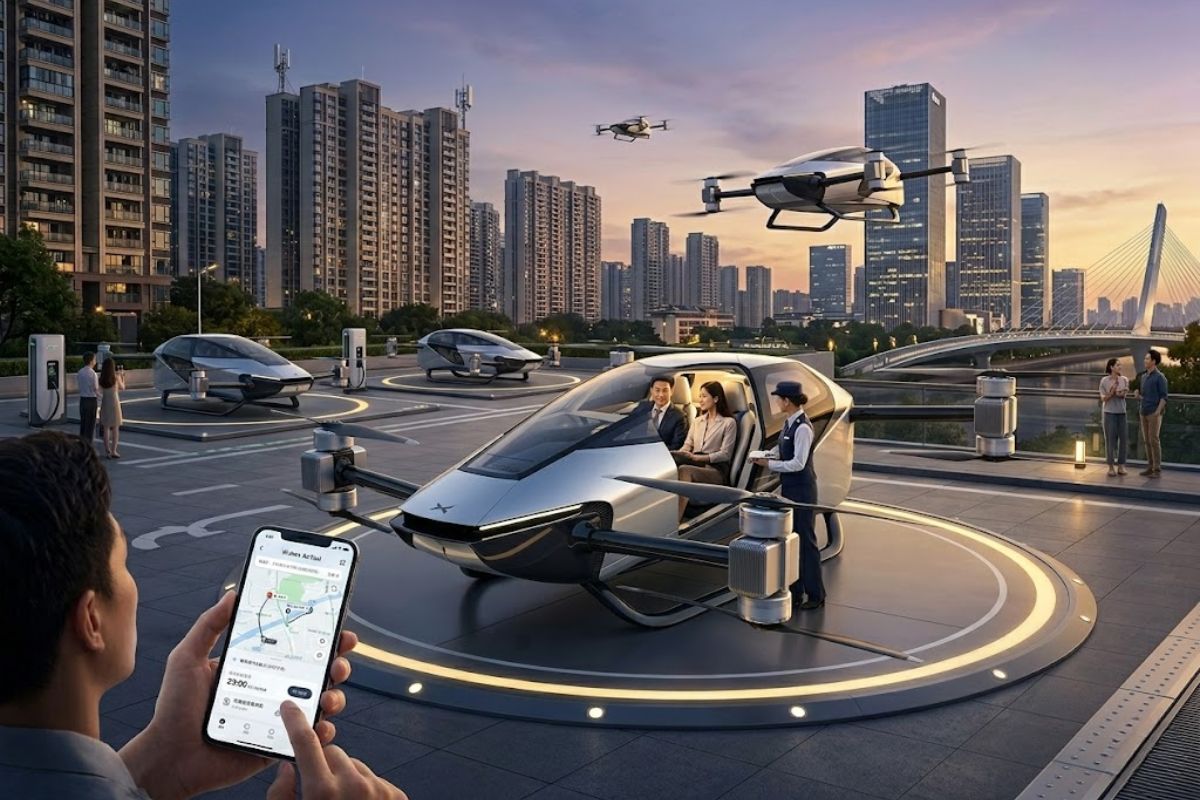
Presented in the Capital of Hubei, Four Electric eVTOL Air Taxis Show How Low-Altitude Aviation Tries to Move from Prototype to Everyday Life, with a 1.2-Ton Model, Medical Functions, and a Bet on a Trillion Yuan Market, Along with Rules Targeting 2026 and Mobile Coverage Until 2027.
In Wuhan, in central China, the display of four air taxis of the eVTOL type placed urban air mobility in the same mental space that transportation apps currently occupy: something that is requested on the phone and arrives in minutes. The difference is that, here, the “pick-up point” can be a park or a condominium, as long as there are rules, infrastructure, and safety for it.
The presentation took place in the capital of Hubei province and was associated with the vision that 2026 is likely to be a milestone for the commercialization of these vehicles. The statement attributed to Huang Xiafei, president of the developing company, reinforces the intended path: to transform the eVTOL from a technological demonstration into a service, targeting a market estimated in trillions of yuan.
Wuhan as a Laboratory for Low-Altitude Aviation

Wuhan stands out as a showcase because it concentrates industrial initiative, regulatory debate, and growth around “low-altitude aviation.”
-
In a flooded well, archaeologists found a 1,700-year-old Roman egg that still contains clear and yolk intact inside the very thin shell.

-
Something is happening around the Earth: Inside the huge explosion of fireballs in 2026

-
A hot air bubble coming from Argentina expands over Brazil, causing thermometers to exceed 38 degrees with a thermal sensation of 40 degrees in late March, affecting 6 states at once.

-
The radish leaf that almost everyone throws away has more polyphenols, flavonoids, and fiber than the consumed root, and a 2025 study showed that the leaf contains compounds that protect the intestine, combat inflammation, and may inhibit the growth of cancer cells.

When four air taxis are presented at the same event, the practical message is simple: this is not a single isolated prototype but a portfolio trying to cover different uses and operational requirements.
The “where” here matters as much as the “what”. By mentioning Wuhan and Hubei, the case gains geography, ecosystem, and administrative focus, which is decisive for any technology that depends on authorization, routes, landing areas, and integration with ground networks.
What Is an eVTOL and Why Does It Change the Boarding Location?

eVTOL stands for Electric Vertical Takeoff and Landing aircraft, designed to ascend and descend in spaces smaller than those required by traditional runways.
This feature is what supports the idea that air taxis could operate near where people already are, such as parks and condominiums, without relying on airports.
But verticality doesn’t solve everything on its own. Taking off and landing in urban areas requires risk control on the ground, mitigation of disturbances, standardization of procedures, and a clear definition of where the safe area begins and ends because the challenge is not just to fly but to operate repeatedly near pedestrians, buildings, and ground traffic.
Four Air Taxis, Several Scenarios, and a Detail That Catches the Eye
Among the four vehicles presented, a 1.2-ton model stood out for using closed propellers, a design intended to reduce dangers on the ground. This type of engineering decision points to the real problem: contact with the urban environment, where people circulate, cars pass, and space is contested.
Another highlight was an aircraft described as a “micro-intensive therapy unit,” designed to accommodate a stretcher and a computed tomography scanner.
When an eVTOL is designed for a medical mission, the focus shifts from just transporting passengers to stability, accommodation of equipment, care protocols, and response time, all within the limitations of an electric vehicle.
Who Is Driving Commercialization and What Does This Suggest for 2026
The transition from concept to commercial stage appears in how the sector describes the moment. The assessment of industry leaders and regulatory bodies, with 2026 as a decisive year, indicates that the debate is not restricted to “does it work or not,” but to “how to operate at scale” without losing control over safety and responsibility.
Huang Xiafei is cited as the president of the developing company and someone who describes the future of hailing air taxis on the phone.
In the same movement, there is mention of the plan to launch a two-seat version this year, aimed at low-altitude logistics and tourism, suggesting a common strategy in new technologies: starting with applications that have more predictable routes and more controllable operations, before tackling widespread urban use.
Trillion Yuan Market and Growth Above 30%: Why Money Is Not Enough
The estimate of a market in trillions of yuan serves as a thermometer for economic interest but not as a guarantee of immediate adoption.
Potential market is not realized market, especially when the product depends on certification, operational licenses, physical infrastructure, and public acceptance.
Still, the fact that this year, revenue from companies linked to low-altitude aviation in Wuhan grew by more than 30% helps explain why the topic gained local traction.
This type of growth tends to attract more investment, more suppliers, and more pressure for clear regulations, and it is precisely there that air taxis stop being just a technological “show” and become an urban planning and governance issue.
Mobile Coverage on 90% of Routes by 2027: Connectivity as a Safety Item


The joint guideline issued by five central agencies, including the Ministry of Industry and Information Technology, forecasts that by 2027 at least 90% of common low-altitude air routes will be covered by terrestrial mobile networks.
This goal reveals that invisible infrastructure, connectivity, becomes part of the flight system, not just a comfort for the passenger.
For air taxis to operate as on-demand service, connectivity comes in layers: request via phone, operational communication, route tracking, telemetry, and coordination with low-altitude traffic rules.
Even without detailing specific technologies, the message is clear: without a network, the service becomes limited, and scaling becomes more difficult to sustain predictably.
What Still Separates the Promise from Everyday Life in Parks and Condominiums
Taking air taxis from the event to routine depends on a chain of decisions that is not just technical. Safety needs to be repeatable, auditable, and understandable for the public, because operating near residential areas increases the weight of noise, perception of risk, and impacts on the surroundings, including in defining schedules, corridors, and landing zones.
There is also the operational part: standardizing boarding points, training teams, establishing maintenance, creating priority rules in medical scenarios, and integrating the “low sky” with life on the ground.
In other words, the question “why now?” is answered with the signals of 2026 and 2027, but the question “when does it become a habit?” depends on how these signals turn into practice, oversight, and trust.
And if the idea is to hail on the phone, the final test is simple: would people accept this near their homes?
In your city, would you be open to seeing air taxis taking off from a park or a condominium, or do you think noise, safety, and regulations still make this scenario too far away? Share your reasons and what would need to change for you to trust.









-

-

-

9 pessoas reagiram a isso.