





 Portuguese
  English
  Spanish
  4 min of reading
  0 comments


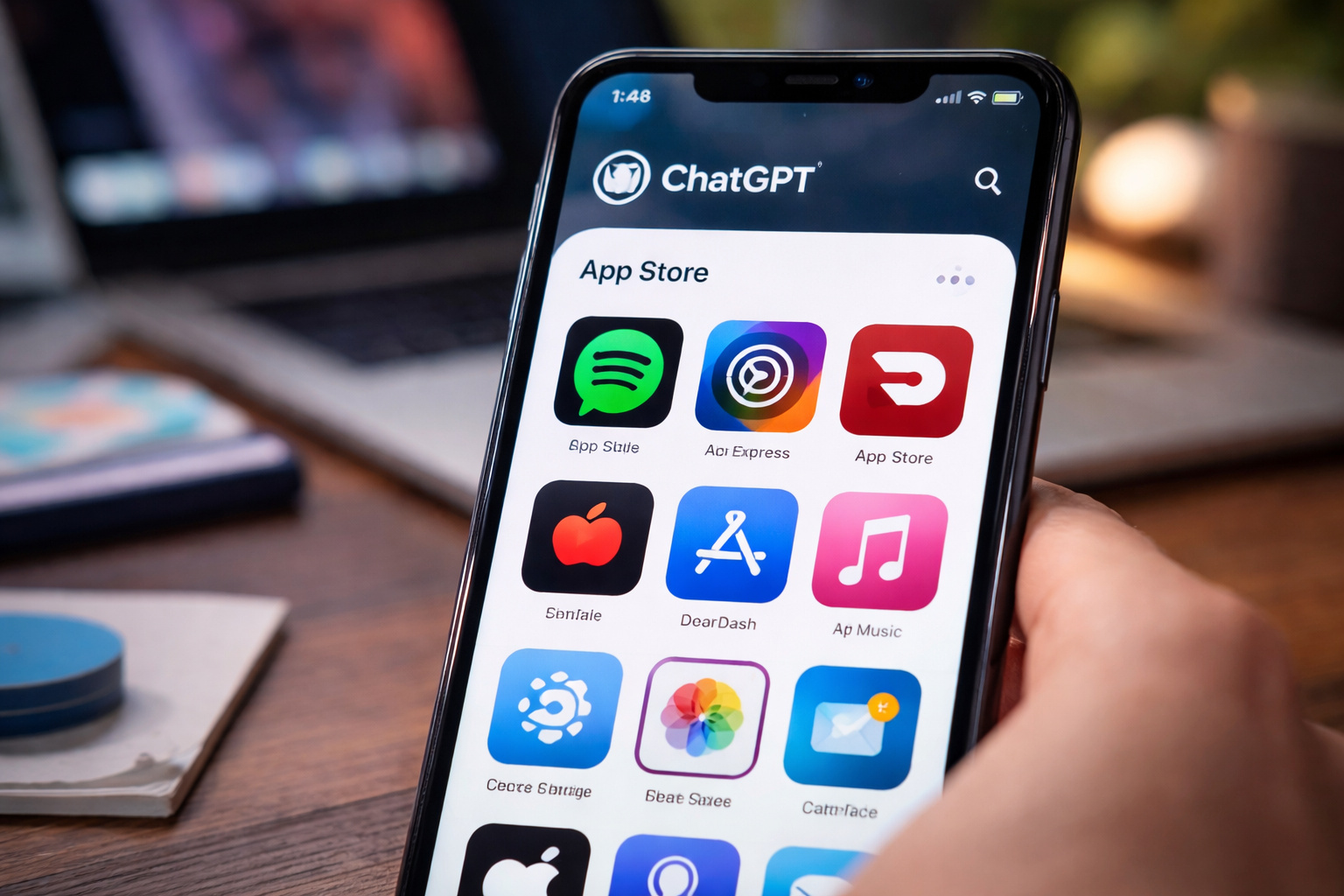
The New App Directory Reorganizes Integrations, Simplifies Actions, and Repositions ChatGPT as the Core of the AI-Mediated Digital Experience
A significant structural change in the artificial intelligence ecosystem was introduced by OpenAI in December 2025, attracting attention from the tech sector.
The launch of the ChatGPT App Directory introduces an app store that operates within the chatbot itself, thereby altering how users interact with digital services.
From this update, ChatGPT stops acting solely as a conversational assistant and gradually begins to concentrate actions, content, and external tools in a single environment.
This move continues a strategy initiated in October 2025 and brings the platform closer to the concept of an “everything app,” where different aspects of digital life are managed in one place.
How the App Directory Redefines the Use of ChatGPT
With the new directory, users can browse, discover, and activate compatible apps directly in the ChatGPT interface.
Thus, the apps operate as extensions of the chat itself, using conversation as the primary means to carry out tasks.
At the same time, OpenAI has reorganized its internal structure and replaced the term “connectors” with the single designation “Apps.”
This change is not limited to nomenclature, as it unifies simple integrations of external searches with tools that offer interactive features within the conversation.
In practice, the apps take on distinct functions depending on the integrated service.
Some display cards, lists, and visual controls, while others conduct searches, organize recurring information, or synchronize data for ongoing use.
This entire process occurs through natural language or by directly selecting the app from the chat’s tool menu, reducing intermediate steps.
-
Artificial intelligence is skyrocketing energy consumption, raising emissions from tech giants and pushing Google, Microsoft, and Meta closer to natural gas.

-
Mercor paid $1.5 million per day for doctors, lawyers, and former Goldman Sachs bankers to teach artificial intelligence to do their jobs, and in 17 months, it went from zero to $500 million in annual revenue while its own contractors accelerated the replacement of their own work.

-
Casio Unveils Moflin, Robotic Pet With Artificial Intelligence Designed To Provide Emotional Comfort And Simulate A Permanent Affectionate Bond

-
Google Maps Revolutionizes GPS Navigation With Gemini Artificial Intelligence, Ask Maps Feature, and Advanced 3D Visualization for Route and Travel Planning


Well-Known Integrations Operate Within the Conversation
Among the examples already available, Spotify allows users to create playlists and suggest songs based on user commands, a feature that also extends to Apple Music.
Similarly, Adobe offers simplified versions of Photoshop, Adobe Express, and Acrobat, enabling quick edits to images and PDF files without leaving the chat.
DoorDash transforms meal ideas or weekly plans into ready shopping carts, all executed within the conversation with ChatGPT.
These cases illustrate how the platform reduces the distance between intention and execution, concentrating steps into a single flow.
OpenAI’s Strategy Reinforces Platform Vision
This advancement goes beyond a one-off technical update.
OpenAI is positioning ChatGPT as a broad platform, no longer as an isolated product.
The company’s CEO, Sam Altman, stated that the organization aims to build “the obvious features you would expect from a robust platform,” signaling that the app store is part of this plan.
In this sense, the App Directory emerges as a central element to support this ecosystem.
The initiative also expands the space for external developers.
OpenAI has started accepting app submissions, which can be published after a review process.
These integrations utilize the Apps SDK and the Model Context Protocol (MCP), allowing external services to bring their own context and execute real actions from the chat.
Commercial Impacts, Access, and Points of Attention
From a business perspective, the potential is significant, albeit still undefined.
Commercially, the potential appears high, although still unclear.
Currently, OpenAI is evaluating monetization models but has not detailed how it intends to implement them.
In the meantime, the company prioritizes experiences where the apps function as natural extensions of the conversation.
For partner companies, ChatGPT solidifies itself as a strategic showcase.
In this sense, traditionally complex tools, like those from Adobe, become more accessible via natural language.
At the same time, points of attention arise regarding data usage.
This information varies according to the contracted plan and user settings.
Additionally, some of the data may train models, provided there is explicit consent.
In light of this broader scenario, the ChatGPT app store makes it clear that the competition in the AI sector has evolved.
Now, the central question involves defining which platform will become the primary interface for artificial intelligence on the internet.
In this context, to what extent can the centralization of services in a single chat transform the relationship between users and technology?










Seja o primeiro a reagir!