





 Portuguese
  English
  Spanish
  5 min of reading
  46 comments


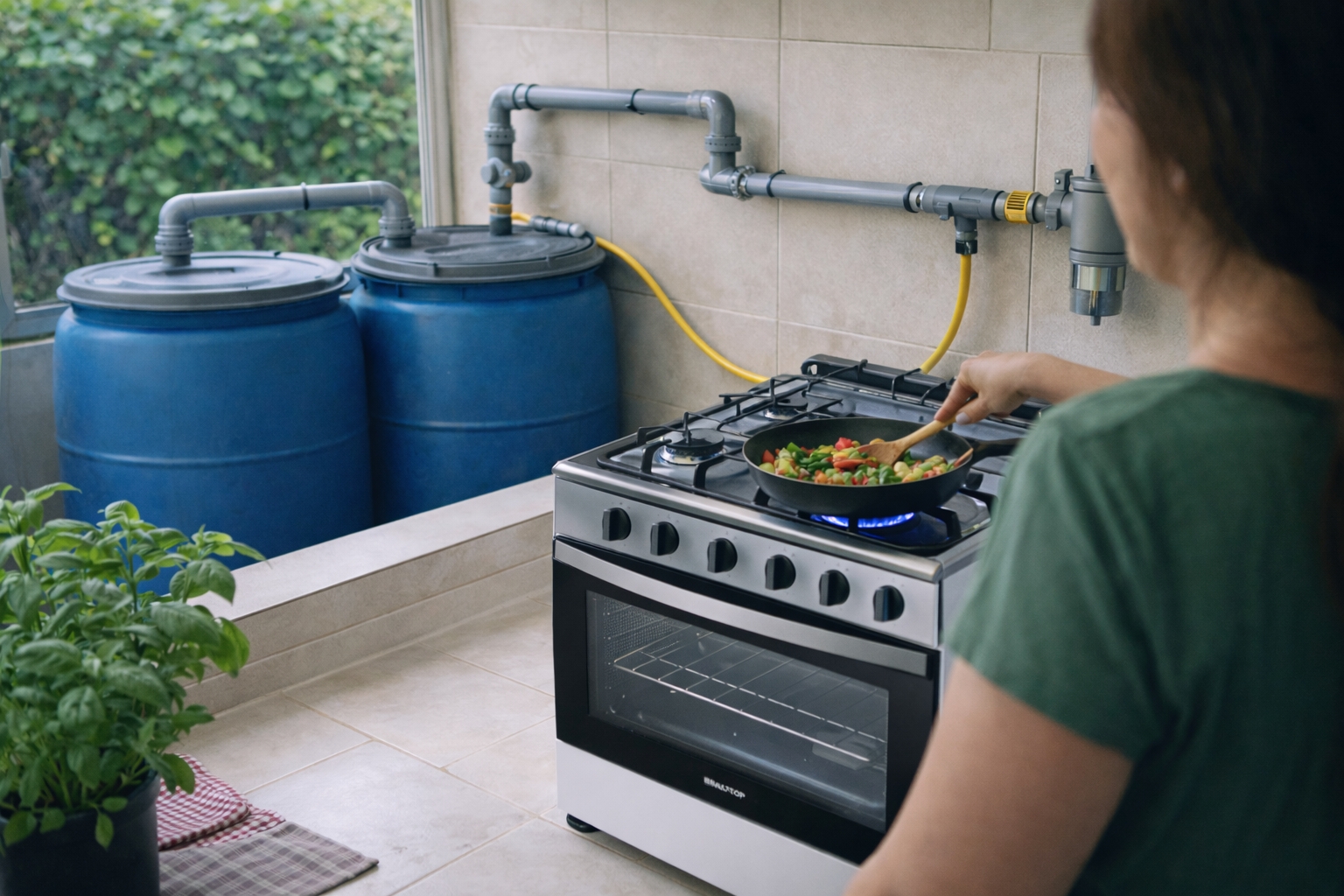


DIY Biogas System Guide Shows a Simple Setup with Two Blue Barrels That Turns Organic Waste into Free Cooking Gas All Year Round at Home
Setup with two containers and PVC piping delivers clean and renewable gas for daily use, focusing on stability, maintenance, and safety
An updated DIY biogas system allows for the production of free cooking gas all year round using two blue plastic barrels and a simple layout of PVC pipes. The setup is designed to operate continuously, with stable output and a feeding routine based on organic waste.
The proposal draws attention for combining straightforward assembly, easily found parts, and a process that can be applied at home. The goal is to reduce reliance on gas cylinders while maintaining a renewable gas source with basic operational control.
-
The Himalayas continue to grow to this day, with tectonic plates advancing 5 cm per year, mountains rising up to 10 mm annually, and the 2015 earthquake that killed 9,000 people may have increased the risk of an even larger seismic mega-event.

-
At an altitude of 400 km by astronauts from the International Space Station, Paris transforms at night into a golden mesh so precise that it reveals the outline of the Seine River, avenues, and entire neighborhoods like a luminous map drawn over the Earth.

-
iPhone 17 reaches historic low price with 256 GB, 120 Hz display, and drops to R$ 5,703 on Shopee, featuring A19 chip, dual 48 MP cameras, battery life of up to 30 hours, and advanced AI features.

-
Trip to Mars getting closer: Pulsar Fusion, from the UK, advances with plasma ignition in fusion engine and could drastically reduce space travel time, making crewed missions faster, safer, and economically viable.


The outcome depends on three points: proper connection between the two barrels, well-organized piping, and frequent maintenance. Safety is a mandatory step, with leak tests and operation in a ventilated area.
Connection Between Two Barrels Stabilizes Gas Output

The solution uses two blue plastic barrels as the system’s base, creating an interconnected volume that enhances supply regularity. The setup also utilizes PVC pipes and fittings, forming the gas transfer path to the usage stage.
The differentiator lies in the blend of simplicity with operational repetition. The system operates with a routine, adequate feeding, checks, and adjustments, without relying on complex components to deliver a continuous flow.
The practical consequence is clear: local production reduces the need to buy gas cylinders and maintains supply for daily tasks. The focus is on autonomy with control and safety.
How to Connect Two Barrels for a Stable Gas Output

The connection between the two barrels is the basis for a more consistent output. Instead of concentrating everything in a single container, the system distributes the volume and improves flow stability with interconnected barrels.
The assembly involves opening passage points and connecting the containers with PVC pipes, using suitable fittings to keep the path firm. The fitting needs to be well-adjusted, and sealing becomes a critical part to prevent losses.
The impact becomes evident in practice when the supply remains more regular. This assists in daily use, especially in situations that require a constant flame and less variation in consumption.
Attention to the joints matters. Proper sealing reduces leaks and enhances the assembly’s reliability, keeping production more efficient.
PVC Pipe Layout for Safe and Efficient Transfer
The pipe layout is simple, but it requires order and logic in the tracing. The path uses PVC pipes and fittings, including T-joints and elbows, to direct the flow and organize the line.
The transfer also includes the use of a check valve, which helps prevent gas backflow and increases system safety. This type of component favors a more controlled operational direction.
The result is a more efficient path, with less risk of reflux and less need for intervention during operation. A well-planned line design also facilitates visual inspection and spot corrections.
When necessary, the setup can include a water seal bubbler, which creates an intermediate step for control and reinforces safe operation.
Proper Fermentation with Organic Waste Keeps Production Stable

The stability of biogas depends on fermentation and care with feeding. The system uses raw material from organic waste, placed in the barrels to sustain continuous gas generation.
The operation requires routine and regularity. Feeding must avoid spikes, keeping the internal process more constant and reducing fluctuations in production. Proper sealing of the containers also influences performance.
The consequence is a more stable generation over time, with better predictability for daily use. Consistency comes from controlling input and being attentive to sealing and lids.
A point of attention is to monitor signs of declining production. Simple adjustments in the routine can prevent interruptions and keep the system reliable.
How to Store, Filter, and Use the Gas for Daily Cooking
After production, the gas needs to be directed to the consumption point. The line can utilize a gas hose connected to the circuit, adding flexibility to position the outlet as needed.
The setup can also incorporate an optional simple filter, installed in the line to reduce impurities and enhance gas quality during use. Storage can be in a volume connected to the circuit, allowing for reserves during higher demand moments.
The practical change is the possibility of cooking daily without relying on gas cylinders. This reduces recurring costs and diminishes the logistics of purchasing and exchanging.
To maintain performance, it is important to check connections and observe the system’s behavior. Small accumulated faults can reduce efficiency and compromise continuous use.
Maintenance Tips, Odor Control, and Long-Term Reliability

Long-term reliability depends on constant maintenance. The system requires repeated checks, cleaning, and adjustment of gaps in PVC pipes, lids, and connection points.
The routine includes reapplying sealant when necessary, keeping the surroundings clean, and monitoring the operation of the water seal, when used. This control helps to avoid instability and may contribute to reducing odors in the environment.
The direct effect is less interruption and less need for emergency adjustments. Preventive maintenance is usually simpler than corrections after failure.
It is also helpful to keep basic spare parts on hand, such as fittings and short pipe sections, for quick repairs without disassembling the entire line.
Points of Attention and Safety Precautions in Handling

Operation must occur in ventilated areas, reducing the risk of gas accumulation in enclosed spaces. It is also essential to avoid flames and sparks near the system, as biogas is flammable.
The leak test should be performed with water and soap, applied to the joints to identify bubbles and fix faults. The check valve is a central part to prevent backflow.
The assembly should also use a siphon, reinforcing physical barriers and enhancing system control. These precautions increase safety and protect efficiency since leaks also mean gas loss.
Periodic testing is recommended, not just after assembly. Handling, vibration, and continuous use can loosen connections, requiring retightening and resealing.
The DIY biogas system with two blue barrels and PVC pipes shows that continuous production depends on stable connections, well-designed piping, and a fermentation routine with organic waste. Sealing, backflow prevention, and intermediate steps strengthen flow control.
The impact for home use is direct: less reliance on gas cylinders and more autonomy with renewable gas for cooking. The outcome is sustained when maintenance and safety are part of the process, with frequent checks and operation in a ventilated environment.
Have you set up a similar system or do you want to try it at home? Leave a comment and share






Nossa eu achei muito inteligente e interessante será que eu conseguiria fazer só com essas explicações sério muito bom o gás está tão caro né
É muito interessante esse modelo,
Queria saber qual tio de orgânicos vocês usam pra fazer o projeto!!
Eu tenho interesse