





 Portuguese
  English
  Spanish
  4 min of reading
  1 comment


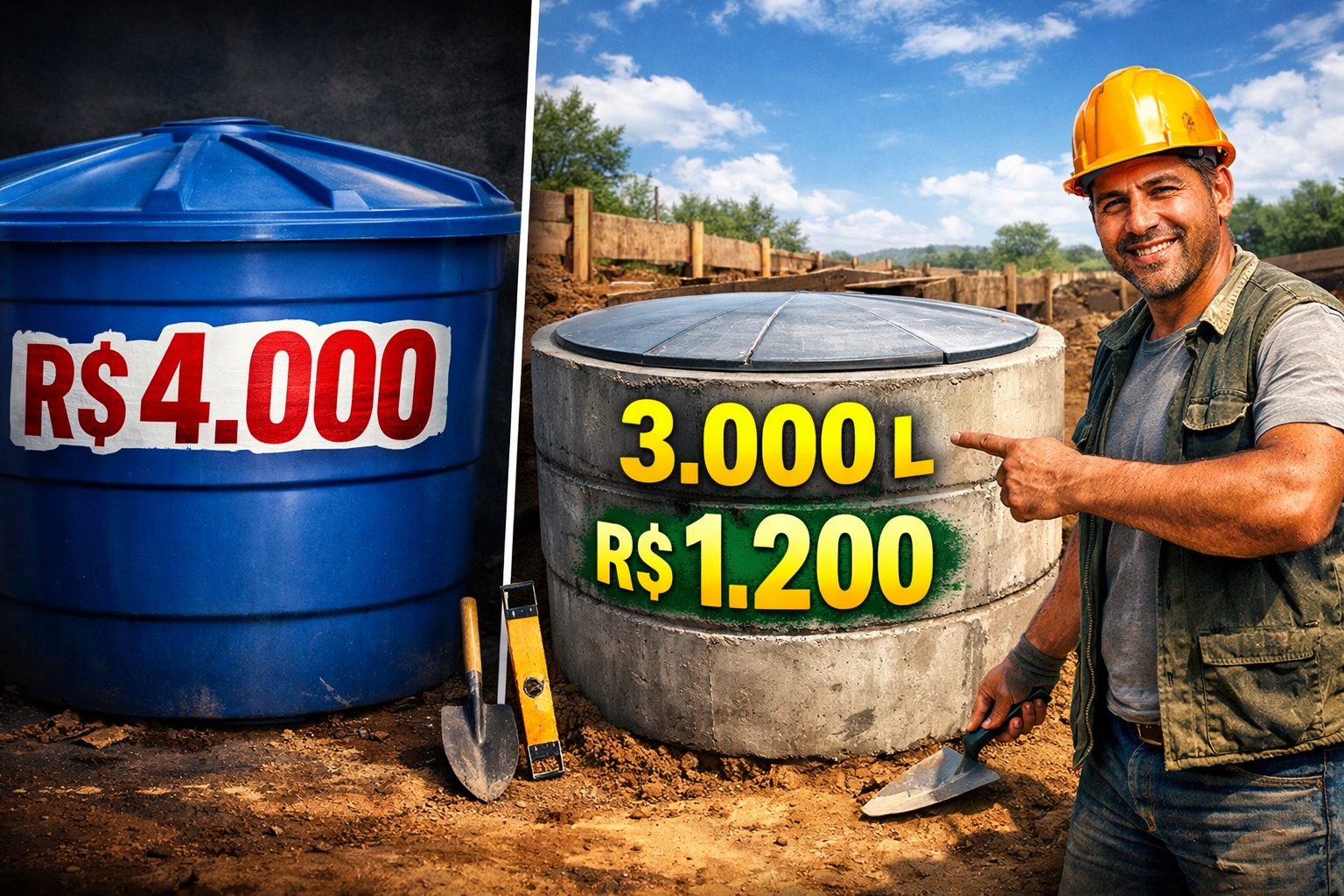


System with Concrete Rings Allows for the Construction of a 3,000-Liter Reservoir for Less Than R$ 1,200, Reducing Costs Compared to Conventional Water Tanks.
The cost of a large-capacity water tank can easily exceed R$ 4,000 when considering the support structure, elevated base, and complete installation. In rural areas and urban peripheries, this amount makes it unfeasible to increase the water reserve of the residence. The alternative presented by experienced masons is the construction of a 3,000-liter reservoir using precast concrete rings, a technique widely used in wells and septic tanks, but adapted for rainwater or supply water storage.
The method combines low material costs, structural durability, and high mechanical resistance.
How the Reservoir with Concrete Rings Works
The system uses precast reinforced concrete rings, typically with a 1-meter internal diameter and an average height of 50 centimeters each. By stacking six units, for example, it is possible to achieve an approximate volume of 3,000 liters, depending on the chosen dimensions.
-
The lack of welders, electricians, and operators becomes a structural threat in 2025, with the construction industry and manufacturing already suffering from delays, cost pressures, and labor shortages in Brazil.
-
Brazil and Paraguay are just 46 meters away from a historic union on the bioceanic bridge that promises to revolutionize trade between the Atlantic and the Pacific.

-
With 55 km over the sea, a cost of US$ 20 billion, and enough steel to build 60 Eiffel Towers, China’s largest project has connected Hong Kong, Zhuhai, and Macau in a colossal bridge that defies the logic of engineering.

-
A trick with joint compound transforms a Styrofoam ceiling into a plaster-like ceiling: leveled panels, wires and mesh at the joints, sand, paint, and change the environment while spending little today.


The sealing is done with waterproof mortar between the joints and, subsequently, with the application of an appropriate internal waterproof coating for water storage.
The top cover can be made of reinforced concrete or precast slab, with an opening for inspection and installation of water inlet and outlet.
Calculation of Volume and Structural Capacity
The volume of a cylindrical reservoir is determined by the formula:
V = π × r² × h
Considering an approximate internal radius of 0.5 meters and a total height near 2 meters, the volume reaches approximately 3,100 liters.
This capacity is sufficient for:
- Satisfying the household consumption of a family for several days
- Storing rainwater collected from roofs
- Serving as a strategic reserve in areas with frequent supply interruptions
The reinforced concrete structure offers high resistance to water pressure and soil uplift when partially buried.

Estimated Costs of the System
Prices may vary by region, but on average:
- Precast rings: R$ 150 to R$ 200 per unit
- Concrete cover: R$ 200 to R$ 300
- Mortar and waterproofing: R$ 200 to R$ 300
- Pipes and fittings: R$ 100 to R$ 200
The total cost can range from R$ 900 to R$ 1,200, significantly lower than the investment in a large water tank with a metal or wooden elevated structure. The savings can exceed 60% depending on the solution compared.
Structural Advantages Over Plastic Tanks
Unlike plastic reservoirs exposed to the sun, concrete:
- Does not suffer degradation from ultraviolet radiation
- Exhibits greater mechanical resistance
- Has a lifespan exceeding decades when properly executed
Additionally, the reservoir can be partially buried, reducing visual impact and thermal variations of the water.
Rainwater Catchment System
The reservoir can be integrated into a rainwater catchment system with:
- Gutters
- PVC downspout
- Leaf filter
- Initial water discard (first flush)
This integration enhances the water autonomy of the residence and reduces dependence on public supply.
Important Technical Precautions
Although it is a low-cost solution, some precautions are essential:
- The base must be leveled and compacted to avoid differential settlement.
- The joints must be properly sealed to prevent external infiltration.
- An overflow outlet must be anticipated to prevent flooding during heavy rains.
When used for drinking water, the internal lining must be appropriate and safe for contact with water intended for human consumption.

Concrete reservoirs, when properly waterproofed, can last for decades with minimal maintenance. Periodic inspection of the joints and the lid prevents contamination and infiltration.
The structural robustness even allows for future expansions, with the addition of new rings if there is a need to increase capacity.
Comparison with Conventional Systems
While plastic tanks require elevated support to ensure pressure by gravity, the ring reservoir can operate with a simple pump or be installed at the natural elevated level of the terrain.
The main difference lies in the cost per liter stored. In the ring model, the cost per liter can be below R$ 0.40, depending on the region. In complete industrial solutions, this value can be significantly higher.
The construction of a 3,000-liter reservoir with concrete rings represents a viable alternative for those seeking to expand water storage with reduced investment.
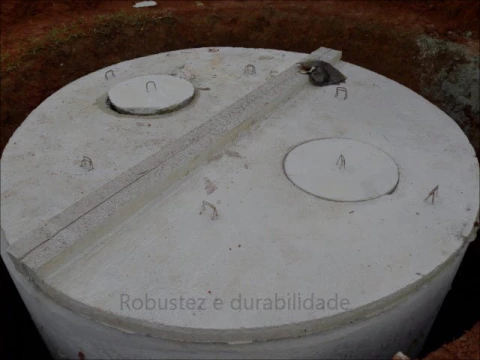

With an estimated cost below R$ 1,200, high durability, and the possibility of integration into rain catchment systems, the technique shows that simple structural solutions can replace high-cost commercial systems.
The method does not completely eliminate the need for technical planning, but provides an accessible path to enhance residential water security without exclusively relying on industrial solutions.









Propaganda enganosa,esse reservatório vai precisar de uma bomba elétrica para puxar a água.considerando os valores acima mencionado,sairá por 2.000 em média,bastante somar seis anéis a 200 reais cada um,mas 300 da tampa,mas 300 da argamassa,mas 200 da tubulação,mas a bomba e a fiação,além do consumo da energia,sem falar no valor pra cavar o buraco e a mão de obra para todo esse serviço….A caixa de PVC já vem quase pronta,com ,40 reais vc compra as conexões e tá pronta. A matéria deveria ser analisada antes de ser publicada. AFF…