





 Portuguese
  English
  Spanish
  6 min of reading
  0 comments



Rare Phenomenon in African Forests Draws Attention for Leaving Visible Tracks on the Ground and Revealing Behavioral Differences Among Groups, Using Stones, Repeatedly Chosen Trees, and Signs of Social Learning While the Species Faces Pressure from Habitat Loss.
In some forests of West Africa, researchers have recorded a behavior that stands out for its simplicity and the visible result on the ground: chimpanzees collect stones, strike them against trunks and roots, throw rocks towards specific trees, or place them inside cavities, accumulating heaps that resemble small stone markers.
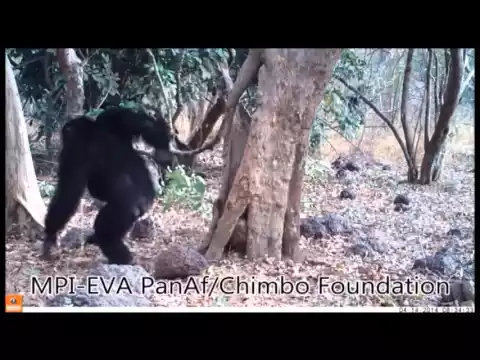
The scene typically occurs near the base of repeatedly chosen trees, where the sound of impact stands out in the environment and, over time, the location becomes concentrated with an unusual volume of rocks deposited around the trunk or inside natural holes, forming a type of “cairn” that does not arise from normal ground processes.
The record does not describe a single isolated action but a pattern observed in specific populations, with sufficient repetition to indicate a habit, not just an occasional playful accident or a momentary reaction to a stimulus.
-
A gigantic dam project in the Himalayas could solve one crisis but silently create another for millions of people.

-
Nikola Tesla said that intelligent people tend to have fewer friends, and now science partially confirms this: a study with over 15,000 people showed that for the more intelligent, socializing too much can even reduce life satisfaction.

-
A superyacht worth US$ 17 million is delivered in impeccable condition, sets out to sail, and hits a bridge in the Bahamas just two hours later.

-
Residents of Australia woke up to a sky completely red like blood before the arrival of Cyclone Narelle, which hit the coast with winds of 250 km/h, tearing off roofs and lifting iron dust in a scene they described as apocalyptic.


Stones in Hollow Trees and Marks Left in the Environment
Among the points most cited by scientists is the fact that the stones are not used there to open food or crack shells, as occurs in other contexts of tool use in primates, but rather in a sequence that involves object choice, movement to the tree, and production of a sound and physical effect in the environment.
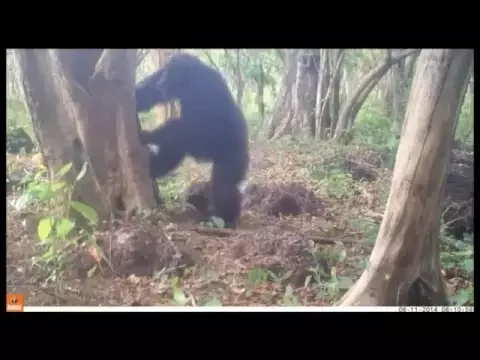

This type of tool use is considered unusual because, most of the time, tools in chimpanzees are linked to feeding, such as sticks to “fish” for termites and ants or stones to crack nuts, while throwing and striking against trunks create an acoustic and visual mark that remains at the site.
The behavior has been described based on observations and records from multiple communities of chimpanzees, including long-term research sites and areas sampled in surveys, focusing on identifying where the pattern occurs and how it presents itself in different regions.
In these populations, the presence of “focal” trees recurs as a central element, with a preference for trunks that produce loud noise upon impact and for points where cavities and roots form a receptacle for the stone to stay, enhancing the cumulative effect of the behavior.
Traditions Among Groups and Social Learning in Chimpanzees
At the same time, the phenomenon is not generalized throughout the species’ distribution, which highlights a recurring characteristic in studies on chimpanzees: behaviors can vary among groups, even when the animals belong to the same species and live in relatively close forests.
This regional variation appears in other forms of tool use and environmental exploration, with documented differences in how to obtain food, the type of object chosen, the technique applied, and the frequency of use, creating “repertoires” that become recognizable to those observing each community.
When a behavior persists within a group and is not observed with the same regularity in another, the most accepted explanation among primatologists is that there is social learning, with young individuals observing adults, repeating attempts, and adjusting movements until mastering the technique, in addition to local preferences influenced by material availability.
In the case of stone “cairns,” the pattern of repetition on the same type of tree and the formation of accumulations on the ground heighten curiosity because the effect is lasting and can be detected even after the animal leaves the area, functioning as a physical signature of that use.
Communication, Impact Sounds, and Social Context in the Forest
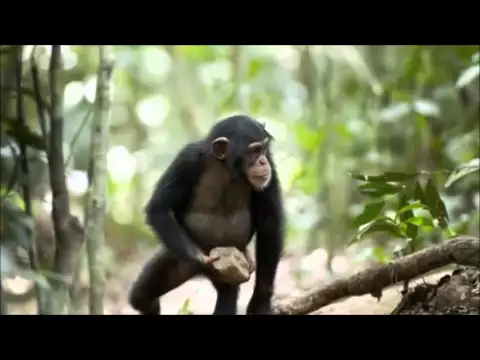
Researchers describe that, during these episodes, chimpanzees may combine the action with intense vocalizations, typical of long-distance communication, which reinforces the perception that the behavior occurs in a social context and not merely as random manipulation of objects.
Still, the studies themselves indicate that the exact function has not been established, and the phenomenon continues to be analyzed with caution, avoiding interpretations that are not supported by direct and repeated observation in different locations.
Part of the scientific interest comes from the contrast between the simple act of throwing a stone and the more complex consequence of creating a recurring site with gradual accumulation in an animal living in societies with dynamic relationships, status disputes, cooperation, and constant communication.
Chimpanzees are known to live in fission-fusion social systems, where subgroups form and dissolve throughout the day, and the coordination of meetings, movements, and feeding depends on vocal and visual signals that can cross long distances in the forest.
Within this scenario, loud sounds produced by impact on trees are not new to the species, as hitting trunks and creating noise can integrate repertoires of display and communication, but the use of stones adds a material element that accumulates and leaves a perceptible trail.
Field Research and Identification of the Behavior “Stone Throwing”
The topic also relates to a larger issue in primatology: the diversity of tool use in chimpanzees and how this use relates to environment, local tradition, and learning, without attributing human intentions to animal behaviors.
Attention to the phenomenon has grown because, in addition to being rare, it is relatively easy to identify in the field once you know what to look for, since trees with cavities can concentrate stones in a volume that stands out from the surroundings, and some rocks show marks compatible with repeated impacts.
Interest, however, is not limited to scientific curiosity, as chimpanzees live under increasing pressure across much of their African distribution, with threats associated with habitat loss and fragmentation, hunting, and conflicts in areas at the border between forest and human occupation.
When the forest loses continuity, groups become more vulnerable to contact with people, face difficulties in movement, and have altered access to food and shelter, which tends to affect not only survival but also the transmission of socially learned behaviors.
CITES and Chimpanzee Conservation in the Face of Habitat Loss
The international protection of the chimpanzee is recognized by the species being framed in one of the most restrictive levels of control over global wildlife trade, through its inclusion in Appendix I of the Convention on International Trade in Endangered Species of Wild Fauna and Flora, CITES.
In practice, this listing subjects international trade to strict rules and, broadly speaking, prevents commercial transactions involving specimens taken from the wild, as well as strengthening the legal framework for enforcement, cooperation between countries, and combating trafficking.
Even with international instruments, conservation depends on local measures, such as maintaining protected areas, enforcement, reducing pressures on forests, and working on supply chains that feed illegal hunting and trade, as the main risk to the species remains linked to habitat disappearance.
The phenomenon of stone “cairns,” being associated with few populations and specific locations, gains additional importance when considering that the loss of a forest fragment may also mean the loss of a rare behavior, recorded precisely because it depends on particular environmental and social contexts.
In a species that has already shown the ability to learn, adapt techniques, and maintain traditions among groups, the accumulation of stones in hollow trees has become one of the most intriguing examples of how a simple gesture can transform into a lasting mark on the forest landscape.
If heaps of stones can arise from a repeated habit by chimpanzees on specific trees, how many other discreet signs of behavior still go unnoticed in the forests where they live?








-

-

5 pessoas reagiram a isso.