





 Portuguese
  English
  Spanish
  3 min of reading
  0 comments



Jilin University Scientists Challenge Old Theories About Lunar Formation by Identifying Graphene on the Moon in Samples Brought Back by the Chang’e-5 Probe.
China Discovers Graphene on the Moon? Recently, Chinese researchers from Jilin University made a new discovery in understanding the mineral composition of lunar soil. By analyzing samples brought back by the Chang’e-5 probe, they identified the presence of graphene on the Moon in its natural form and in few layers for the first time. This discovery could transform our understanding of lunar geological evolution and influence future space exploration plans, especially in the context of using local resources on the Moon’s surface.
Presence of Graphene on the Moon Has Significant Implications for Space Exploration
Analysis of the Chang’e-5 Samples
In December 2020, the Chinese probe Chang’e-5 brought lunar soil samples back to Earth. The analysis of these samples, as reported by the South China Morning Post, revealed the presence of few-layer graphene, a form of graphene made up of two to ten layers.
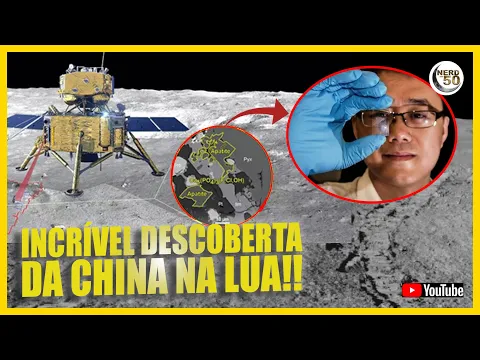

This discovery was confirmed by a team of scientists from Jilin University, using a technique called Raman spectroscopy, which allows non-destructive chemical analysis of materials.
-
Archaeologists find an intact tomb over 2,500 years old, with more than 100 preserved objects, weapons, jewelry, and human remains never touched.

-
Volcanic lava transforms into threads as fine as human hair that travel over 30 kilometers by wind and fall like cutting rain on roofs and backyards in Hawaii and Iceland.

-
NASA issues a warning for the feared Godzilla El Niño that could change the planet’s climate in 2026 with extreme warming of the Pacific capable of causing devastating droughts in some regions and historic floods in others simultaneously.

-
Archaeologists discover a 100-meter ship graveyard in a submerged Greek city, and what has appeared on the seabed of Libya could change what was known about this ancient port.


The identification of graphene on the Moon has significant implications for space exploration. Graphene is known for its exceptional properties, such as high electrical and thermal conductivity, mechanical strength, and flexibility. The presence of this material could also provide a local source of advanced materials for future lunar missions, reducing reliance on resources brought from Earth.
Challenging Existing Theories
The discovery of graphene on the Moon also challenges the prevailing theory that the Moon was formed after a collision between a small planet and the Earth. Known as the Giant Impact Theory, this premise suggests the Moon is carbon-poor, based on initial analyses of samples from the Apollo missions. However, the presence of natural graphene suggests that a carbon capture process may have occurred on the Moon, leading to the gradual accumulation of native carbon.
Researchers suggest that the graphene found may have formed due to the impact of solar wind on the lunar surface and ancient volcanic eruptions. This hypothesis is supported by the presence of “native carbon” in pure form, which could challenge the idea that most of the carbon on the Moon was a result of meteorites. Future studies on the properties of natural graphene on the Moon may provide more insights into the geological evolution of Earth’s natural satellite.
Potential Applications of Graphene on the Moon
The discovery of graphene on the Moon opens new possibilities for utilizing local resources in future lunar missions. The material could be used in constructing structures, producing advanced electronics, and energy systems due to its exceptional properties. The possibility of producing graphene directly on the Moon could significantly reduce the costs and complexity of space missions, making them more sustainable.
The ability to explore and utilize advanced materials like graphene on the Moon could also impact long-term space exploration. As humanity expands its presence in space, efficiently utilizing local resources will be crucial for mission success. The discovery of natural graphene represents an important step in that direction, providing new opportunities for science and space technology.
Understand What Graphene Is

Graphene is a crystalline form of carbon, consisting of a single layer of atoms arranged in a hexagonal structure. This material stands out for its exceptional properties: it is extremely lightweight, with high mechanical strength, flexibility, and the ability to efficiently conduct electricity and heat.
Discovered in 2004, graphene has revolutionized various areas of science and technology due to its versatility. Its applications range from electronics, such as transistors and batteries, to composite materials and biomedical devices. The discovery of graphene on the Moon suggests new possibilities for the use of advanced materials in future space missions.








Seja o primeiro a reagir!