





 Portuguese
  English
  Spanish
  5 min of reading
  0 comments


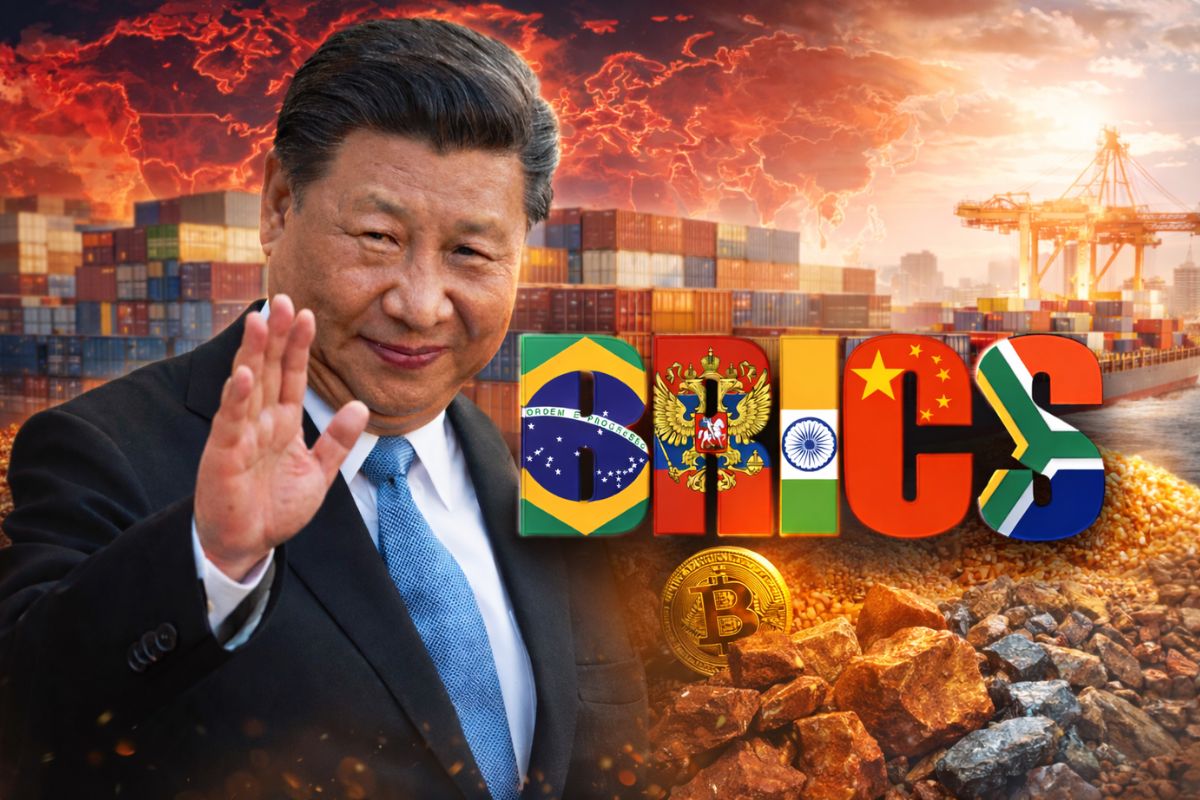
Trade between BRICS countries reached US$ 1 trillion in 2025, with an average growth of 4.75% per year over the last five years, 67% of transactions already conducted in national currencies, and China operating as the main economic engine of the group, while Brazil consolidates as a strategic supplier of commodities.
BRICS has ceased to be just an elegant acronym for emerging economies. According to the TV Brics portal, in 2025, trade among the countries of the group surpassed US$ 1 trillion, and BRICS+’s share of global GDP reached 39.7%. The volume of transactions using national currencies has already exceeded 67%, according to estimates from the Sk Fintech Hub ecosystem of the VEB.RF Group. These numbers show that the group is practically transforming into one of the main trade alliances on the planet.
Within this machinery, one country stands out disproportionately. China alone accounts for about 70% of trade within BRICS, functioning as the main engine of growth and commercial integration of the group. In the first nine months of 2024 alone, trade within the bloc totaled US$ 648 billion. Meanwhile, Brazil establishes itself as an essential supplier of food and minerals, with 36% of the group’s exports in 2024. The global trade game is changing, and BRICS is at the center of this transformation.
China as the engine of BRICS: 70% of trade passes through Beijing

You cannot talk about BRICS without mentioning China. The country is the largest trading partner of all other members of the group and functions, according to experts, as a market maker in various segments.
-
Starting in May, those who do not have registered biometrics will not be able to apply for Bolsa Família, sickness benefits, or unemployment insurance: understand the new rule that changes access to benefits for millions of Brazilians.

-
A new law being voted on in Brazil proposes a minimum fare of R$ 10 per trip and R$ 2.50 per kilometer for Uber and 99 drivers, and promises to ensure they earn as well as taxi drivers did during the golden age of taxis in the country.

-
Bauer Group collapses after failed judicial recovery: 25 years, 800 vehicles, and a network of gas stations leave a debt of R$ 50 million and 100 layoffs, exposing costs, tight margins, and expensive credit in Brazil.
-
Premium Brazilian brand born during the pandemic brings fine cocoa from Bahia to Switzerland, Germany, and France, has won 9 awards, and claims to have the 2nd best milk chocolate in the world: meet Luz Cacau.

China absorbs raw materials, energy, and food from BRICS partners and, at the same time, is the main supplier of industrial products, machinery, electronics, and intermediate goods to the entire bloc.
According to Professor Erik Escalona Aguilar from Bernardo O’Higgins University (Santiago, Chile), China acts as “a pillar of demand” that organizes and directs trade flows within BRICS.
The country exports increasing volumes of high-tech products, such as automobiles and equipment, while increasing imports of critical resources such as oil, microchips, and food. This dynamic makes BRICS function, in practice, as a system where China is both the largest buyer and the largest seller.
The role of Brazil: food, minerals, and fertilizers

Brazil occupies a strategic position within BRICS that goes far beyond the size of its economy. The country is an essential supplier of agricultural and mineral products to the group, with iron ore as the main export product, followed by soybeans, crude oil, and sugar.
In 2024, Brazil accounted for 36% of exports within BRICS, consolidating itself as the second-largest exporter in the bloc behind China.
The relationship with Russia is also revealing: Brazil imports large volumes of Russian fertilizers, as Russia is the world’s largest producer of this input.
This complementarity is what experts call the “macroeconomic synergy” of BRICS: countries that produce what others need, reducing dependence on suppliers outside the bloc. Together with China and Russia, Brazil forms the tripod that supports the commercial base of BRICS.
National currencies and the end of dependence on the dollar
One of the most significant changes within BRICS in recent years is the increase in transactions in national currencies.
Payments in yuan, Indian rupees, and Russian rubles have consistently grown, and more than 67% of trade within BRICS is already conducted without passing through the US dollar. This trend was reinforced at the state leaders’ summits held in Russia in 2024 and in Brazil in 2025.
International Relations expert Aníbal Garzón highlights that the strengthening of the use of local currencies has been accompanied by the deepening of South-South cooperation, creating internal production chains within BRICS that previously depended on intermediaries from outside the group.
The next step, already under discussion, is the creation of BRICS Bridge, a proprietary payment system, in addition to the use of digital currencies in internal transactions. If implemented, this system could further reduce dependence on the dollar and expand mutual trade among BRICS countries.
The obstacles that BRICS needs to overcome
Despite the impressive numbers, BRICS faces concrete challenges to maintain its growth pace. The first is geographical distance.
The member countries are spread across Latin America, Africa, the Middle East, Asia-Pacific, and Europe, which raises logistical costs and creates very distinct continental realities.
BRICS does not have a formal trade agreement or a common customs union. Each country maintains its own trade rules and legislation, which creates barriers that can hinder trade.
To circumvent this, the group is betting on the development of strategic transport corridors: the Northern Maritime Route, which shortens the link between Europe and Asia; the North-South corridor, which connects Russia to Iran, India, and the Persian Gulf; and the Transoceanic Corridor, announced by China and Brazil.
In addition to logistics, the simplification and digitalization of customs procedures is pointed out as a critical factor. At the Kazan summit, BRICS countries adopted a declaration agreeing to simplify procedures and strengthen cooperation in standardization.
What lies ahead: grain exchange and free trade zones
Among the most ambitious initiatives under discussion is the creation of a BRICS grain exchange, which could eventually evolve into a complete commodities exchange.
The platform aims to make the grain market more transparent and predictable, protecting producers and consumers against price speculation and artificial shortages. For Brazil, the world’s largest soybean exporter and a global agricultural powerhouse, this exchange could represent a huge strategic advantage within BRICS.
Another area of expansion is the formation of free trade zones within the bloc, which would transform predominantly bilateral relations into multilateral economic collaboration, reducing tariffs and eliminating non-tariff barriers.
BRICS countries account for more than 40% of global oil production, about 25% of global raw material exports, and hold 30% of the planet’s iron ore reserves. If free trade zones come to fruition, BRICS could become not only a political alliance but the largest trading bloc in the world.
Will BRICS really change global trade?
BRICS already moves US$ 1 trillion a year in internal trade, represents almost 40% of global GDP, and conducts more than two-thirds of its transactions in its own currencies. China leads the group with 70% of the trade volume, and Brazil ensures the food and mineral security of the bloc. Challenges exist, but the magnitude of what is happening cannot be ignored.
And you, do you think BRICS will manage to become a real alternative to trade dominated by the West? Is Brazil making the most of this position? Share your thoughts in the comments.






Seja o primeiro a reagir!