





 Portuguese
  English
  Spanish
  4 min of reading
  0 comments


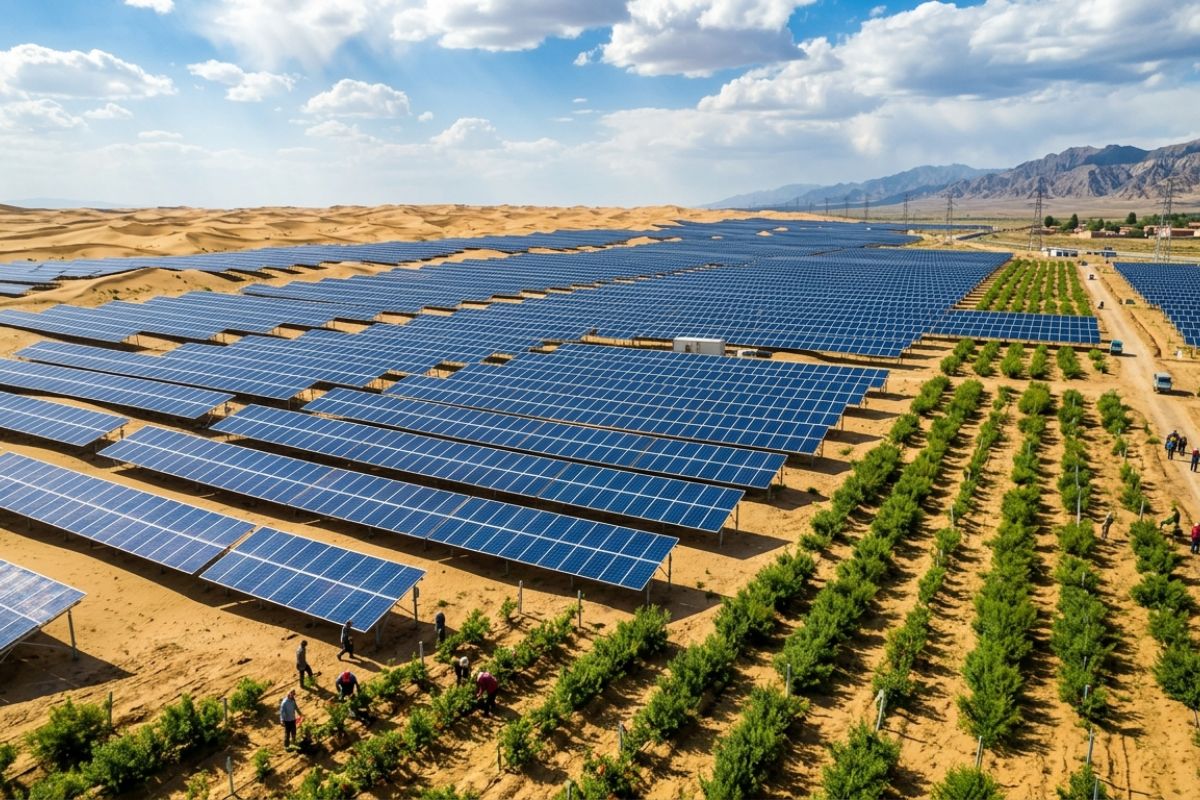
The advance of the desert has become the target of a plan that uses solar panels as shade for shrubs and goji, preserves agricultural land, and promises to recover 7,000 km².
The advance of the desert in northern China is gaining an unlikely ally: thousands of solar panels installed over arid areas, forming a kind of cover that reduces moisture evaporation and creates a microenvironment for resilient plants to take root.
In the northwestern region of Ningxia, a 1 gigawatt agro-solar facility combines energy generation with combating the advance of the desert by placing shrubs and crops like goji under the shade of the modules, while barriers around reduce wind and sand movement.
Solar panels as “mini umbrellas” against the advance of the desert
In the outskirts of Yinchuan, workers prune goji shrubs that extend under the shade of thousands of solar panels. The logic, according to the vice president of Ningxia Baofeng, Liu Yuanguan, is straightforward: the panels act as mini umbrellas, casting shade over plants and soil and reducing moisture evaporation.
-
MetSul issues alert for 72 hours of severe weather in the South of Brazil with an extratropical cyclone, a line of instability, and a cold front that will hit Rio Grande do Sul from Monday to Wednesday with strong winds and heavy rain.

-
Scientists have built a prototype of a quantum battery that actually works, charges faster as it gets larger, stores and releases energy using quantum physics instead of chemical reactions, and can be wirelessly charged by laser.

-
New technology allows payment with the palm of the hand and may replace cards and cell phones in Brazil; The system is in development and uses the unique patterns of the veins in the hand to make the payment.

-
Scientist who “predicted” the pandemic issues new warning, says the world may be entering a phase of disintegration and urges us to prepare for what is to come.

This approach is part of a network expanding across northern and western China aimed at stopping and reversing the advance of the desert using the volume and shade of solar structures.
The 1 GW project in Ningxia and the expansion to 30 GW
The 1 GW installation in Ningxia is operated by Ningxia Baofeng, a company described as a major player in the coal chemical industry. The company plans to build 30 GW of solar generation, and part of that total will be used to combat desertification, according to Liu.
He also cites a similar 1 GW project already in operation in the neighboring city of Majiatan, reinforcing that the strategy is not an isolated pilot but a model that tends to be repeated.
How the model works in practice: shade, barriers, and response time
The standard approach described involves three layers. The first is the shade from the panels, which protects seeds and desert-resistant shrubs planted underneath them.
The second is the use of barriers around the sites, which reduce wind speed and help prevent sand movement. The third is patience: according to the Ningxia government, it may take up to five years for results to become clear.
The goal is pragmatic: minimize damage and stabilize vulnerable areas, not to eliminate deserts completely.
Why the advance of the desert is a huge issue in China
Approximately one quarter of China is classified as “desertified,” and campaigns to contain and recover the sands date back to the 1970s. Solar energy enters as the most recent measure within this set.
It was included in a September review of the “Three Norths” program, a flagship initiative to combat desertification initiated in 1978 and expected to extend until 2050, although the concept has already appeared in planning documents since 2021.
253 GW by 2030 and the goal of recovering 7,000 km²
Although projects like the one in Ningxia are still a small fraction of the total solar energy that China installs every year, Beijing has announced plans to accelerate this type of initiative.
Between 2025 and 2030, the official plan aims to install 253 GW of solar energy to revitalize about 7,000 km², according to state media citing plans from the National Development and Reform Commission (NDRC) and two other agencies.
Solar energy in the desert also preserves agricultural land
An important component of the strategy is where to place the panels. In 2023, China enacted regulations that prohibit the installation of solar panels on arable land, and state media criticized projects in high-quality agricultural areas.
By relocating these ventures to desert and dry regions, the country aims to tackle two problems at once: generating energy and addressing the advance of the desert, without competing with agricultural land use.
Progress exists, but it is slow and requires continuous work
National results show small but consistent improvement. Desertified lands represented 26.8% of China last year, a reduction from 27.2% a decade earlier, even with massive tree planting programs.
In Baijitan, a nature reserve a few hours away from the Baofeng site, decades of work have recovered about 800 km², an example that the advance of the desert can be contained, but rarely at speed.
The site director, Wang Xiaoling, sums up the idea realistically: controlling the desert is a prolonged war, and the expectation is to reduce damage, not to eradicate the problem completely.
Do you think using solar panels to curb the advance of the desert is a smart solution or a temporary fix that could bring new problems later?





Seja o primeiro a reagir!