





 Portuguese
  English
  Spanish
  5 min of reading
  1 comment


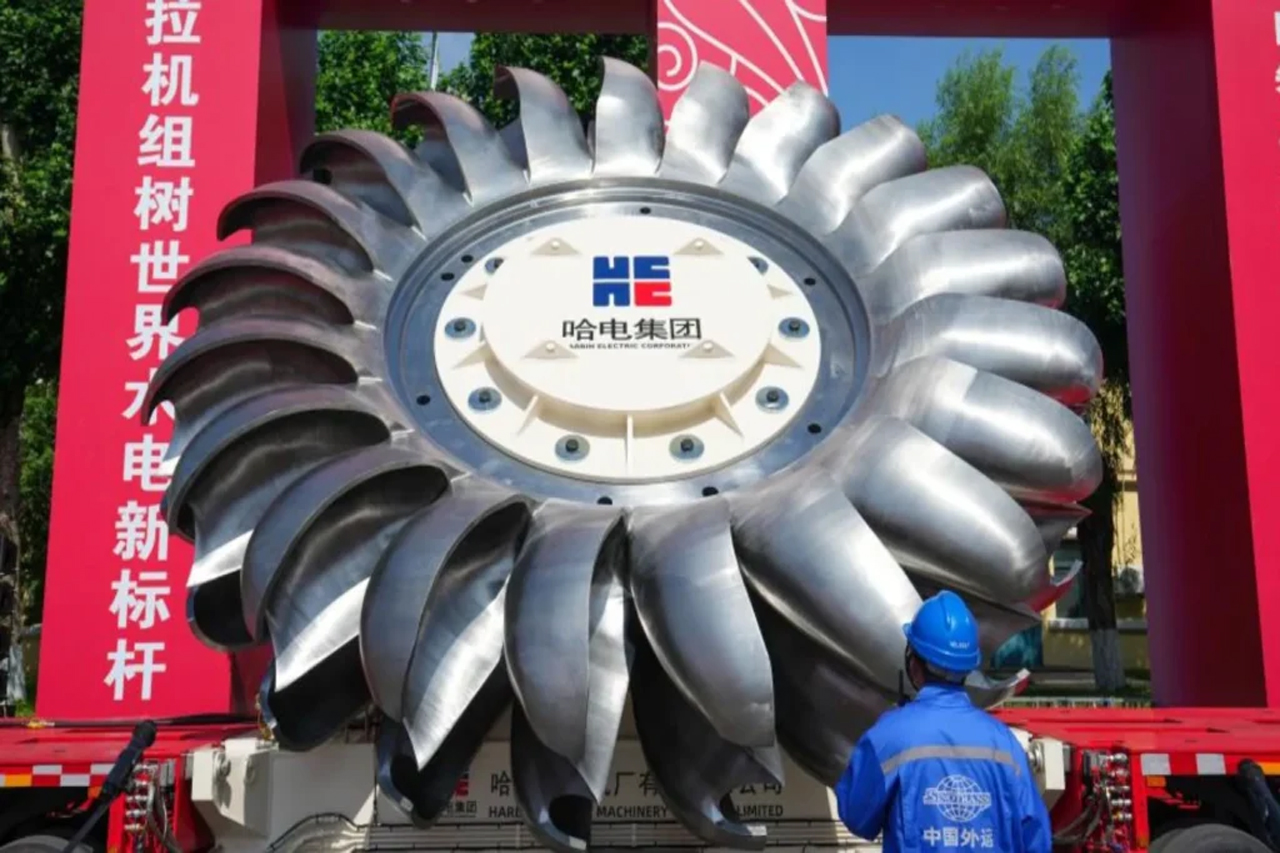


Each of These Hydroelectric Turbines Weighs 80 Tons, Measures 6.2 Meters in Diameter and Are Made of High-Strength Martensitic Steel, with 21 Water Buckets to Ensure the Ideal Flow During Operation
The Impulse Turbines (such as the Pelton model used in the Datang Zala project) operate with high-pressure water jets that hit the turbine blades, causing it to spin in the air, unlike reaction turbines, such as the Francis, which operate fully submerged. This operation in high drop is ideal for locations with significant elevation, leveraging gravity.
Here, reaching a capacity of 500 MW per unit is something never seen before. It is the first time the world sees impulse turbines with this level of power, a true technological leap that serves as a milestone in hydroelectric engineering.
This achievement gains even more relevance by combining great capacity with operational efficiency. When a turbine is as powerful as it is efficient, it positively impacts the entire energy mix, representing innovation, sustainability, and economies of scale.
-
Brazilians paid R$ 18 billion more for energy from the Itaipu plant, reflecting a direct impact on tariffs and generating discussions about costs, transparency, and balance in the national electricity sector.

-
Equatorial adopts new national number for consumer units on electricity bills starting in April, following ANEEL standards and modernizing energy bills in several states.

-
Itaipu Impresses the World: Hydroelectric Plant with 20 Turbines and 14,000 MW Generates Over 2.9 Billion MWh and Leads Global Clean Energy Production
-
Aneel Revokes CMAA Thermal Power Plants After Network Restrictions and Excess Energy in the System


For those interested in clean technology and energy advancements, the project symbolizes how China is rapidly advancing in the renewable energy sector, establishing a new standard in both generation capacity and turbine sizing.
The Engineering Behind the Giant Turbines of Harbin Electric
Each turbine weighs an impressive 80 tons and has a diameter of 6.2 meters, being constructed from high-strength martensitic steel, with 21 water buckets to ensure the necessary flow for its operation. This demonstrates the technical complexity involved.
The martensitic steel was chosen for its balance between durability and corrosion resistance — essential for equipment operating under high pressure and at an industrial scale. This durability is vital, especially considering that the turbines will operate almost 24 hours a day.
The development of these turbines took about four years, with fully internal technology from Harbin Electric. Manufacturing by a Chinese company contributes to technological independence and the consolidation of national expertise in heavy engineering.
Compared to standard hydraulic turbines, this technical innovation signals that China not only produces more but also raises the level of complexity and efficiency of the equipment itself — something critical to maintaining leadership in renewable energy.
The Datang Zala Hydropower Plant and Its Role in the Chinese Energy Mix
The plant is located on the Yuqu River, a tributary of the Nu River (or Salween), in eastern Tibet. The area has a vertical drop of 671 meters, characterizing it as a “high drop” system — maximizing the efficiency of impulse turbines.
It is expected that the efficiency of the turbines will jump from 91% to 92.6%, representing approximately 190,000 kWh extra per day — a significant gain considering we are talking about continuous energy generation.
With two 500 MW turbines, the plant will have a total installed capacity of 1,000 MW. Annually, it should generate nearly 4 billion kWh, enough energy to replace 1.3 million tons of coal — and reduce 3.4 million tons of CO₂ associated with thermal generation emissions.
This project is part of China’s strategy for carbon neutrality by 2060, using advanced hydropower as a pillar for decarbonization and sustainable energy transition.
Environmental Benefits and Contribution to the Carbon Neutrality Goal
The replacement of thermal coal generation with clean hydropower represents a huge reduction in greenhouse gas emissions. The 3.4 million tons of CO₂ avoided annually is a significant advancement for the environment.
Additionally, the plant leverages its efficiency gains to maximize production within ecological parameters — generating more energy with less impact, a fundamental principle of modern renewable energy.
China has been heavily investing in reversible hydropower plants, which allow for water storage in reservoirs and the release of energy on demand. These systems are versatile and flexible, reinforcing the role of hydro plants as “clean batteries” for the power grid.
All of this converges into a more efficient and sustainable energy transition, crucial for the country to achieve its national goal of carbon neutrality by 2060 — with hydropower as the protagonist.
Geopolitical and Environmental Issues in the Nu/Salween River
The Nu River, which becomes the Salween, flows through Tibet and continues into Myanmar, becoming a vital international waterway for millions of people who depend on it for water, agriculture, and energy.
Previous projects, such as the Yarlung Tsangpo, faced strong resistance due to risks of water scarcity and legal and environmental tensions with neighboring countries. The Datang Zala plant, although smaller, raises similar debates.
China was previously prevented from building a 6,000 MW dam on the Irrawaddy River by Myanmar in 2011 — showing that there is a regional sensitivity that must not be overlooked.
Therefore, even if the project is not at the same level of geopolitical controversy, it brings to light the debate: who decides the fate of a river shared by millions of people? Transparency and dialogue are essential to ensure that energy advancements do not turn into environmental conflicts.
China’s Leadership in Global Hydropower
By the end of 2024, China had accumulated around 436 GW of installed hydropower capacity, compared to 103.1 GW in the United States — clear evidence of its global leadership in the sector.
In 2024, China was also responsible for nearly half of the 24.6 GW of new global hydropower capacity — with 14.4 GW coming online in the country. This includes reversible hydropower plants, highly valued for their flexibility.
This expansion reinforces that China is not only expanding its infrastructure but also impacting the global market in hydropower technology.
The construction of 500 MW turbines only enhances this competitive advantage. The country is paving the way to export technology, propose new efficiency standards, and dictate the course of the sector for the coming decades.
The Future of Impulse Turbine Technology
With this innovation, a range of possibilities opens up: other nations with high-drop rivers may adopt similar turbines to expand their clean energy mix — with high efficiency and generation power.
Efficiency gains are expected to continue increasing as projects learn from the development of technology. Integration with hybrid systems (wind, solar, storage) may elevate the energy impact of these systems.
Moreover, as expected, the Datang Zala project is set to be fully operational by 2028 — when these turbines will transition from prototypes to operational components in the Chinese electrical system.
This technical advancement is an important step towards the future of renewable energy — where capacity, efficiency, and sustainability go hand in hand.









I was suggested this web site by my cousin Im not sure whether this post is written by him as no one else know such detailed about my trouble You are incredible Thanks