





 Portuguese
  English
  Spanish
  6 min of reading
  0 comments


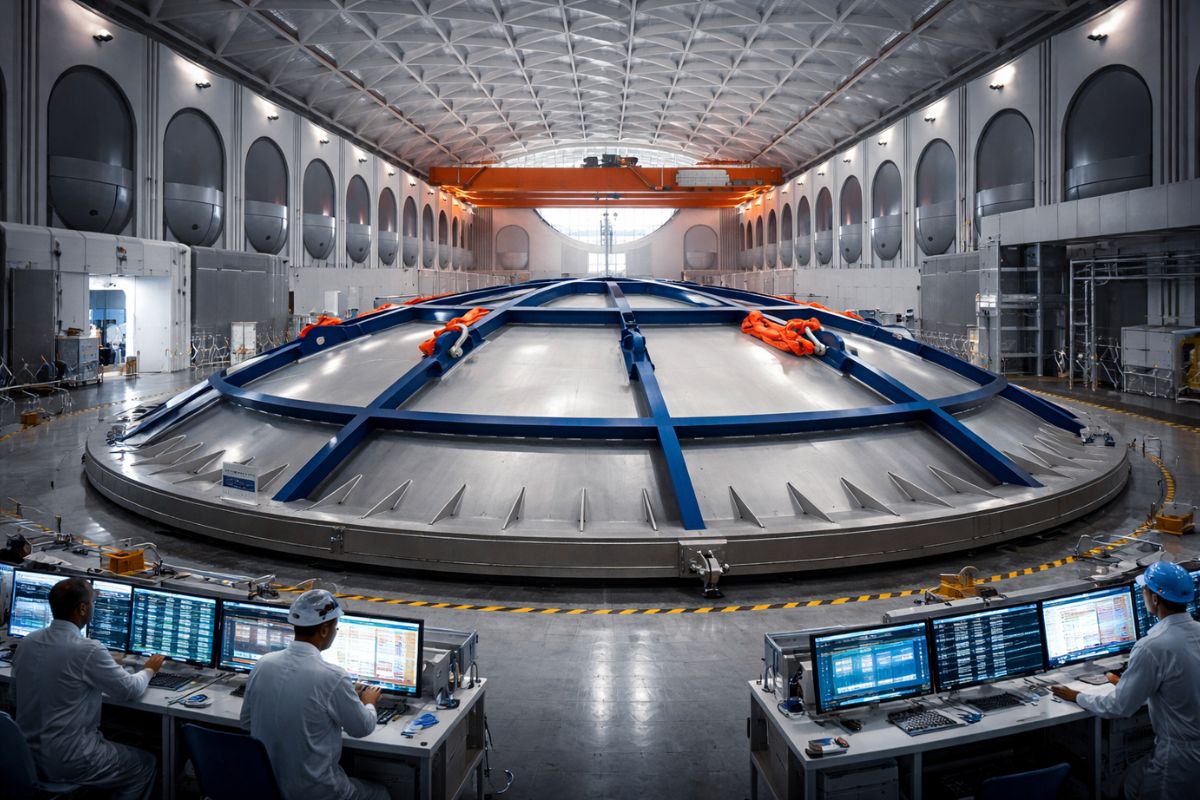
The Subterranean Machine Installed 15 Meters Deep Transforms Hypergravity Into a Scientific Tool to Accelerate Geological Phenomena, Test Dams, Reproduce Earthquakes, and Observe, at a Controlled Scale, Processes That Normally Would Take Centuries or Millennia to Leave Marks on Soil, Water, and the Most Complex Human Structures of the Modern World.
The subterranean machine built by Zhejiang University in Hangzhou takes geotechnical research to an uncommon level: instead of waiting decades, centuries, or millennia to observe how the ground behaves, it recreates extreme conditions in the laboratory capable of accelerating this type of transformation. Buried about 15 meters below the surface, the facility houses the CHIEF1900 centrifuge, designed to generate hypergravity at levels far exceeding what Earth produces naturally.
In practice, this means placing soil, water, structures, and materials under gigantic forces and observing, in a reduced time frame, how they react to stresses that would normally only appear over long periods or during major disasters. The result is an attempt to anticipate real-world behavior before it fails, something especially relevant when the subject involves earthquakes, tsunamis, dam failures, aquifer contamination, and ground deformations under large projects.
What Makes the CHIEF1900 Different
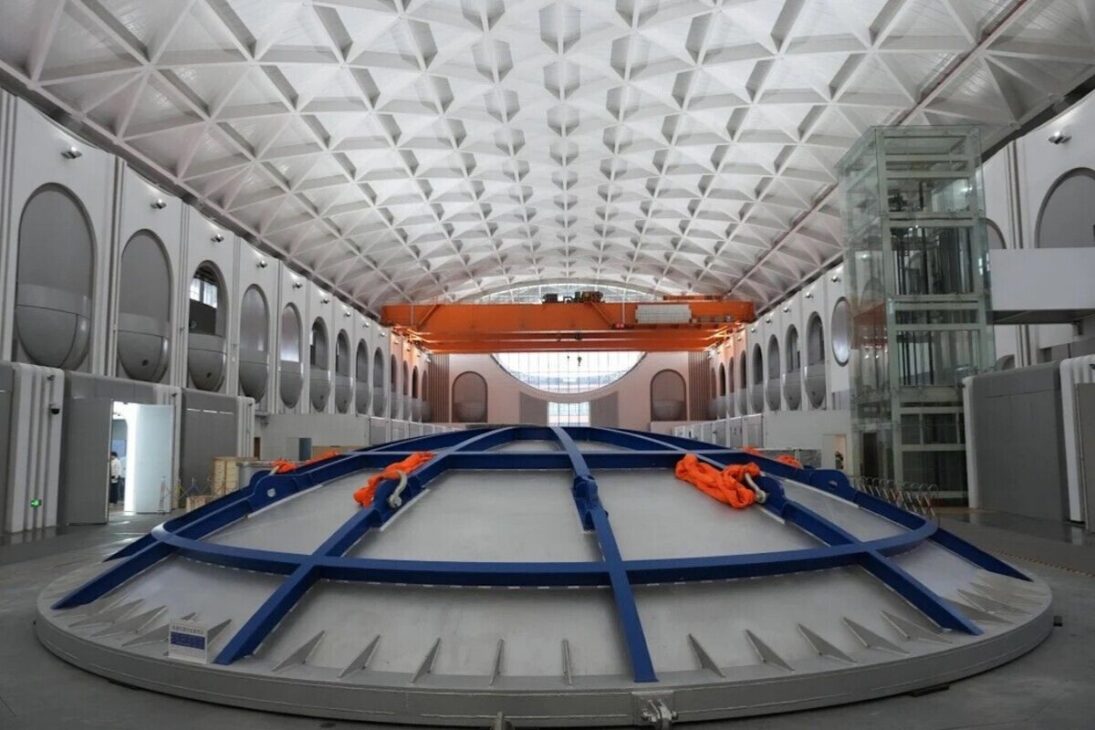
The CHIEF1900 was introduced as the most powerful hypergravity centrifuge ever built, surpassing the CHIEF1300, which had set the previous record just a few months earlier. The central figure of this new phase is its total capacity of 1,900 g per ton, equivalent to applying 1,900 times Earth’s gravity on a one-ton sample. This is not just about brute force, but about experimental control on a rare scale.
-
The most famous volcano in the world could paralyze one of the largest metropolises on the planet: Japan accelerates emergency plans for the eruption of Mount Fuji, which could bury Tokyo in ash for over two consecutive weeks.

-
The United States has a serious problem with its F-35s: China is already producing fighters at a pace that exceeds American capacity and could manufacture up to 300 aircraft per year before the end of the decade, shifting the global military balance.
-
Remains with battle wounds of over 100 soldiers from the Roman Empire are found beneath a football field in Vienna, leaving everyone surprised.
-
Elon Musk notes Brazil and lowers the price of his internet, Starlink, promising to connect all corners of the country with affordable plans, 10,000 satellites, and 1 million active users in the national territory!


This leap changes the scope of testing. Instead of merely working with small approximations, the subterranean machine expands the possibility of reproducing soil deformations on a kilometer scale, analyzing contaminant displacement over very long periods and testing the resistance of critical structures under severe events. This also helps produce new material samples under extreme conditions, something valuable for civil, environmental, and energy research.
How Hypergravity Accelerates Phenomena That Would Be Too Slow
To understand the impact of the subterranean machine, one must imagine how a geologist reads the planet’s history. Layer by layer, the soil records compressions, infiltrations, displacements, and structural changes that emerge slowly. The great obstacle has always been this: nature operates at much slower rhythms than science can observe directly. Hypergravity shortens this waiting time by intensifying the physical conditions that govern these processes.
The principle is that of centrifugation at extremely high speeds. As the machine’s arms rotate, they impose an increasing external force on everything inside the system. The greater the speed, the greater the load applied to the sample. This controlled hypergravity environment compresses both distance and experimental time. In other words, the subterranean machine does not alter real time, but accelerates the manifestation of effects that would take much longer to become visible outside.
What the Subterranean Machine Can Simulate Inside the Laboratory
The most impressive use of this technology appears when it is applied to risk scenarios. The subterranean machine can be used to assess how a dam reacts to an earthquake, how the ground deforms under the passage of heavy infrastructure, how contaminants move through the underground, and how large geological events affect human-built structures. It transforms potential disasters into controlled tests, which helps produce previously inaccessible data.
This type of simulation is not limited to classic natural disasters. The same reasoning applies to the consequences of human activity, such as failures in construction, instability in soils subjected to heavy loads, pressure in energy exploration regions, and changes associated with glacial melting.
The previous generation, the CHIEF1300, had already been used to reproduce deep-sea pressure at 2,000 meters, evaluate methane hydrate extraction, and simulate the impact of a 20-meter tsunami on the seabed. The CHIEF1900 emerges precisely to push this limit even further.
Why the Installation is Buried
The fact that the subterranean machine is buried is not an aesthetic detail nor an excess of engineering. In such sensitive systems, any external vibration can contaminate the experiment and compromise data readings. Installing the structure below the surface helps reduce interference from the environment and provides a more stable foundation for high-rotation operations. When the goal is to measure tiny deformations under extreme forces, stability becomes a requirement rather than a luxury.
Moreover, the construction of the CHIEF1900 required a multidisciplinary effort involving civil engineering, automation, and thermodynamics. The greatest technical challenge was the heat generated by rotation at extreme speeds.
In equipment of this size, the temperature increase is not just a side effect: it can directly affect system stability. To address this problem, a combination of vacuum, forced ventilation, and glacial refrigerant fluid was adopted, a solution designed to maintain operation within safe limits.
The Scientific Reach and What is Still Left to Prove
The ambition behind the subterranean machine is vast. The stated goal of the project is to create experimental environments capable of covering scales ranging from milliseconds to tens of thousands of years and from atomic dimensions to kilometer scales.
This helps explain why the installation is considered one of the four largest dynamic centrifuges in the world: besides its power, it is designed to simulate active earthquakes under hypergravity, something crucial for high-complexity geotechnical modeling.
At the same time, there are important cautions. Although the installation has been completed and is already described as operational, there are still no scientific results released from the CHIEF1900. This prevents hasty conclusions about the actual performance of this new phase.
There is a significant difference between building an extraordinary machine and proving, with published data, everything it promises to deliver. At the current stage, the engineering achievement is clear, but scientific validation still depends on what future experiments will show.
The Limits of Reduced-Scale Simulation
Even with all the power of the subterranean machine, the science of this type of experiment requires careful interpretation. Scale models can accurately replicate the applied loads, but not all size effects behave linearly under hypergravity.
This means certain materials may react differently when transitioning from the laboratory to reality, especially in very complex or heterogeneous situations.
For this reason, a result obtained in a centrifuge should not be treated as an automatic translation of the real world. The safest procedure is to compare data from different installations, test complementary hypotheses, and cross-observations before turning the simulation into a basis for technical decision-making.
The subterranean machine reduces uncertainties but does not eliminate the need for caution. Its value lies precisely in shortening the path between hypothesis and evidence, not in completely replacing the complexity of nature.
What This Technology Reveals About the Future of Prevention
The advancement represented by the CHIEF1900 shows an important shift in the logic of geotechnical research. Instead of merely studying disasters after they occur, science seeks to recreate their mechanisms before collapse.
This has direct implications for public works, dam safety, urban planning, high-speed transportation, aquifer protection, and risk assessment in sensitive areas. The better we understand the behavior of soil and structures under extreme stress, the greater the chance to act before failure occurs.
At the center of this transformation is precisely the subterranean machine, which combines extreme force, experimental control, and the ability to shorten processes that are too slow for conventional observation.
There are still no public results confirming how far it will be able to go, but the technical leap already suggests a new stage in the way of studying the relationship between infrastructure, environment, and risk. More than simulating collapse, the goal is to learn to prevent it.
What catches your attention most about this subterranean machine: the possibility of anticipating disasters, its use for testing dams and large projects, or the limits of trying to reproduce nature inside a laboratory? This is a topic that divides views on technology, safety, and prevention, so it’s worth sharing your opinion and stating where you think this type of research can have the most impact.




Seja o primeiro a reagir!