





 Portuguese
  English
  Spanish
  3 min of reading
  0 comments


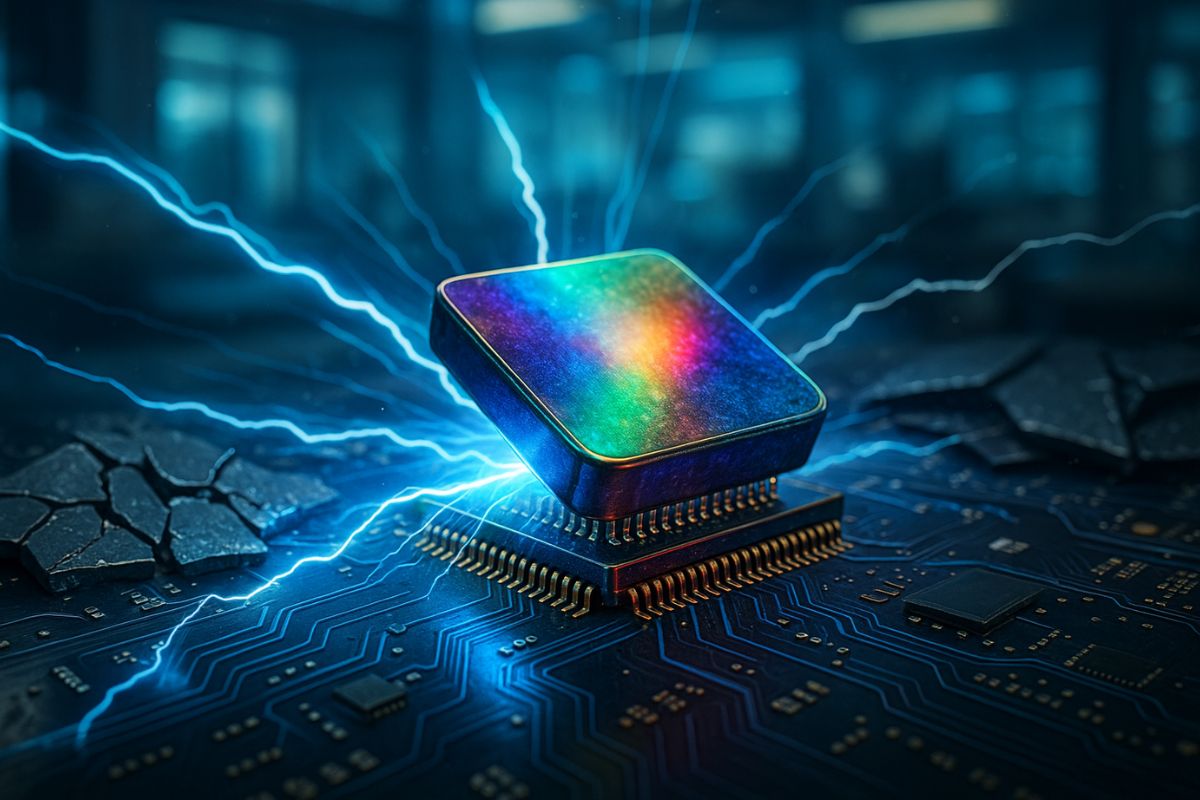
China Creates First Chip Without Silicon and Already Surpasses Intel and TSMC. New Technology Based on Bismuth and Graphene Challenges the Limits of Physics and Could Change the Global Semiconductor Industry
For the first time, Chinese scientists have developed a fully functional processor without using silicon, and initial tests show that it already outperforms the most advanced chips from Intel, TSMC, and Samsung. The breakthrough, led by Peking University, paves the way for the so-called post-silicon era, a time when quantum physics begins to limit the performance of traditional semiconductors.
The prototype, built with doped bismuth and graphene interconnections, achieves frequencies above 500 GHz and consumes three times less energy than conventional chips. More than just a technological leap, it represents a strategic change: China holds over 70% of global bismuth reserves, positioning itself ahead in the new chip race.
Why Silicon Is Coming to an End
Since the 1960s, silicon has been the foundation of virtually all electronic devices. However, with miniaturization reaching scales of 3 nanometers and below, quantum phenomena such as quantum tunneling compromise the operation of transistors.
At this scale, electrons pass through theoretical barriers as if they were invisible walls, causing current leakage, heating, and loss of performance. It is a physical limit that cannot be overcome by traditional engineering alone.
-
In Mexico, a 3,000-year-old Maya site with the dimensions of an entire city may have been built as a colossal map of the cosmos, created to represent the order of the universe and reveal how this people organized space, time, and rituals.

-
Japan wants to build a solar ring of 10,900 kilometers on the Moon to continuously send energy to Earth.

-
Weighing almost 1 ton, with temperatures of up to 3,000°C, the ability to launch 10,000 fragments within a radius of 1 km, capable of penetrating concrete and melting steel, Turkey’s terrifying bomb emerges as one of the most destructive non-nuclear weapons ever presented.

-
After a submarine disappeared beneath the “Doomsday Glacier,” scientists announce a new monstrous machine capable of operating at 3,000 meters depth to return to the heart of the ice and investigate a threat that could raise sea levels worldwide.

This barrier has opened the door for the search for new materials capable of maintaining electrical control at atomic dimensions, and bismuth has emerged as a candidate.
The Crystal That Challenges Physics
Bismuth, a heavy metal with an iridescent luster, exhibits extremely strong spin-orbit coupling, allowing control not only over the electric charge of electrons but also their spin. This paves the way for devices that combine quantum and conventional processing within the same architecture.
The problem is that pure bismuth behaves like a metal, with no “band gap” to function as a semiconductor. The solution found by engineers was to doped the material with telluride, creating a compound capable of functioning as a transistor.
The First Chip Without Silicon
Published in the journal Nature, the study from Peking University shows that the new chip was manufactured at the scale of Ångström, even smaller than 2 nanometers, with transistors just 0.5 nm thick.
Tests revealed three victories over market leaders:
Frequency above 500 GHz (Intel and Samsung operate between 5 and 6 GHz in cutting-edge chips)
Energy consumption three times lower
Switching speed 40% higher
Additionally, graphene was used to interconnect the transistors, creating virtually lossless connections without active silicon parts.
Geopolitical and Industrial Implications
The dominance of technology has a direct impact on the geopolitics of semiconductors. Today, China not only leads development but also controls the raw material. With over 70% of bismuth reserves, the country gains a strategic advantage if the technology is scaled up.
Manufacturers like TSMC have already started their own research in partnership with MIT and the National Taiwan University to explore the potential of the material. The race has already begun, and there is no turning back.
Challenges to Reach the Market
Despite the advancement, the bismuth chip is still a laboratory prototype. Producing the material in high purity, aligning layers of graphene, and manufacturing at industrial scale will require new factories, processes, and billion-dollar investments.
Silicon has decades of established infrastructure; bismuth does not. Until then, initial use is expected to be limited to research centers and military applications.
The Post-Silicon Future
If the technology is made feasible, we could see processors that are much faster, more economical, and powerful, capable of revolutionizing everything from artificial intelligence to quantum computing.
Just as silicon replaced germanium, bismuth could be the foundation of the next digital era.
Do you believe that silicon can last another decade, or are we already witnessing the birth of its successor? Share your opinion in the comments; we want to know how you view the impact of this change on the future of technology.








-

-

-

4 pessoas reagiram a isso.