





 Portuguese
  English
  Spanish
  5 min of reading
  6 comments


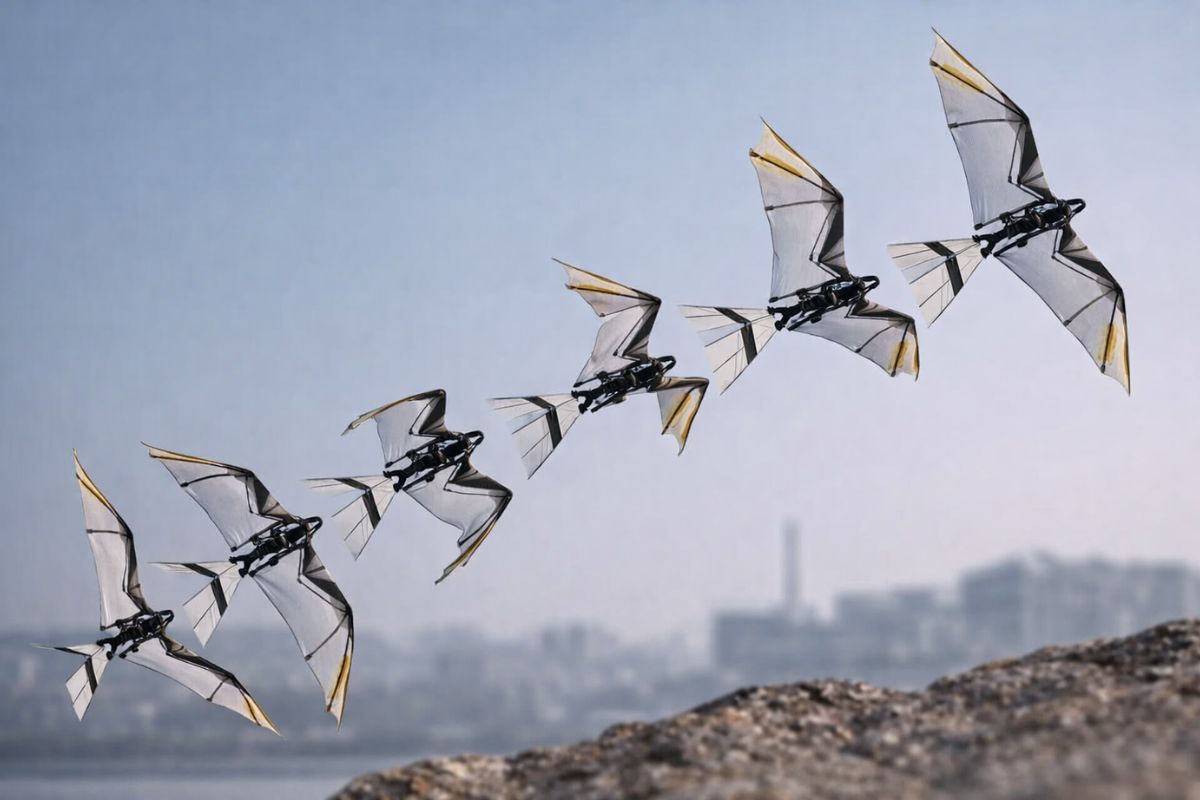


In China, Engineers from Northwestern Polytechnical University Describe a Prototype That Combines Flapping, Sweeping, and Folding Wings in the Same Cycle, Reproducing the Slow Flight Pattern of Birds and Bats, Validated in a Science Advances Study with Real Tests and in a Wind Tunnel, in Addition to Autonomous Takeoff in the Laboratory.
The China has brought biomimetic robotics back to the forefront of technological debate with RoboFalcon 2.0, a prototype created to replicate the flight of winged vertebrates with greater mechanical fidelity. Instead of relying on propellers and rotors, the proposal aims to solve a classic problem: making a machine flap its wings like birds and bats, with functional aerodynamic coordination at low speeds.
The most relevant point is that the project does not limit itself to “flying differently”: it attempts to reproduce principles that traditional aeronautical engineering has avoided for decades due to the complexity of control. When a robot deviates from the common drone pattern and enters the realm of natural flight, it changes not only the shape of the machine but also the logic of lift, stability, and takeoff.
What RoboFalcon 2.0 Does Differently in the Air

RoboFalcon 2.0 was designed to emulate the slow flight observed in vertebrates, especially in critical situations such as hovering, taking off, and landing. This focus is important because slow flight requires extreme precision: any phase error in wing flapping can compromise lift, direction, and balance. The Chinese proposal directly addresses this point, with a mechanism that coordinates movements in a cyclic and integrated manner.
-
These living root bridges and ladders are over 700 years old and help indigenous people survive in one of the rainiest regions in the world.

-
From sertanejo star to international investor: Ana Castela invests millions in a mansion in the USA, creates a themed accommodation in Orlando, and shows that the “boiadeira” also wants to grow away from the stage.

-
The 10 most stunning motorhomes in the world: a $3 million trailer with a rooftop nightclub and garage for a Ferrari, “palaces on wheels” with Italian marble, private cinema, and five-star hotel luxury for billionaires.

-
Trump wanted to spend $400 million on the White House, but the courts prohibited the million-dollar construction.


The central technical difference lies in the distribution of forces throughout the wing cycle. During the downward motion, the robot generates lift; in the upward motion, the gesture is treated as aerodynamically inactive, reducing losses and respecting the pattern seen in many flying animals. This fine adjustment between active and inactive phases brings the machine closer to real biological behavior, rather than a simple mechanical repetition without aerodynamic intelligence.
Why the FSF Movement Changes the Logic of Aerial Robotics
The study describes the reproduction of the FSF (Flap-Sweep-Fold) pattern, translated as flapping, sweeping, and folding. In practice, this means that the robot does not just open and close wings: it combines flapping, sweeping, and folding into a single functional cycle. This detail transforms the quality of flight because each step contributes to controlling lift and efficiency during slow maneuvers.
According to researchers, many robots inspired by insects or birds operate with a single degree of freedom, with rotation limited to the longitudinal axis. This simplified design works for certain scenarios but diverges from the sweeping patterns seen in the flight of vertebrates.
RoboFalcon 2.0 stands out precisely because it tries to address this historical gap: incorporating descents that generate lift and aerodynamically inactive ascents into a coherent process. That’s where innovation shifts from being aesthetic to structural.
Where the Project Was Developed and How It Was Validated
The work was conducted by engineers from Northwestern Polytechnical University, in Xi’an, the capital of Shaanxi province in western China.
The study was published in early September in Science Advances, placing the project within a high-visibility scientific circuit with technical review. The geographic data also matters: Xi’an has a tradition in advanced engineering research, which helps to understand the level of mechanical sophistication presented.
Validation included real flights and wind tunnel tests, with records of autonomous takeoff capability. At the same time, the authors themselves remain cautious: despite the progress, it is still likely that, in certain scenarios, the robot will require additional support to take off, such as thrust, catapulting, or other auxiliary devices.
This balance between positive results and declared limits increases the credibility of the study and avoids the narrative of premature definitive solutions.
Why China Insists on This Biomimetic Path

China’s choice of a flapping-wing robot is not just a design choice; it is a technological strategy to overcome the limits of conventional aerial robotics at low speeds. Bio-inspired systems can make room for more adaptable machines in environments where fine maneuverability matters more than raw speed. In engineering terms, the aim is to copy natural principles of movement efficiency, not just visual forms of animals.
There is also a factor of industrial and scientific continuity. China has been accumulating large-scale initiatives in robotics and automation, and RoboFalcon 2.0 emerges as another step in this trajectory, now in the biomimetic aerial locomotion segment. When a country connects fundamental research, prototyping, and experimental validation, it creates a cycle of innovation with the potential to accelerate future applications, even when the first prototype still carries practical limitations.
How This Turn Can Influence the Future of Winged Robots
The immediate impact is not in replacing common drones overnight, but in establishing a new technical benchmark for projects that rely on controlled flight at low speeds. The contribution of RoboFalcon 2.0 is showing that the combination of flapping, sweeping, and folding can move from theory to a functional system. This repositions the discussion about what is feasible in bio-inspired aerial robotics.
In the medium term, the advancement tends to influence how engineering teams define wing architecture, cycle control, and experimental validation criteria. If autonomous takeoff in a laboratory has already been demonstrated, the next challenge is to enhance robustness, repeatability, and operational efficiency without losing fidelity to the biological model. The breaking of decades of limitation does not come from a single leap, but from the sum of mechanical precision, consistent testing, and incremental evolution of the project.
China has presented a concrete case of how machines can approach natural flight without relying on the logic of conventional drones.
RoboFalcon 2.0 does not solve the problem of biomimetic aerial robotics, but it redefines the starting point: now there is a prototype that executes a complex cycle, has been tested under real conditions, and transparently embraces what still needs to mature.
Thinking about what you have seen, what application should be prioritized first for this type of robot inspired by birds and bats: technical inspection in hard-to-reach areas, precise environmental monitoring, or search operations? And what limit do you consider essential to overcome before trusting this technology in wide use?









The video commentary is definitely AI generated and for those familiar, you would be able to discern the atypical male-female speakers.
Autonomous robots are a good idea, especially if designed to serve humani needs rather than to be deployed for war and destruction of human beings and nature.
THEY WILL USED FOR MILITARY WEAPON TACTIC BECAUSE BIRDS CAN FLYING EVERYWHERE WITH OUT KNOW IT AND CAN FLY TOGETHER TO THE NORMAL BIRDS.