





 Portuguese
  English
  Spanish
  4 min of reading
  8 comments


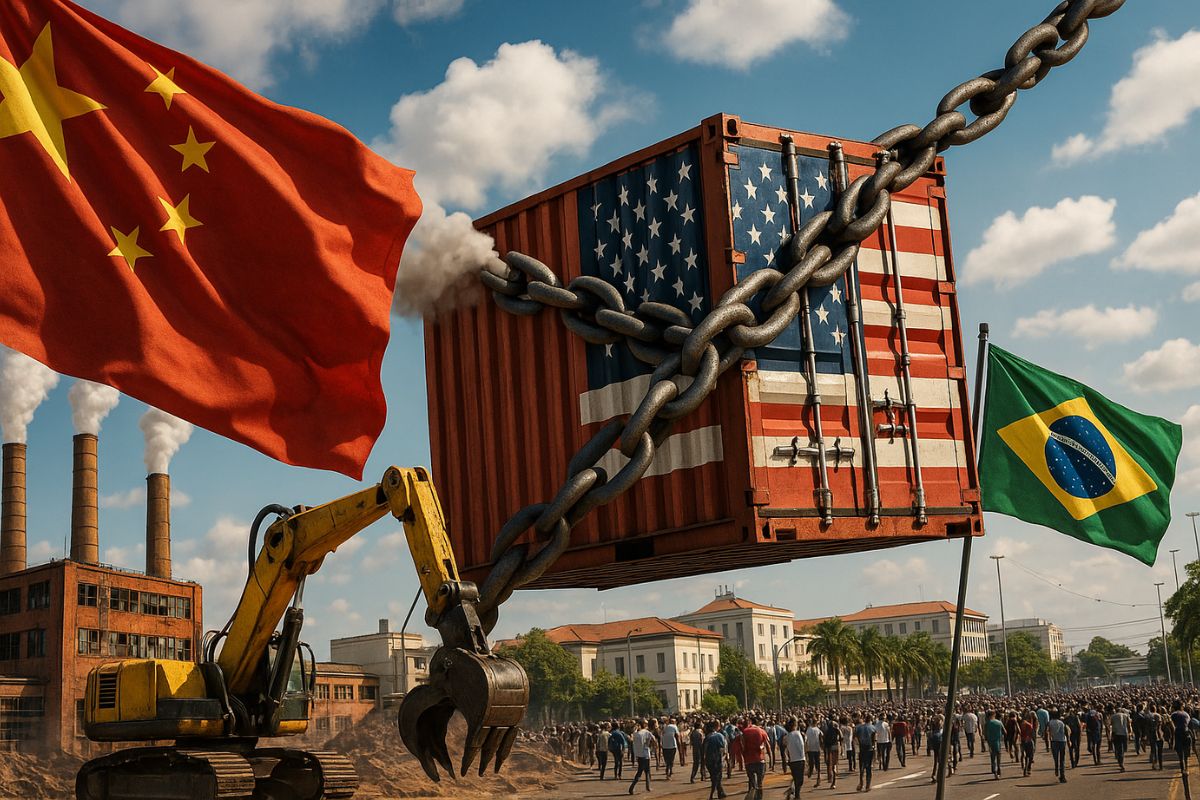


Signs Of Weakness In China Combine Factory Closures, Layoffs And Industrial Deflation With Tightening Of The US Tariff War; Brazil Monitors Impacts On Soy, Minerals, Meat And Manufactures To Protect Foreign Revenue And Jobs
China is experiencing a moment of deceleration with multiple pressure fronts: factories closing down, youth unemployment close to 19 percent, high inventories, and deflation squeezing margins. The external shock gained an additional vector with the intensified tariff war from the United States, which reduced part of the demand for Chinese goods and reordered global supply chains.
Domestically, tensions in the labor market and social fatigue add to falling prices, while companies try to preserve cash through cuts and automation. For Brazil, a major supplier to China, the situation requires active risk management: from agriculture to mining, any slowdown in Chinese demand could reduce exports, affect the exchange rate, and pressure the industry.
What Is Happening In China: External Shock And Internal Weaknesses
The loss of steam in China involves both cyclical and structural factors.
-
Brazilian city bets on the business environment to generate jobs and attract investments in the energy sector — secretary reveals strategy at Macaé Energy 2026.

-
50 viaducts, 4 tunnels, 28 bridges, and 40 kilometers of bike paths: BR-262 in Espírito Santo will receive 8.6 billion reais for the largest engineering project in the state’s history, inspired by the Immigrant Highway in São Paulo.

-
Brazil produces too much clean energy and doesn’t know what to do with it: over 20% of solar and wind capacity was wasted in 2025 while investors flee and 509 renewable generation projects were abandoned in the last year.

-
Piauí will produce a new fuel that replaces diesel without needing to change anything in the truck’s engine and reduces pollutant gas emissions by half: truck drivers from all over the Northeast are already celebrating the news that will arrive later this decade.


On one hand, tighter US tariffs have reduced foreign sales in segments dependent on the American market, creating excess inventory and falling prices.
On the other hand, internal demand has not rebounded with the necessary strength, keeping industrial activity erratic.
Companies are responding with cuts, collective vacations, and automation, attempting to preserve margins.
However, this adjustment feeds into unemployment and reduces disposable income, fueling a cycle of weak consumption.
The result is an environment of prolonged uncertainty for managers, workers, and local governments.
Youth Unemployment And Social Behavior Change
Unemployment among those aged 16 to 24 in China is approaching 19 percent, a level high by historical standards and sensitive from a social perspective.
Highly educated young people are migrating to temporary jobs, such as deliveries, due to a lack of positions that match their qualifications.
This mismatch combines with fatigue from extended hours and a search for work-life balance, a phenomenon that has emerged in recent cultural movements.
When the economy fails to convert education into opportunities at the expected pace, signs of frustration arise that complicate consumption recovery.
Tariff War, Deflation And Reconfiguration Of Supply Chains
The tariff war has raised costs and redirected trade flows, pressuring export sectors in China.
Some factories have lost access to traditional customers and repricing production to move inventory — which pulls industrial deflation and compresses margins.
At the same time, global companies are reevaluating suppliers, seeking to reduce risks of concentration in a single source.
This redesign does not happen overnight, but it is already redistributing orders, forcing the Chinese industry to compete on price in alternative markets.
Sectors In Focus: Technology, Manufactures And Electric Vehicles
In technology and manufacturing, China faces excess capacity and aggressive price competition.
The electric vehicles segment exposes the dilemma: high production, margins under pressure, and accelerated consolidation.
Discounts to gain market share can weaken cash positions and impact suppliers, a typical risk of very rapid investment cycles.
To mitigate this, companies are accelerating automation and AI to cut costs and maintain competitiveness.
The transition is not painless: short-term efficiency gains reduce jobs and increase the need for retraining.
What This Means For Brazil: Trade, Exchange And Employment
China is the main destination for Brazilian exports such as soy, minerals, and meat.
If Chinese demand slows down, there is a risk of declining volumes and prices, with repercussions on foreign revenue, exchange rate, and tax revenue.
Worsening terms of trade tend to pressure margins in agriculture and mining and impact employment in exporting regions.
In industry, price competition coming from China may tighten the margins of local manufacturers, while barriers in third markets may redirect surpluses to Brazil.
Public policy response and private strategy (hedge, market diversification, and contracts) gain immediate relevance.
How Brazil Can Prepare: Three Practical Fronts
1) Market Diversification. Opening and activating alternative channels for agriculture and mining reduces dependence on China in times of volatility. Commercial agility helps preserve prices and volumes.
2) Risk Management And Financing. Exporters can recalibrate price and exchange rate hedges, extend deadlines, and negotiate flexible delivery clauses, mitigating the impacts of demand shocks.
3) Industrial Competitiveness. Productivity, logistics, and energy are levers to protect margins in adverse global cycles. Retraining programs help absorb the effects of accelerated automation in supply chains.
And The United States On The Board?
As China stumbles, recent indicators from the US point to growth above expectations and resilience in consumption, reinforcing the view that tariffs and reindustrialization policies have redirected part of the production.
For Brazil, this means mapping opportunities where American import substitution opens niches for competitive suppliers.
Still, the landscape is fluid: policy changes and business cycles can reverse signals quickly. Scenario planning is essential to avoid anchoring decisions on a single vector.
The current snapshot suggests that China faces simultaneous pressures, both external and internal, while the effects of the tariff war reorganize supply chains and raise alarms for trading partners.
For Brazil, the message is pragmatic: diversify destinations, strengthen risk management, and accelerate productivity.
Do you agree that China is at a turning point? Which Brazilian sectors feel it first — agriculture, mining, or manufacturing? What practical strategies (hedge, new contracts, niches in the US) do you see working on the ground? Leave your opinion in the comments — we want to hear from those who live this in practice.








Essa porcentagem de quase 19% do emprego JUVENIL corresponde a quantos porcento do total de trabalhadores? 70% dos Brasileiros não sabem interpretar texto.
Tem gente achando que é 19% do país inteiro. Obs.: A CACACA REPUBLICANA nos EUA vai cair na próxima eleição, foi muito prejuízo interno e externo. Vai dar DEMOCRATAS por falta de opção.
China tem lastro grande e de sobra para aguentar essa mudança. Mesmo com 1,7 bilhões de pessoas, assalariadas que possuem educação e saúde de primeira categoria gratuitas, sustentam isso sem ter dívida. Ao contrário dia USA que estão com um dívida 6 vezes maior que o próprio PIB
Sobre o comentário do bostonarista que fala que ChIna cópia tudo, aparentemente copia melhor que o resto, já que virou a maior potência do planeta em 50 anos. As empresas gastam fortunas em espionagem e contra espionagem, para que suas tecnologias não sejam roubadas, porque qualquer uma, principalmente as norteamericanas, roubam
China é o futuro do mundo, pelo projeto de um sistema organizado, com uma política de desenvolvimento do país e da população. China jamais invadiu um país externo militarmente.
Está promovendo alianças com o resto do mundo que beneficiam todos.
Ese artículo es pernicioso
A China subsidia a sua economia e esconde a realidade econômica do País. A dívida interna chinesa não é muito diferente dos EUA. Essa bolha vai estourar logo, logo.
Sem o maior mercado do planeta a China vai pras cucuias rapidão….não existe China sem USA…
a China tem que se lascar, embora o governo não goste muito que tais informações saiam, mas toda empresa brasileira que ja foi para china teve sua tecnologia copiada…
e ainda tem brasileiro que puxa saco do governo chinês.
No mundo quase tudo se cópia e o pior pouco se cria , falta competência e cultura a 99% do todo todo do mundo .
IIIIIIIIIIIIIIAAAAAAAAAUUUUUUUU
para frente e para o alto, pé na tábua do potente F.N.M. DATADA DOS ANOS 60
JBGARCIA
03.10.2025 h. 18.12 pm