





 Portuguese
  English
  Spanish
  10 min of reading
  0 comments


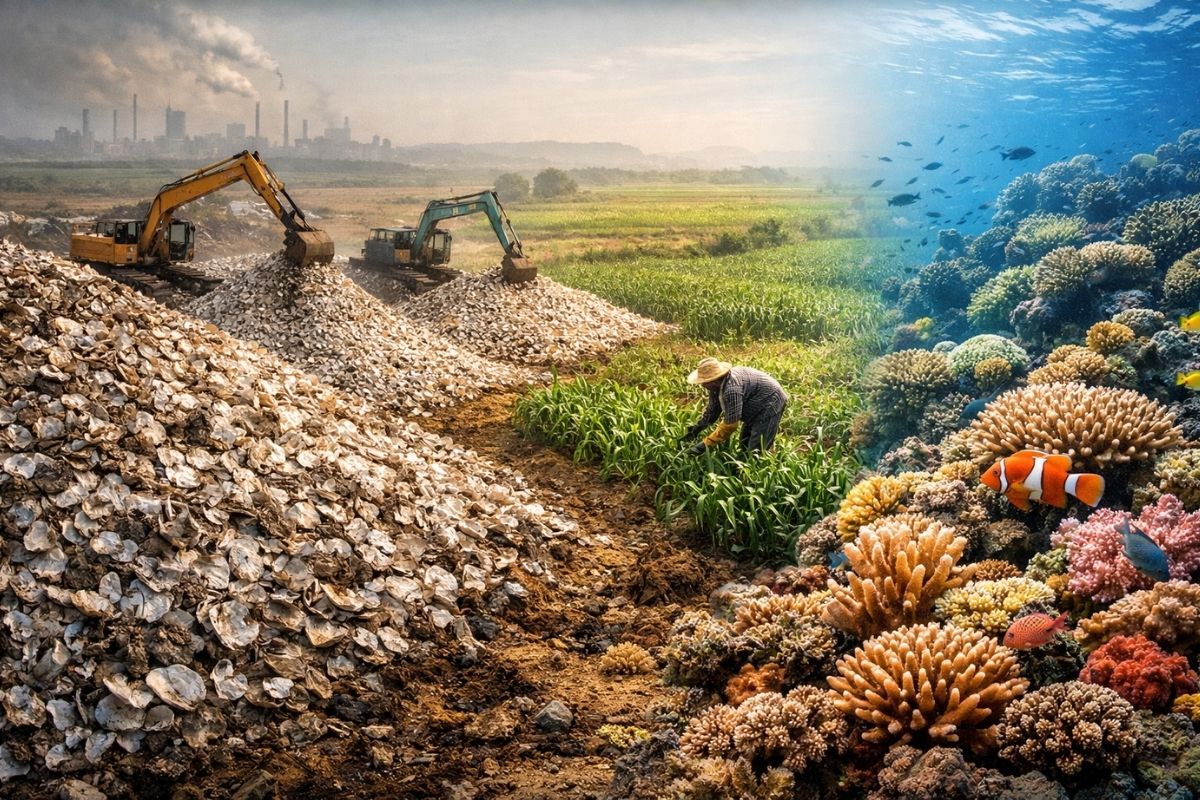
In China, the residue of 3 million tons of annual shells turned into mineral powder, raised the acid soils of Fujian, recovered longan, lixia, tomato, and scallion, and also helped rebuild reefs near Hong Kong, where 85% collapsed, restoring biodiversity and water filtration in global force projects
In China, an environmental crisis that seemed impossible to manage began with an annoying detail: the largest oyster industry on the planet also produces mountains of shells that do not degrade quickly, accumulate bad odors, and become a source of pollution along the coast.
What shocked researchers and farmers was the practical turnaround in Fujian, southern China: treated shells in a furnace and ground into a mineral powder applied to degraded and acid agricultural lands, reanimating soil structure, raising pH, and restoring productivity to crops that were losing strength.
Why China Accumulated Mountains of Shells and Turned It into Coastal Crisis

The oyster chain in China operates on a dominant scale. The cited information is direct: about 80% of the oysters consumed by humanity each year come from China, which places the country’s coastline at the center of production, consumption, and export.
-
Expedition 501: Scientists drill into the ocean floor and discover a giant reserve of fresh water hidden beneath the sea, extracting nearly 50,000 liters and revealing an invisible system that could reshape the map of water scarcity.

-
Archaeologists find an intact tomb over 2,500 years old, with more than 100 preserved objects, weapons, jewelry, and human remains never touched.

-
Volcanic lava transforms into threads as fine as human hair that travel over 30 kilometers by wind and fall like cutting rain on roofs and backyards in Hawaii and Iceland.

-
NASA issues a warning for the feared Godzilla El Niño that could change the planet’s climate in 2026 with extreme warming of the Pacific capable of causing devastating droughts in some regions and historic floods in others simultaneously.


This volume has grown steadily since the 1980s. In 1983, the area dedicated to oyster farming was about 25,000 hectares, and by 2020 it reached approximately 190,000 hectares, a leap described as four times larger.
The cited production also scaled up, rising from 3.89 million tons in 2006 to 5.4 million tons in 2020, with four provinces standing out: Fujian, Guangdong, Guangxi, and Shandong, totaling 4.6 million tons.
The problem is physical and chemical. The oyster has only 10% meat and 90% shell. And the shell does not disappear quickly: made of calcium carbonate crystals, it is hard and can take 50 to 100 years to degrade naturally.
In practice, this creates white mountains of discarded shells, visible along the beaches of coastal provinces.
In humid periods, these piles begin to emit bad odors. Bacteria associated with diarrhea and skin diseases can proliferate in the cracks.
And the organic decomposition around the shells releases hydrogen sulfide and ammonia, toxic gases that irritate the eyes, nose, and lungs, and can kill fish in nearby ponds.
The central data of the crisis is disposal: about 3 million tons of oyster shells per year are improperly discarded in China, pushing coastal areas towards a scenario of growing pollution.
The Other Crisis in China That Seemed Unrelated to the Coast: Agricultural Soil in Collapse in Fujian
Just a few dozen kilometers from the mountains of shells, China was facing a second problem in Fujian: degraded agricultural lands, with declining productivity and clear signs of soil collapse.
In orchards that were once lush, the scene described in 2021 turned into a warning. The soil pH plummeted to 3.842, an extreme level of acidity for agriculture.
Trees began to be uprooted after heavy rains because the soil structure was degraded. Scallion beds appeared yellowed and weak, as if vitality had been drained.
The situation was associated with the phenomenon described as rapid collapse, a quick collapse of soil fertility that usually appears after intense exploitation over long periods.
The sequence of cited causes is cumulative: intensive agriculture, improper use of chemical fertilizers, acid rains from the coastal industry, and prolonged degradation that nearly made organic matter disappear.
When the soil becomes compacted, water does not infiltrate. It runs off and takes away the little fertile land left. The soil begins to behave like “wet cement” during the rainy season.
The consequences appear in the harvests: orchards with split fruits, dead branches, and productivity drops of over 40% in some areas, as well as abandoned stretches after mass plant death.
A 2021 report from the Fujian government recorded that many districts lost 70% of productive efficiency over 15 years. And during an official meeting, agricultural sector leaders cited the risk of abandoning entire regions in 10 to 15 years if there was no immediate recovery.
The Decision That Turned the Tide in China: Using Oyster Shells to Resurrect a Dead Soil
The solution that seemed crazy began when China connected the two problems. If the shells would not disappear, they needed to become useful. The idea was bold: using oyster shells to correct acidity and revitalize soil biology.
The logic is materially based. The oyster shell is natural calcium, the same component of agricultural lime used to reduce acidity. Additionally, the shells carry micronutrients described as essential for the degraded soils of Fujian.
There is also a historical background within China itself. The use of oysters appears associated with traditional medicine and an ancient view of “biological material” with structural function.
A record attributed to scholar Kang mentions, in 158 (during the Eastern Han Dynasty), the proposal to strengthen bridges by cultivating oyster reefs around the foundations, creating a kind of “biological concrete” against waves and erosion. This ancient view reinforced the modern idea: the oyster is not just food, it is raw material.
How China Turned Contaminated Shells into Safe Powder for Agriculture
For the oyster shell to become soil conditioner, China needed to solve the sanitary problem. The described process has clear steps.
First, thousands of tons of shells began to be collected at coastal factories. Then, they were taken to furnaces and heated to 245 degrees for 30 minutes, a step used to eliminate bacteria and make the structure more fragile.
Next, the shells were ground into a white, fine powder, compared to chalk, nicknamed by specialists as ocean biological lime.
The mechanism of action was described as direct: the powder raises pH, releases calcium and magnesium ions, activates beneficial bacteria, helps the soil “breathe,” restores organic decomposition, and facilitates NPK absorption by plants.
In summary, China tried to return to the soil a basic function: to operate again with living processes, instead of relying only on chemical fixes.
The Decisive Test in Fujian: What Changed in the Field After the Application
The major turnaround in China came when the experiment moved from the laboratory to exhausted land. In 2022, the first test mentioned began in an area of about 0.33 hectares in Fujian province.
The longan trees that had been slowly dying, with split fruits and early drop, received the first application of the powder.
Months later, the recovery was described as visible: greener leaves, whole fruits, and greater vigor.
In scallions, the effect appeared even more clearly. Productivity increased by almost 60%, a level described as rare even with chemical fertilizers.
What changed below the surface was measured. The pH increased significantly. Essential nutrients grew between 49% and 57%.
Organic matter accumulated, and beneficial bacteria began to multiply again. The description used by a researcher was of “waking the soil from a long sleep.” Compact and impervious lands became fluffier and aired out, signaling the regeneration of structure.
With initial results, China expanded tests for more demanding crops: pomelo, tomato, and lixia. After one year, soils with pomelo showed a one-point increase in pH and 27.7% more organic matter.
In tomatoes, exchangeable calcium increased by 10.45%. In lixia, pH rose by 1.36 points, transforming acidic soil into productive soil in one harvest.
To confirm it was not a coincidence, control tests were cited: with the oyster-based conditioner, organic matter increased by 48%, nitrogen by 69%, and exchangeable calcium by 32%.
The Exception That Curbed Enthusiasm in China: Why Peanuts Did Not Respond Like Other Crops
Not every crop responded the same way. The biggest surprise in China was peanuts.
The country is described as the largest producer in the world. In 2013, it produced more than 17 million tons, about 37.3% of the global total, with 4.5 million hectares cultivated.
The cited comparison indicates that India plants about 5.3 million hectares but achieves half of China’s productivity, with numbers cited as 8 versus 3.6.
The peanut problem in China worsened with continuous cultivation. Between 2013 and 2018, productivity declined in several regions.
The soil lost organic matter, pH plummeted, structure was damaged, and intense rains compacted the land.
A warning attributed to a specialist at the Chinese Academy of Agricultural Sciences pointed out that, without soil recovery, areas could disappear from the agricultural map.
When the oyster shell powder was applied in this context, the soil responded well in structure, pH, and organic matter, but peanut productivity continued to fall steadily.
The cited explanation lies in the biology of legumes: peanuts rely on nitrogen-fixing bacteria in nodules in the roots.
If pH and mineral ions change rapidly, these bacteria suffer shock and need time to adapt. The soil improves, but the nitrogen-fixing system does not keep pace at the same speed.
Why China Treats This as Green Technology and Not Just as Alternative Fertilizer
The strategy gained another dimension in China by combining agricultural gain, waste reduction, and climate benefit.
One cited point is the dependence on chemical fertilizers: they are described as responsible for about 2% of global greenhouse gas emissions, in addition to being associated with the degradation of millions of hectares.
By raising pH and stimulating beneficial bacteria, oyster powder allows the soil to return to operating its natural nutrient cycle, making nitrogen, phosphorus, and potassium absorption more efficient, with less fertilizer.
There is also an economic gain in China with food quality. In Ruian, tests with lettuce showed a 20% productivity increase and improvements in crunchiness, flavor, and vitamin C content compared to the use of chemical fertilizers, with a price increase of 12% to 18% at sale.
For the more than 300,000 families involved with oysters in China, the logic closes: less discarded shell, more valuable product, more income, and less environmental pressure on the coast. The shell stops being waste and becomes input.
From Soil to Sea in China: Reefs Collapsed Near Hong Kong and Came Back with an Ancient Method
The story did not stay on land. From coastal China, the crisis also hit the sea: wild oysters nearly disappeared in areas that stretched from Hong Kong to Guangdong. Previously dense reefs began to be described as empty and fragmented, in a scenario linked to accelerated urbanization, pollution, and decades of overfishing.
A cited study from 2019, linked to the University of Hong Kong, pointed out that more than 85% of natural oyster reefs collapsed in the last 150 years.
In 2020, The Nature Conservancy and the University of Hong Kong started a restoration project in Pacai, a coastal village near Shenzhen, China, using a method described as over 300 years old.
The technique reused an ancient logic: wooden stakes driven into the mud for oysters to naturally attach, without machines and without chemicals, using larvae brought by currents. By recreating small sets of stakes, the reef began to rebuild itself.
The described results drew attention. 61 species were recorded returning to the restored reefs, almost three times more than in neighboring mud areas, with 26 species. Total biomass increased tenfold.
The return of the horseshoe crab was noted, associated with a sign of ecological stability, and the discovery of a new species of crab, nanisarma pontiana, was cited directly in the restored reefs.
In addition to biodiversity, there is a functional effect in China: oysters filter water. An adult oyster can filter about 30 liters, removing algae, suspended particles, and excess nutrients. In reefs of approximately seven meters, the volume filtered daily was compared to that sufficient to clean an entire Olympic swimming pool.
The Residue That Became Global Material: How China Led a Wave of Applications in Green Technology
The use of shells surpassed agriculture in China and opened space for a chain of green materials in other countries, with applications in paint, filtration, bioplastics, and construction.
In Japan and South Korea, ground shells have been used in eco-friendly paints, with calcium carbonate improving adhesion and natural ions offering antibacterial action.
A cited study from Hiroshima University in 2021 indicated that paints with 20% and 30% shell powder managed to eliminate up to 99% of staphylococcus aureus in 24 hours.
In Seoul, chemical companies tested self-disinfecting paints capable of neutralizing microorganisms without artificial products.
In marine life recovery, Taiwan and Japan used shell powder mixed with turtle food during recovery from damaged shells, accelerating remineralization by up to 25%. In aquaculture, shells appear as a source of microminerals for fish, shrimp, and shellfish.
In environmental laboratories, the microporous structure of shells showed efficiency in absorbing heavy metals.
A cited report from Environmental Science and Technology 2022 indicated the removal of 95% of lead and 87% of arsenic, in addition to a large portion of pesticide residues in water.
With this, treatment stations in the United States and Japan began replacing activated carbon with recycled shells, with cost reductions cited of up to 60%.
In the air, Japanese startups incorporated calcined shells into domestic filters. At high temperatures, the carbonate transforms into oxide capable of absorbing CO2.
A cited test from 2023 indicated a 12% reduction of CO2 in a closed environment of 30 cubic meters in 90 minutes.
Shell filters also appeared, with increases in antibacterial efficiency cited between 15% and 20%.
In the biodegradable plastics industry, South Korean researchers announced in 2024 a bioplastic in which 30% to 40% of petroleum derivatives were replaced by calcium carbonate from oyster shell, with faster decomposition than traditional PLA and 12% more resistance, targeting cups, cutlery, and packaging.
In construction, South Korea and Singapore tested concrete with ground shells, with cited gains of 9% to 11% in resistance and reductions of 10% to 12% in clinker use.
In Japan, shells reached asphalt to improve adhesion in rainy periods, referencing Shell Asphalt on roads in Hiroshima.
And a South Korean startup created ultralight bricks with 40% recycled shells, reducing waste by up to 90%, with good thermal resistance and sound absorption.
What China Revealed with This Experiment at Scale
The sequence of events in China transformed a troublesome waste into a multilayered solution. First, the shell became a response to acidic soil in Fujian.
Then, coastal restoration near Hong Kong and Shenzhen showed that reefs can come back with simple techniques and persistence. And finally, the shells entered the global race for green materials.
The idea that seemed insane gained traction because it solved two problems at once: pollution from disposal and soil degradation, with positive side effects on biodiversity, water quality, and material innovation.
Do you think China should prioritize soil recovery in Fujian first or rebuilding reefs near Hong Kong and Shenzhen?









-

-

-

-

-

21 pessoas reagiram a isso.